Skip to content
Artwork for Latent State
Latent State · April 4 · 38 min

Ep.02. The Eureka Effect: Why Insights Burns Information Into Memory?

You've had this experience. Stuck on a problem for days. Nothing connects. And then — not at your desk, not during your scheduled thinking time — something shifts. The pieces lock together with a finality that feels qualitatively different from just figuring something out step by step. You know, immediately and completely, that it's right. That's the Aha! moment. The Eureka experience. And here's what's remarkable about it neuroscientifically: you will almost certainly remember that moment vividly, possibly for the rest of your life, even though it lasted three seconds and you weren't trying to memorize it. Meanwhile, you've forgotten where you put your keys approximately four hundred times this year. Why? What is it about the phenomenology of insight — that sudden, certain, slightly embarrassing rush of understanding — that burns itself into memory so effectively? In Episode 2 of The Latent State, we cover Becker & Cabeza (2025), "The Neural Basis of the Insight Memory Advantage," published in Trends in Cognitive Sciences. Their proposal: insight is, at its computational heart, a prediction error — a very large, very precise, very surprising one. And everything distinctive about the Aha! experience, including its unusual power to enhance long-term memory, follows from that identification. We walk through the framework, the behavioral evidence across magic tricks and Mooney images and verbal puzzles, the hippocampal and dopaminergic mechanisms, and — because this is The Latent State — exactly where the theory is still ahead of the data. Paper: Becker, M. & Cabeza, R. (2025). The neural basis of the insight memory advantage. Trends in Cognitive Sciences, 29, 255–268. Key concepts covered: Insight, Aha! experience, insight memory advantage (IMA), prediction error, precision weighting, representational change theory, Einstellung effect, hippocampus, medial prefrontal cortex, schemas, dopamine, noradrenaline, locus coeruleus, long-term potentiation, generation effect Further reading: Kounios & Beeman (2014), Annual Review of Psychology — the cognitive neuroscience of insight Jung-Beeman et al. (2004), PLoS Biology — the original gamma burst paper Van Kesteren et al. (2012), Trends in Neurosciences — schema and memory formation Danek & Wiley (2020), Cognition — behavioral evidence for IMA Dubey et al. (2021), PsyArXiv — Aha! moments as metacognitive prediction errors Rouhani et al. (2023), Trends in Cognitive Sciences — multiple routes to enhanced memory for emotional events
0:00-38:10

transcript

No transcript — this publisher did not publish one.

show notes

You've had this experience. Stuck on a problem for days. Nothing connects. And then — not at your desk, not during your scheduled thinking time — something shifts. The pieces lock together with a finality that feels qualitatively different from just figuring something out step by step. You know, immediately and completely, that it's right.

That's the Aha! moment. The Eureka experience. And here's what's remarkable about it neuroscientifically: you will almost certainly remember that moment vividly, possibly for the rest of your life, even though it lasted three seconds and you weren't trying to memorize it.

Meanwhile, you've forgotten where you put your keys approximately four hundred times this year.

Why? What is it about the phenomenology of insight — that sudden, certain, slightly embarrassing rush of understanding — that burns itself into memory so effectively?

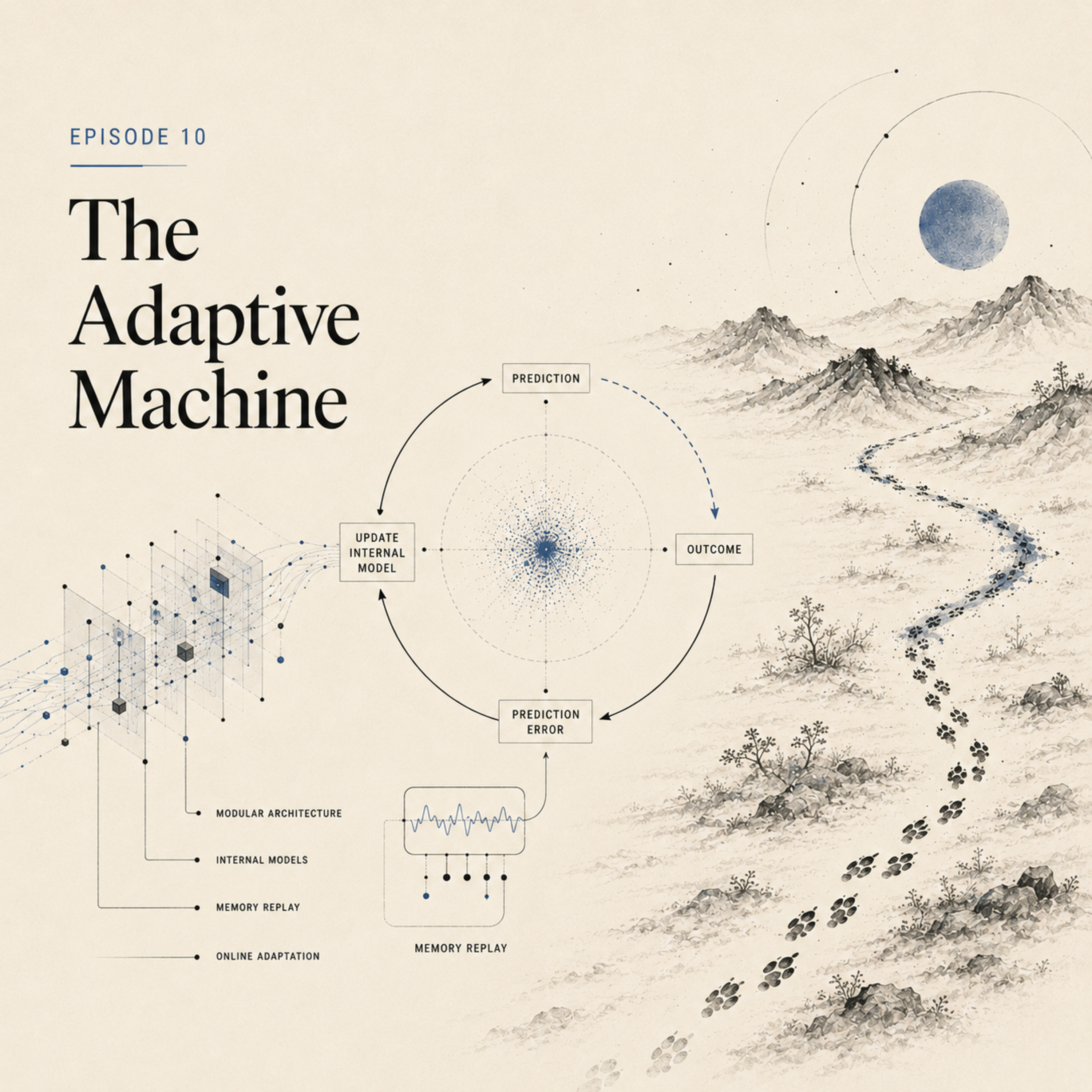
In Episode 2 of The Latent State, we cover Becker & Cabeza (2025), "The Neural Basis of the Insight Memory Advantage," published in Trends in Cognitive Sciences. Their proposal: insight is, at its computational heart, a prediction error — a very large, very precise, very surprising one. And everything distinctive about the Aha! experience, including its unusual power to enhance long-term memory, follows from that identification.

We walk through the framework, the behavioral evidence across magic tricks and Mooney images and verbal puzzles, the hippocampal and dopaminergic mechanisms, and — because this is The Latent State — exactly where the theory is still ahead of the data.

Paper: Becker, M. & Cabeza, R. (2025). The neural basis of the insight memory advantage. Trends in Cognitive Sciences, 29, 255–268.

Key concepts covered: Insight, Aha! experience, insight memory advantage (IMA), prediction error, precision weighting, representational change theory, Einstellung effect, hippocampus, medial prefrontal cortex, schemas, dopamine, noradrenaline, locus coeruleus, long-term potentiation, generation effect

Further reading:

  • Kounios & Beeman (2014), Annual Review of Psychology — the cognitive neuroscience of insight
  • Jung-Beeman et al. (2004), PLoS Biology — the original gamma burst paper
  • Van Kesteren et al. (2012), Trends in Neurosciences — schema and memory formation
  • Danek & Wiley (2020), Cognition — behavioral evidence for IMA
  • Dubey et al. (2021), PsyArXiv — Aha! moments as metacognitive prediction errors
  • Rouhani et al. (2023), Trends in Cognitive Sciences — multiple routes to enhanced memory for emotional events