Skip to content
Artwork for GreenPill
EducationSociety & Culture

GreenPill

Kevin Owocki

GreenPill is about crypto-economic systems that create positive externalities for their neighbors & for the world.

We explore the intersection of programmable money, game theory, & mechanism design. We search for powerful new ways to fund, design, develop, & market regenerative web3-era applications and digital assets. We launch the meme of regenerative crypto-economics into the world.

Ethereum is the ultimate substrate for human coordination. Learn about the web3 builders who are solving coordination failures and creating a more regenerative infrastructure for the world using Ethereum.

Take the Green Pill!

Play
  • 20 episodes
  • Avg 59 min
  • English
  • S1 · E1
    Thursday · 48 min

    Greenpill IRL: Building a Coordi-Nation with Kevin Owocki, Matt & Afolabi

    New @greenpillnet pod out today! Welcome to Greenpill IRL, a new season spotlighting three years of Green Pill Network development and the people carrying it forward. In Episode 1, "Building a Coordi-Nation," Kevin Owocki sits down with Matt (Matty Compost) and Afolabi, two stewards of the Green Pill Network, to look back at how the movement grew from a meme and a book into a network of local chapters, and where it goes as we head into 2027. Matt & Afolabi share how they found Green Pill and what chapters are building, from Regen Rio funding 21 local projects in Brazil to GreenSofa in Taiwan, Water Cup in Nigeria and air-quality sensors in Koh Phangan. They also take an honest look at what worked and what didn't: grant funding drying up, burnout, coordinating across time zones, and the loss of Izzy, whose vision lives on through Tech & Sun, a solar hub giving students in Awka, Nigeria reliable internet and energy. Afolabi walks through Green Goods, Matt shares the Regen Knowledge Commons and the case for "boring" endowment-style structures, and Kevin closes with an updated thesis: right relationship with technology, with a more cosmolocal focus. In this episode: How Matt and Afolabi found Green Pill What local chapters are building around the world What binds the network together Lessons from building a decentralized regen movement Remembering Izzy and the Tech & Sun hub The Regen Knowledge Commons Green Goods: needs, promises, verified work and funding in one loop Why the space needs more endowment-style structures Kevin's revised thesis and a cosmolocal future Find a local chapter, get involved and help shape what Green Pill becomes next. Some of the materials we mention in the episode: https://greenpill.network https://techandsun.com https://greengoods.app https://regencommons.com https://hub.regencoordination.xyz https://github.com/regen-coordination https://x.com/owocki https://x.com/mattycompost https://x.com/time_is_oba https://x.com/greenpillnet https://gitcoin.co Timestamps 00:00 — Introduction to the Green Pill Network 01:00 — How Matt and Afolabi found Green Pill 02:40 — What is greenpill.network? 05:30 — A tour of the local chapters 06:30 — Green Pill NYC: Gardens and Octant vaults 07:50 — What chapters are building worldwide 10:45 — What ties the network together 12:25 — Stewards Syncs and the Greenpill Garden 14:50 — Building the network's onboarding 15:55 — The Greenpilled book and pro-social crypto culture 17:20 — AI, burnout and the end of easy grant money 18:15 — What worked and what didn't 22:20 — Losing Izzy and keeping the network alive 25:00 — Tech & Sun: a solar hub in Nigeria 27:15 — Regen Knowledge Commons 29:30 — Regen Commons and knowledge sovereignty 32:40 — Passive knowledge sharing with local AI 35:35 — Green Goods: origins and evolution 37:00 — Gardens and local endowments 38:00 — Closing the full loop 39:20 — What's next for the Green Pill Network 40:40 — Stewardship, accounting and curation 42:00 — The case for endowment-style structures 44:25 — Kevin on rebuilding Gitcoin and techne 46:20 — A cosmolocal future for Green Pill 47:40 — Wrap-up and how to get involved Subscribe to the podcast here https://pod.link/1609313639 https://greenpill.network/

  • S13 · E1
    November 3 · 1 hr 15 min

    Economic Media Ep:1 – Introducing the Laboratory: What If the Economy Is a Medium?

    New episode on @greenpillnet out now! 🌐 This is the first episode in a special guest season hosted by Akseli Virtanen, Jorge López and Jonathan Beller of the Economic Space Agency. We're kicking off Economic Media: A Laboratory, a new Greenpill mini-series exploring how protocols, ledgers, AI agents and computational systems are becoming the media through which economic coordination is recorded, interpreted and governed. They ask what changes if the economy is itself a medium: how screens and platforms turned meaning-making into value extraction, why accounting has a grammar of its own, and why blockchain distributed computation without distributing economic agency. Who gets to define an asset, recognize a contribution or change a network's rules, and what would it take for care, community priorities and long-excluded people to count? Along the way they discuss whether the economy is a medium at all, or an ecology of media, and close on why the series is a laboratory rather than a run of interviews: an experimental, interdisciplinary space for building economic literacy and new practices. For more detailed field notes on this episode, visit https://ecsa.io/?L=2.podcast,4.e01-introducing-the-laboratory Some of the materials we mention in the episode: - Digital Colonialism, a panel at the Center for the Humanities, CUNY Graduate Center (April 21, 2026): https://centerforthehumanities.org/event/digital-colonialism/ (video: https://vimeo.com/1185587529) - The Evolution of Economic Computation, from the Economic Space Agency: https://ecsa.io/?L=3.thesis,4.evolution-of-economic-computation-v2,4.evolution-of-networks-table 🌐 https://economicspace.agency | https://greenpill.network 🌐 Timestamps 00:00 – Introducing the Economic Media Laboratory and its hosts 01:02 – Kevin Owocki introduces the Economic Space Agency and post-AGI economics 02:47 – What if the economy is a medium? 03:58 – Jonathan Beller: from industrial labor to attention and screen-based extraction 05:20 – Jorge López: technology ownership, authority, and economic power 07:05 – Technology, social struggle, and the extraction of everyday life 10:30 – Computational networks, expressive fluency, and the distribution of power 12:03 – LLMs make programmability accessible to more people 14:03 – AI, digital colonialism, and contested technological futures 15:49 – AI capabilities versus economic intelligence: what economic media make possible 18:23 – Meaning-making and the hidden economic protocol layer 20:02 – Accounting and media: how grammars organize meaning 23:00 – Economic literacy and the asymmetry between users and corporations 24:47 – Accounting as a network of records and mutually recognized changes 26:01 – Accounting's syntax, semantics, and unexplored expressivity 27:59 – From shared economic memory to capitalism's growth rule 31:51 – Mapping capital's source code: intervention, extraction, and economic rule-making 34:46 – Paper-era constraints and the compression of value into money 37:56 – Accounting's efficiency, historical violence, and excluded realities 40:15 – From bookkeeping to blockchain: what changed and what persisted 43:08 – Bitcoin's limited expressivity, capital markets, and social goals 47:52 – Distributed computation versus distributed economic protocols 48:50 – Currencies as bets on futures: funding alternative possibilities 50:28 – What does economic agency mean? 52:26 – Redefining assets and recognizing care and plural values 54:05 – Social media rewards and control over what a network recognizes 58:35 – A disagreement: economy as a medium or a media ecology? 01:00:12 – Changing economic agents, events, resources, and their relations 01:02:22 – Recognition, sovereignty, and communities defining their own value 01:04:18 – Why a laboratory: experimentation, practices, and economic literacy 01:07:14 – Xerox PARC as a model for exploring a new medium 01:08:59 – Interdisciplinary inquiry and listening beyond disciplinary biases 01:10:16 – Disagreement, partial knowledge, and the fields needed for future inquiry 01:14:16 – Translation into code, economic literacy, and agency from the edges 01:15:16 – Closing and continuing in episode two

    • Transcript
  • S10 · E13
    September 15 · 39 min

    S.10 Ep.13 The DAO Security Fund: Round 2 with Griff Green

    New @greenpillnet pod out today! In this episode of the Green Pill Podcast, Griff Green returns to discuss Round 2 of the DAO Security Fund a new approach to funding and coordinating security initiatives across the Ethereum ecosystem. Griff explains what the first round revealed about the Ethereum security landscape, why Round 2 is designed to go deeper rather than wider, and how the DAO Security Fund aims to become a Schelling point for security funding coordination. The conversation covers quadratic funding, security initiatives, RFPs, grants, milestone-based funding, market adoption, formal verification, operational security, bug bounties, and the role AI could play in making Ethereum more secure. Griff also shares his vision for the DAO Security Fund: making Ethereum safer than banks by building shared infrastructure and moving the ecosystem from a reactive security posture to a proactive one. In this episode: - The results of DAO Security Fund Round 1 - What changes in Round 2 - How the new funding mechanism works - Grants vs. RFPs - Why market participation matters - Funding Ethereum's shared security infrastructure - Formal verification and compiler security - The economics of collective security - Why Ethereum needs to stop funding hackers - Moving from reactive to proactive security - AI and the future of Ethereum security - The role of DAOs and collective action - How you can propose a security initiative If you're an Ethereum security researcher, builder, company, or community member, Griff's message is simple: bring forward the security problems you want to see solved, and help the ecosystem fund them together. Some of the materials we mention in the episode: https://x.com/Giveth/status/2036815581685350671?s=20 https://x.com/griffgreen https://x.com/Giveth https://x.com/thedaofund https://thedao.fund https://gitcoin.co Timestamps 00:00 — Introduction & Griff Green's Ethereum journey 01:36 — TheDAO Security Fund Round 1: What worked and what they learned 03:49 — From broad funding to deeper security initiatives 04:58 — How Round 2 works: Initiatives, multisigs & ecosystem funding 07:20 — Security Badge holders, rankings & the funding process 09:47 — Grants vs. RFPs and milestone-based funding 20:01 — Why security needs better market coordination 22:24 — Formal verification and the case for funding shared infrastructure 24:22 — The apartment-building analogy: Why collective security makes sense 25:45 — Why Ethereum needs to stop funding hackers 27:31 — Griff's goal: Making Ethereum safer than banks 29:13 — Moving Ethereum security from reactive to proactive 30:38 — Why coordinated security spending can save everyone money 30:44 — Lightning Round: Incentives & public goods 31:28 — Quadratic funding & participatory budgeting 32:02 — Are DAOs making a comeback? 32:37 — AI, robotics & the future of DAOs 34:11 — The most overrated crypto trend: TradFi in crypto 36:01 — How to get involved with TheDAO Security Fund 38:17 — Wrap-up & where to learn more Subscribe to the podcast here https://pod.link/1609313639 https://greenpill.network/

  • S10 · E12
    June 30 · 40 min

    S.10 Ep.12 Can Quadratic Funding Go Mainstream? | Ma Earth, Hypercerts & the Future of Public Goods

    New @greenpillnet pod out today! In this episode, Kevin Owocki sits down with Matthew Monahan (Ma Earth) and Holke Brammer (Hypercerts Foundation) to discuss a bold new experiment: a $1 million Quadratic Funding round designed to bring public goods funding beyond the crypto ecosystem. After years of learning from Gitcoin Grants, the conversation explores what comes next. How can communities fund local regeneration? How do Hypercerts create measurable impact? And what does it take to make coordination mechanisms accessible to everyday people not just Web3 natives? Together, they unpack the lessons from Ethereum, the future of regenerative funding, and why building open infrastructure matters more than ever. Topics covered: The $1M Ma Earth Quadratic Funding round Lessons learned from Gitcoin Grants Bringing Quadratic Funding to local communities Hypercerts and impact verification Public goods beyond crypto Open infrastructure and regenerative finance Ethereum's role in the next generation of coordination AI, collective intelligence, and future collaboration The core idea: Better coordination creates better communities. Quadratic Funding and Hypercerts aren't just crypto experiments they're tools for building a more collaborative future. Some of the materials we mention in the episode: Ma Earth - https://maearth.com Hypercerts - https://hypercerts.org Certified - https://certified.app Hypercerts Docs - https://docs.hypercerts.org Gitcoin - https://gitcoin.co Greenpill Network - https://greenpill.network Follow Matthew Monahan - https://x.com/matthewmonahan Follow Holke Brammer - https://x.com/holkexyz https://bsky.app/profile/holke.xyz Donate to the Ma Earth Quadratic Funding Round (July 1–21, 2026) https://maearth.com Timestamps 00:00 – Introduction & why this conversation matters 01:34 – Meet Matthew Monahan & Holke Brammer 04:17 – The $1M Ma Earth Quadratic Funding round 05:53 – How the funding round works 07:24 – Why Quadratic Funding still matters 09:04 – Lessons from Gitcoin Grants 10:37 – Hypercerts explained 13:56 – Measuring real-world impact with Hypercerts 16:44 – Why blockchain matters for public goods 19:49 – Ethereum's influence on the project 22:14 – Building beyond the crypto ecosystem 24:24 – Public goods, regeneration & systems change 26:52 – The future of regenerative funding 28:02 – Why the team remains bullish on Ethereum 30:08 – What success looks like in the next decade 33:02 – AI, coordination & the future of collaboration 35:30 – Finding builders and growing the ecosystem 38:01 – Final reflections & call to action 39:52 – Closing remarks

  • S12 · E12
    April 27 · 1 hr 6 min

    VDAO Ep 12 The Hidden Risks of Stablecoins (And Why Decentralization Matters) | Michael

    In this episode, Michael explores one of the most overlooked risks in crypto today: Are stablecoins actually safe? As billions flow into stablecoins, most users don't realize the hidden layers of risk from custodians and intermediaries to complex yield strategies happening behind the scenes. This conversation breaks down the difference between centralized vs decentralized stablecoins, and why that distinction matters more than ever. From early Ethereum days to building in DeFi, Michael shares how crypto unlocks true financial sovereignty giving individuals the ability to opt out of fragile systems. Topics covered: • What inspired Michael to build in Ethereum • Peer-to-peer finance & financial sovereignty • What "resilience" and "anti-fragility" really mean • Stablecoins explained (simple breakdown) • Centralized vs decentralized stablecoins • Hidden risks in yield farming ("trust me bro" zone) • Why your stablecoin is "traveling" behind the scenes • Counterparty risk vs code-based trust • Silicon Valley Bank & real-world failures • Why optionality is the key to financial freedom • Liquity, BOLD & decentralized stablecoin design • The future of money, regulation & crypto systems The core idea: Not all dollars are equal. Not all stablecoins are safe. If you don't understand where your money is going, you're taking risks you didn't sign up for. Greenpill isn't just about building new systems. It's about building systems you can actually trust. greenpill.network vdao.org https://x.com/JoinVDAO https://x.com/greenpillnet https://x.com/svobodamichael https://x.com/LiquityProtocol Timestamps 00:00 – Introduction 00:11 – Michael's "why" & discovering Ethereum 01:36 – Peer-to-peer finance & removing intermediaries 02:29 – Journey into crypto & early DAO era 03:31 – Early crypto vs traditional finance mindset 04:22 – Ethereum community & early DeFi innovation 05:28 – Resilience, sovereignty & optionality 08:27 – Why financial independence matters 10:16 – Introduction to stablecoins 10:58 – What is a stablecoin (simple explanation) 12:00 – Centralized vs decentralized stablecoins 13:25 – The "trust me bro" risk zone 14:09 – On-chain vs off-chain backing explained 15:04 – Why decentralization matters in stablecoins 16:28 – Stablecoins for payments vs savings 17:04 – Risk comparison: CeFi vs DeFi 19:17 – Sovereignty, control & censorship resistance 21:05 – Why most stablecoins don't give real claims 21:29 – Human systems vs code-based systems 21:56 – Risks in centralized finance (SVB example) 23:05 – Optionality & monetary systems 25:25 – Regulatory risks & future scenarios 26:58 – Why decentralized stablecoins matter 27:47 – Pegging to the dollar explained 30:39 – Scalability limits of crypto-backed stablecoins 31:24 – Stablecoins as "last resort" money 32:12 – Risk & resilience in DeFi systems 33:14 – How to earn yield on stablecoins 35:39 – The "journey" your stablecoin takes 37:46 – Why chasing yield increases risk 38:32 – Terra Luna & unsustainable yields 39:48 – Where yield actually comes from 40:20 – Risk vs reward in DeFi 42:45 – Regulation vs code-based trust 43:11 – Understanding hidden dependencies 44:19 – Rehypothecation & hidden risks 47:34 – Who should use decentralized stablecoins 49:00 – Network states & financial systems 50:23 – Why stablecoin adoption is hard 52:38 – The idea of an "Ethereum-native dollar" 53:48 – Future of stablecoins & regulation 56:43 – Risks of over-regulation 59:08 – Why decentralized systems need support 01:00:03 – Stablecoins & Ethereum security 01:00:58 – Why this matters for Ethereum's future 01:01:46 – Aligning with crypto values 01:03:40 – The need for stronger community voice 01:05:24 – Final thoughts & closing

  • S10 · E12
    April 24 · 53 min

    S.10 Ep.11 $170M to Fix Ethereum Security (After Another Major Hack) with Griff Green

    In this episode, Griff Green dives into one of the most urgent challenges in crypto today: Can Ethereum actually become safe enough for everyone? From billion-dollar hacks to AI-driven exploits, security has become the defining bottleneck for the future of decentralized systems. Griff shares lessons from over a decade in crypto from the original DAO hack to leading new efforts like the DAO Security Fund, a $170M initiative designed to fund and coordinate Ethereum security at scale. This conversation explores: • The DAO Security Fund & how it works • Turning Ethereum security into a public good • The recent wave of hacks across DeFi & Web2 • The Arbitrum Security Council decision & North Korea exploit • Why incentives for white hats are broken • AI as both the biggest threat and biggest defense • Coordination vs fragmentation in Ethereum security • Why crypto still isn't safe for normal users • Lessons from the original DAO hack • Quadratic funding & new experiments in capital allocation • The future of public goods funding in Ethereum The core idea: Security isn't just a feature. It's the foundation of everything. If Ethereum can become truly safe, it won't just compete with traditional finance it could replace it. Greenpill isn't just about funding public goods. It's about building systems people can actually trust. greenpill.network @owocki @greenpillnet https://x.com/griffgreen https://x.com/Giveth Some of the materials we mention in the episode: - https://x.com/thedaofund - https://qf.giveth.io/qf/apply - https://qf.giveth.io/qf Timestamps 00:00 – Intro: Greenpill & Griff Green 01:19 – What is the DAO Security Fund? 03:16 – $170M fund & Ethereum security as a public good 04:25 – The current wave of hacks (Web3 + Web2) 05:07 – AI arms race: white hats vs black hats 07:14 – Short-term risk vs long-term security 08:10 – Lindy, AI & system resilience 09:06 – Arbitrum hack situation explained 10:26 – KelpDAO exploit & systemic DeFi risk 12:50 – Why hackers didn't move funds immediately 13:54 – Emergency governance & Arbitrum response 15:35 – Flashbacks to the original DAO hack 18:17 – The hardest part: returning funds to users 20:40 – Multi-DAO coordination problem 22:21 – Why this situation is more complex than before 23:43 – DAO Security Fund: goals & vision 26:08 – Security as a scalable public good 27:48 – Coordination vs individual defense 28:22 – Why "security" works better than "public goods" 29:10 – Why crypto still isn't safe for normal users 30:14 – Open source vs public goods framing 31:06 – Giveth QF round & how to apply 33:33 – Expert-weighted quadratic funding experiment 36:18 – Tunable QF & improvements over past models 38:01 – Is quadratic funding still relevant? 39:06 – 10-year vision: Ethereum as global infrastructure 41:36 – Why hacks keep happening 43:17 – Misaligned incentives for white hats 44:57 – Future of public goods funding 45:21 – How the Arbitrum situation plays out 47:22 – Decentralization vs security council debate 49:11 – Social media manipulation & misinformation 50:53 – Are L2s still decentralized? 51:20 – Final call to action (QF round) 52:44 – Closing thoughts

  • S12 · E11
    April 20 · 55 min

    VDAO Ep 11 Rethinking Systems: Resilience, Coordination & the Future We're Building | Raphael

    In this episode, Raphael explores a fundamental question shaping our future: How do we build systems that can actually withstand uncertainty? As the world becomes more complex, interconnected, and fragile, it's no longer enough to optimize for efficiency. We need systems that are resilient, adaptive, and aligned with human values. This conversation dives into the deeper layers of coordination beyond technology into incentives, culture, and long-term thinking. Topics covered: • Why modern systems struggle under stress • The trade-off between efficiency and resilience • Coordination challenges in decentralized systems • Cultural vs technical solutions • Designing systems that evolve over time • Incentives, behavior, and unintended consequences • Local vs global resilience • The role of communities in system design • How narratives shape the systems we build This isn't just a conversation about infrastructure. It's about rethinking the foundations of how we organize society. The core idea: Resilient systems don't emerge by accident. They are designed intentionally, iteratively, and collectively. Greenpill isn't just about better tools. It's about building systems that can last. greenpill.network vdao.org https://x.com/JoinVDAO https://x.com/greenpillnet Timestamps 00:00 – Introduction & framing the problem 01:30 – Why resilience matters now 04:00 – The limits of current systems 07:00 – Efficiency vs resilience trade-off 10:00 – Coordination challenges 13:30 – Decentralization & its realities 17:00 – Incentives shape behavior 20:30 – Cultural vs technical solutions 24:00 – Designing adaptive systems 28:00 – Local vs global resilience 32:00 – Community as infrastructure 36:00 – Failure modes & unintended consequences 40:00 – Long-term thinking vs short-term optimization 44:00 – Narratives & system design 48:00 – What needs to change 52:00 – Final reflections 55:00 – Closing

  • S12 · E10
    April 13 · 1 hr 43 min

    VDAO Ep 10 Humans as a Keystone Species: Regeneration, Crypto & the Meta-Crisis | Gregory

    In this expansive episode of the VDAO Series, Gregory shares a sweeping journey across ecology, permaculture, economics, crypto, and community building all anchored in a bold thesis: Humans can become a planetary keystone species. Drawing on decades of work in regenerative design, supply chains, eco-villages, and Web3 infrastructure, Gregory explores how broken relationships between humans and the biosphere sit at the root of today's "meta-crisis" and how regeneration offers a practical path forward. From Alaska fisheries to intentional communities, from the Eight Forms of Capital to founding Regen Network, this conversation connects local land stewardship with global coordination technologies. Topics covered: • Keystone species thinking & planetary stewardship • Resilience vs antifragility in ecosystems and society • Origins in permaculture & eco-village movements • Environmentalism beyond doom narratives • Regeneration as a "third way" beyond political polarization • Degrowth vs regrowth debates • Traditional skills, technology & appropriate scale • The Eight Forms of Capital framework • Financial permaculture & local economics • Regen Network and ecological credit markets • Carbon, biodiversity & ecosystem service valuation • Blockchain as infrastructure for living capital accounting • Limits of supply-chain sustainability efforts • Personal resilience through land-based living • Rural-urban reconnection (Kuni model) • Community as the core of antifragility • Network nations & place-based coordination • Regeneration as the root solution to the meta-crisis The core message: The future isn't choosing between nature and technology. It's learning how to regenerate both together. greenpill.network vdao.org https://x.com/JoinVDAO https://x.com/greenpillnet https://x.com/gregory_landua https://www.registry.regen.network/team/gregory-landua Timestamps 00:00 — Introduction & Gregory's "why" 00:44 — Humans as a planetary keystone species 03:08 — What regeneration looks like in practice 04:52 — Relationship between humanity and nature 05:37 — Resilience vs antifragility explained 07:21 — Applying resilience in everyday life 08:37 — Early roots: Alaska, fisheries & environmental science 10:55 — Frustration with doom-focused environmentalism 12:20 — Discovering permaculture & eco-villages 15:43 — From apprentice to educator & consultant 17:53 — Financial permaculture & early Bitcoin era 20:15 — Founding TerraGenesis & large-scale projects 22:08 — Optimism vs activist pessimism 24:42 — Regeneration as a "third way" 29:25 — Pre-political nature of land stewardship 31:39 — Degrowth, primitivism & collapse narratives 33:19 — Practical preparedness vs ideology 35:39 — Regrowth as a design challenge 37:38 — Critiques of techno-civilization 38:58 — Learning from diverse communities 40:56 — Back-to-the-land movements today 43:20 — Pluralism & shared human needs 45:46 — Global shifts & regenerative acceleration 47:35 — The Eight Forms of Capital framework 49:09 — Origins in financial permaculture workshops 53:36 — Regenerative Enterprise & practical tools 55:53 — Capital beyond money 57:29 — Applying the framework personally & locally 59:18 — Early path toward Regen Network 01:01:42 — Building cacao farms & regenerative supply chains 01:04:00 — Consulting with mission-driven brands 01:05:58 — Why good intentions fail in markets 01:08:06 — Need for ecological accounting systems 01:10:24 — Carbon markets & ecosystem services 01:12:49 — Regen Network's on-chain ledger approach 01:14:25 — Moving upstream for systemic change 01:16:41 — Limits of education & consulting alone 01:18:20 — Aligning markets with regeneration 01:19:35 — Creating value systems around ecological health 01:21:52 — Crypto, fintech & systemic shifts 01:25:08 — Technology vs culture in adoption 01:26:52 — Personal resilience practices 01:27:02 — Living on land & community building 01:29:27 — Local enterprise: maple sugaring operation 01:31:41 — Kuni model: reconnecting urban & rural 01:33:36 — Relationships as true resilience 01:34:30 — Invitation to collaborate & co-create 01:36:58 — Network nations & shared infrastructure 01:39:24 — Grounding digital visions in physical places 01:41:48 — Regeneration as the solution to the meta-crisis 01:42:55 — Closing reflections

  • S12 · E9
    April 6 · 54 min

    VDAO Ep 9 Trust, Resilience & Regenerative Systems: From Farm Roots to Blockchain Futures Donny Lewis

    🐦In this episode of the VDAO Series, Donny Lewis shares a deeply personal journey from growing up on a Texas farm to building decentralized systems for resilient communities worldwide. Motivated by firsthand experience with ecological degradation, centralized power structures, and broken trust in institutions, Donny explores how blockchain, local coordination, and regenerative practices can help rebuild society from the ground up. The conversation spans politics, agriculture, global travel, supply-chain transparency, microgrids, and the future of community-scale infrastructure. Topics covered: • Donny's "why" for building in Web3 • Systems change through coordination technologies • Trust vs trustless systems • Resilience & antifragility at the community level • Local food systems and energy independence • Lessons from farming, soil degradation & industrial agriculture • Disillusionment with traditional politics • Global travel & understanding human common needs • Fast fashion waste & supply-chain opacity • Product passports & on-chain transparency • Rural communities and tech adoption • AI, automation & modern agriculture • Microgrids and energy resilience • Agrivoltaics (solar + agriculture) • Trading commodities peer-to-peer without intermediaries • Robotics and the future of labor • Why trust is the foundation of all value The core message: Resilience doesn't start with technology. It starts with trust, relationships, and local capacity technology simply amplifies it. 🌱 greenpill.network 🌐 vdao.org 🐦 https://x.com/JoinVDAO 🐦 https://x.com/greenpillnet 🐦 https://x.com/Donny7Lewis Timestamps 00:00 — Introduction & Donny's "why" 01:41 — Blockchain as a coordination unlock 04:20 — Defining resilience & antifragility 06:30 — Local food, energy & trust networks 08:37 — Trust vs trustless systems explained 10:37 — Rebuilding trust after institutional failure 11:10 — Local coordination & network communities 14:40 — Shared learning across global projects 17:45 — Why terms don't matter trust does 19:33 — From theory to personal journey 20:28 — Growing up as a Texas farm kid 22:19 — Soil degradation & industrial agriculture 25:33 — Loss of small farms & centralization 28:23 — Entering politics to seek change 30:26 — Disillusionment with power structures 31:38 — Fashion industry & global travel years 33:44 — Universal human needs across cultures 35:42 — Discovering fashion's environmental impact 37:01 — Supply-chain tracking & transparency 39:18 — Product IDs & blockchain verification 41:11 — Rural communities & technology adoption 44:20 — Why usefulness drives adoption 46:45 — Energy independence & microgrids 48:12 — Learning from developing regions 49:41 — Vision for the next 5 years 50:52 — Agrivoltaics & on-chain infrastructure 51:41 — Robotics & future farming 52:41 — Closing reflections 52:59 — Advice to builders: start with trust 53:51 — Outro

  • S12 · E8
    March 31 · 1 hr

    VDAO Ep.8 Building Local Resilience in Uncertain Times with Adrian

    In this episode of the VDAO Series, Adrian shares a deeply personal and practical journey into building local resilience in an age of uncertainty. Drawing inspiration from natural ecosystems, Adrian explains how communities, families, and individuals can become more resilient by learning from nature's ability to survive disturbance and regenerate. From urban permaculture and food systems to water independence, composting, biodiversity, and interdependence over convenience, this conversation explores what it actually means to prepare for disruption not through fear, but through stewardship. Topics covered: • What resilience really means (and what it doesn't) • Learning from ecosystems and disturbance cycles • Building resilient families and communities • Urban homesteading & food production in cities • Calgary Harvest: community fruit-gleaning network • Rainwater harvesting & water security • Soil health, composting & regenerative gardening • Low-tech skills vs high-tech convenience • Dependency vs interdependence • Biodiversity as a resilience indicator • Challenges of inspiring change in modern lifestyles • Urban vs rural resilience • Preserving traditional skills in a globalized world • Creating local food networks & mutual aid • Practical advice for getting started The core message: Resilience isn't about withdrawing from society. It's about rebuilding local capacity, relationships, and ecosystems so communities can thrive through disruption. 🌱 greenpill.network 🌐 vdao.org 🐦 https://x.com/JoinVDAO 🐦 https://x.com/greenpillnet Timestamps 00:00 — Introduction & theme of resilience 00:35 — Adrian's "why" for building resilience 02:35 — Uncertainty and ecosystem thinking 03:09 — Defining resilience & anti-fragility 05:44 — Wildfire ecology & renewal cycles 08:04 — Disturbance as a strengthening force 09:47 — Applying resilience to daily life 10:05 — Building community through Calgary Harvest 12:30 — Urban food networks & relationships 14:52 — Growing food, composting & soil health 16:27 — Preserving traditional skills (canning, storage) 18:46 — Moderating peaks and shortages (seasonality) 21:16 — Food, water & energy resilience domains 23:00 — Choosing low-tech skills intentionally 25:17 — Diet diversity & microbiome health 27:30 — Rainwater harvesting & drought resilience 29:51 — Infrastructure failures & local solutions 30:58 — Wellbeing benefits of resilience practices 32:13 — Role of technology vs low-tech systems 35:26 — Urban resilience vs rural resilience 38:00 — Producing significant food in cities 41:57 — Personal impacts & challenges of the journey 44:41 — Inspiring others & social barriers 46:42 — Convenience traps & modern life 48:26 — Leading by example & storytelling 50:52 — Biodiversity gains from regenerative practices 52:00 — Dependency vs interdependence 54:58 — Community exchange & local economies 56:22 — Advice for beginners: learn from ecosystems 58:46 — How nature teaches how to "make a living" 59:43 — Simplifying resilience through observation 01:00:25 — Closing remarks

  • S10 · E10
    February 9 · 59 min

    S.10 Ep.10 AI Agents on Ethereum Inside the Emerging Agentic Economy with Austin Griffith & Zak Cole

    New @greenpillnet pod out today! 🌐 In this episode of the Greenpill Podcast, Kevin Owocki is joined by Zak Cole and Austin Griffith for a live, builder-focused conversation on AI agents, OpenClaw, and the emerging agentic economy on Ethereum. They dive deep into how they're actually running AI agents today from hardware setups and coordination layers to adversarial review loops, memory systems, and on-chain reputation. The conversation explores why agents need roles, audits, and social contracts, how ERC-8004 could enable agent discovery and trust, and why Ethereum may be the settlement layer for autonomous AI coordination. A raw, high-signal discussion for builders experimenting at the frontier of AI × crypto, touching on open source, security, reputation, payments, and what a real agent economy might look like. 🌱 greenpill.network @greenpillnet https://x.com/owocki https://x.com/0xzak https://x.com/austingriffith ⏱️ Timestamps 00:00 – Intro: why AI agents + OpenClaw matter right now 01:20 – Bear market builders & shipping through the noise 02:10 – Productivity, GitHub graphs & AI as leverage 03:10 – Hardware setups for running AI agents 04:20 – OpenClaw stacks, Telegram, Discord & coordination 05:50 – Network effects vs building your own tools 07:00 – Agent coordination problems & feedback loops 08:30 – Assigning roles and adversarial agents 10:20 – Scalability, failover & federated agents 12:10 – Managing many models & local vs cloud LLMs 14:00 – AI productivity, family time & work-life alignment 15:55 – Treating agents like junior developers 17:25 – Auditing smart contracts with AI 18:25 – Why blockchains matter for agent coordination 19:45 – ERC-8004: discovery & reputation for agents 21:00 – Hiring agents, marketplaces & reputation systems 22:15 – Taste, marketing & why agents still fail 24:10 – Weird failures, hallucinations & trust boundaries 25:55 – Wallet security & private key nightmares 27:00 – Emergency stops, rules & critical constraints 28:20 – Memory systems: files vs databases 30:20 – Agents as relay runners (Memento analogy) 31:55 – Tokens, BankerBot & clanker launches 33:55 – Agents launching tokens accidentally 35:30 – Builders vs trenchers & social contracts 37:00 – Defining covenants for agent-run projects 38:30 – Never selling tokens & aligning incentives 40:30 – Vesting, liquidity & sustainable token models 42:30 – ETH Wingman & AI-assisted dev tooling 44:00 – Skills, MCPs & Ethereum-native agents 46:00 – Funding hardware & scaling local agents 48:00 – The singularity feels close 49:50 – Why Ethereum fits the agentic economy 51:00 – Reputation, payments & new primitives 52:45 – Where exogenous capital comes from 54:50 – AI as the new UI for crypto 56:25 – Agents coordinating real life 57:40 – Separation of personal vs work agents 58:35 – Closing reflections & what's next

  • S10 · E9
    February 7 · 52 min

    S.10 Ep.9: ElizaOS, FOSSRPG, and the Future of Open-Source AI Agents with Shaw

    New @greenpillnet pod out today! 🌐 In this episode of the Greenpill Podcast, Kevin Owocki sits down with Shaw, founder of ElizaOS, to talk about AI agents, open source culture, and what it means to build meaningful systems in an age of automation. Shaw reflects on shipping ElizaOS through the bear market, lessons from agent-native games, navigating hype cycles, and why software is becoming cheaper while agency, ownership, and coordination matter more than ever. They explore AI agents as collaborators, the future of work, crypto culture, abundance networks, and why communities not speculation should define what comes next. A candid conversation about AI, culture, and building with purpose. 🌱 greenpill.network @greenpillnet https://x.com/owocki https://x.com/shawmakesmagic Some of the materials you may be interested in checking out. Join EthBoulder and see Shaw speak February 14, 2026: https://luma.com/o9qpeepn Guest Twitter/X: https://x.com/shawmakesmagic Guest Farcaster: https://farcaster.xyz/shawmakesmagic Guest Website: https://elizaos.ai ElizaOS GitHub: https://github.com/elizaOS/eliza ElizaOS Docs: https://docs.elizaos.ai ElizaOS on X: https://x.com/elizaos The Great Online Game (Packy McCormick): https://www.notboring.co/p/the-great-online-game The Meritverse (M3): https://paragraph.com/@m3org/the-meritverse Context Graphs (Foundation Capital): https://foundationcapital.com/context-graphs-ais-trillion-dollar-opportunity/ Clank Tank (M3): https://paragraph.com/@m3org/clank-tank ⏱️ Timestamps 00:00 – Intro & why Shaw's work matters 01:10 – Catching up after the bear market 03:00 – How Shaw's perspective on AI has changed 05:10 – From Eliza v1 to ElizaOS 07:20 – Shipping fast & throwing code away 09:30 – AI agents as autonomous actors 12:00 – Agent-native games as experimentation spaces 15:10 – Open source, forks & losing mindshare 18:00 – Hype cycles, narratives & incentives 21:00 – Why "code is getting cheap" 24:00 – Rewriting systems & technical tradeoffs 27:00 – What AI agents still can't do 30:00 – Builder culture vs speculation culture 33:00 – Centralized platforms & getting banned 36:00 – Decentralized social: what's missing 39:00 – Are AI agents taking jobs? 41:30 – Meaning, agency & human creativity 44:00 – Ownership, UBI & coordination problems 46:30 – Abundance networks & positive-sum systems 49:00 – What Shaw wants to build next 51:00 – Closing thoughts

  • S11 · E15
    February 6 · 59 min

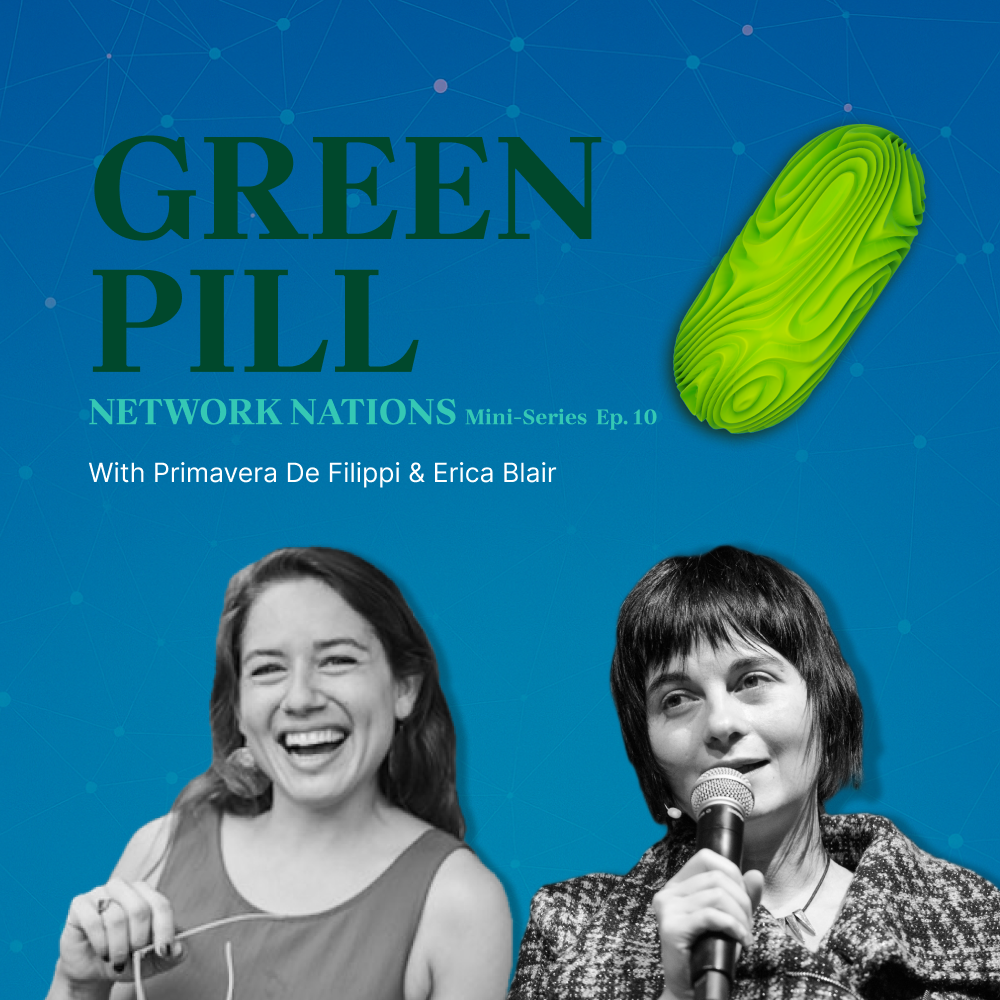
    NN Ep:15 - Catalysing Network Nations: Movement Building with Benjamin Life & Patricia Parkinson

    New @greenpillnet pod out today! 🌐 In this episode of the Network Nations mini-series, Primavera De Filippi is joined by Patricia Parkinson and Benjamin Life, long-time community builders working on the OpenCivics Project, to explore how Network Nations can evolve from a conceptual framework into a real political movement. Together, they unpack what it takes to move from ideas to action: building a shared theory of change, nurturing a scenius before formal institutions, balancing commons-based governance with movement leadership, and avoiding the traps of co-optation, extraction, or techno-elitism. The conversation dives into functional sovereignty, parallel societies, movement inclusivity beyond tech, progressive protocolization, and how Network Nations might grow as a pluralistic, polycentric movement capable of real-world impact. A foundational episode on movement-building, legitimacy, and how communities can coordinate without losing their soul. 🌱 greenpill.network 🌐 networknations.network 🐦 @owocki @greenpillnet opencivics.co omniharmonic.com patriciaparkinson.com https://x.com/yaoeo https://x.com/kosmicgardener https://x.com/omniharmonic ⏱️ Timestamps 00:00 – From concept to movement: why ideas aren't enough 01:20 – Introducing Patricia Parkinson & Benjamin Life (OpenCivics) 02:25 – Why Network Nations must become embodied in real life 04:15 – Theory of change & "parallel societies" 06:30 – Network Nations vs Network States 08:20 – Categories, scenes & movements (from idea to scenius) 10:15 – Shared culture vs shared markets 12:30 – Functional sovereignty as a unifying principle 14:25 – Vibes, aesthetics & kinship in movements 16:45 – Meta-politics vs politics 18:55 – Design criteria for healthy systems 20:50 – Territorial sovereignty & neo-colonial risks 22:55 – Who is this movement for? 26:30 – Scenius: collective genius & proximity 29:00 – Insiders, outsiders & beyonders 31:10 – Dual power & negotiating with institutions 33:15 – Forking the system (and re-merging) 35:25 – Making Network Nations inclusive beyond tech 37:45 – Web3 vs Occupy: lessons from past movements 40:05 – Centering the "why" before the tools 42:10 – Infrastructure for post-capitalist futures 44:05 – Commons governance & movement fragility 46:10 – Movements without charismatic leaders 48:15 – Progressive protocolization & anti-fragility 50:30 – Protocols as culture (Burning Man example) 52:10 – Network Nations Alliance & early constitutions 54:05 – Concrete ways OpenCivics supports the movement 55:30 – Pattern languages & civic infrastructure 57:30 – Calls, rhythms & shared artifacts 59:10 – How to get involved & closing thoughts

  • S11 · E14
    January 30 · 53 min

    NN Ep:14 - Networked Diasporas: The Case of SeeDAO with Helena Rong

    New @greenpillnet pod out today! 🌐 In this episode of the Network Nations mini-series, host Felix Beer is joined by Helena Rong, Assistant Professor at New York University Shanghai, to explore SeeDAO as a real-world case study of a proto Network Nation. They unpack how SeeDAO evolved from a Web3 startup into a translocal, diasporic community rooted in Daoist philosophy, kinship, and the pursuit of a "good life." The conversation dives into co-presence, emergence, non-coercive governance, social ledgers, on-chain identity, and how SeeDAO blends digital infrastructure with physical gathering from online town halls to rural pop-up communities in China. A rich, grounded discussion on how culture, values, and practice not just tooling shape the future of Network Nations, and what bottom-up community governance can look like beyond the Western DAO paradigm. 🌱 greenpill.network 🌐 networknations.network 🐦 @owocki @greenpillnet https://x.com/felix_beer https://x.com/helena__rong https://seedao.xyz/ Helena's work on SeeDAO: https://papers.ssrn.com/sol3/papers.cfm?abstract_id=5731428 ⏱️ Timestamps 00:00 – From theory to practice: proto Network Nations 01:10 – Introducing SeeDAO as a case study 02:19 – Digital policy for global nomads 03:20 – Welcoming Helena Rong 04:26 – Helena's research on SeeDAO 05:42 – SeeDAO as a Chinese-speaking DAO 08:00 – From startup to community 09:45 – COVID, isolation & diasporic connection 11:46 – What does a "good life" mean in SeeDAO? 12:30 – Daoist philosophy & Web3 13:40 – Co-presence as the foundation of community 14:55 – Emergence & non-governance as governance 16:23 – Wandering (xiaoyao) as freedom 18:09 – Culture vs tooling in Web3 communities 19:30 – Day-to-day practices inside SeeDAO 20:18 – On-chain onboarding & participation 22:32 – Reputation, contribution & governance tokens 24:38 – Blockchain as a social ledger 26:34 – Is SeeDAO a proto Network Nation? 28:31 – Translocality & offline gatherings 30:32 – Digital nomad week & rural revitalization 32:51 – DAO as scaffolding for real communities 34:48 – Instrumental vs value-driven governance 36:53 – Sovereignty, China & parallel worlds 39:02 – Network Nations alongside nation-states 41:21 – Digital nomads & rural China 43:41 – Co-presence across villagers, nomads & DAOs 45:52 – Integration, not exit 48:00 – Interoperability between communities 50:13 – Lessons from SeeDAO for Network Nations 52:13 – Helena's research & where to find her work 53:10 – Closing thoughts

  • S12 · E7
    January 26 · 55 min

    VDAO Ep.7 From Software to Soil: Health, Food & Building Real Resilience with Danilo Da Rosa

    New @greenpillnet pod out today! 🌐 In this episode of the VDAO × Greenpill Anti-Fragile Network States mini-series, host Kris Miller speaks with Danilo, a software engineer who left city life behind to rebuild his health, relationship with food, and sense of resilience through permaculture, natural building, and community living in Uruguay. Danilo shares how a health crisis pushed him to rethink his lifestyle, why growing food changed everything, and how moving closer to nature reshaped his understanding of resilience. They explore food autonomy, water catchment, natural house building, digital tools for land design, patience as a strategy, and why community is the most important layer of resilience. A deeply human conversation about bridging technology and nature to build a regenerative, antifragile way of life. 🌱 greenpill.network 🌐 vdao.org 🐦 https://x.com/JoinVDAO 🐦 https://x.com/greenpillnet linktr.ee/danilo_da_rosa ⏱️ Timestamps 00:00 – Cold open: city life, darkness & missing nature 00:59 – Danilo joins & his "why" 02:30 – Health crisis & rethinking food 03:55 – Farmers markets, seasons & nutrient-dense food 05:00 – Leaving the city for a small farm 06:45 – Technology, screens & losing connection with nature 08:05 – What resilience means on a human level 09:15 – Health challenges as antifragility 11:15 – COVID, gardens & food security 13:15 – Choosing land: early mistakes & lessons 15:00 – Advice: observe land for a full year 17:25 – Studying soil, biodiversity & local laws 18:10 – Using digital tools to assess land 19:35 – Making land-design tools free & accessible 22:00 – Water catchment & reading the land 25:55 – Rainwater systems, ponds & long-term planning 27:50 – Slow solutions & patience in permaculture 29:40 – Building a natural (cob) house 31:45 – Learning by building & skill-sharing 33:30 – Loneliness, then rediscovering community 35:45 – Mingas, workshops & social resilience 37:45 – Local materials & low-tech building 41:35 – Bridging tech skills with land stewardship 43:50 – Using software to support regeneration 45:50 – Food autonomy: annuals vs perennials 48:20 – Energy efficiency & working with nature 49:40 – One-square-meter gardens as a starting point 52:00 – Energy use, renewables & solar plans 53:15 – Advice for developers starting this journey 54:50 – Final thoughts & closing

  • S11 · E13
    January 23 · 55 min

    NN Ep:13 - Intentional Communities & New Jurisdictions with Jessy Kate Schingler

    New @greenpillnet pod out today! 🌐 In this episode of the Network Nations mini-series, Primavera De Filippi is joined by Jessy Kate Schingler, co-founder of the Embassy Network, to explore how intentional communities and new jurisdictions can give Network Nations real-world grounding. Jessy shares lessons from over a decade of building translocal co-living communities, explains why the Embassy Network thought of its spaces as "embassies to the future," and how identity, culture, and entanglement emerge without formal membership rules. The conversation then turns to jurisdictional innovation, including Gelephu Mindfulness City in Bhutan, and how special administrative regions, charter cities, and regulatory sandboxes could act as physical anchor points for Network Nations. A rich discussion on culture, identity, subsidiarity, functional sovereignty, and how digital communities might interface with states without losing their values. 🌱 greenpill.network 🌐 networknations.network 🐦 @owocki @greenpillnet https://x.com/yaoeo https://x.com/jessykate ⏱️ Timestamps 00:00 – Can Network Nations become political actors without land? 01:10 – Intentional communities vs new jurisdictions 02:25 – Introducing Jessy Kate Schingler (Embassy Network) 03:20 – What intentional communities look like today 04:45 – The origin of the Embassy Network 05:40 – "Embassies to the future" where the name came from 06:45 – Membership, curation & why formal rules failed 08:15 – Sister communities & translocal identity 09:30 – Cultural, financial & people-based entanglement 11:40 – Cultural transfusion as the strongest glue 13:00 – Financial support between community nodes 14:20 – Identity through shared people & movement 16:20 – Drift: experiments with shared currencies & mobility 18:05 – Private law vs public law in Network Nations 19:10 – Why jurisdictions matter for scaling 20:05 – Rise of new jurisdictions worldwide 21:50 – Introducing Gelephu Mindfulness City (Bhutan) 23:30 – Values, culture & mindful development 25:35 – Experimentation, subsidiarity & the "diamond strategy" 27:20 – Visas, access & digital-first services 29:35 – Jurisdictions as platforms for Network Nations 31:45 – New corporate forms & DAO-native structures 33:45 – Network state vs network nation approaches 36:05 – Polycentricity & layered governance 38:00 – Embassies as portals between cultures 40:15 – AI, credentials & future statutory innovation 42:40 – Regulatory equivalence & sandboxing 44:40 – Intentional communities vs territorial zones 46:40 – Dispute resolution as a legitimacy bridge 50:30 – Lessons from working with states 52:40 – Land policy, mutualism & functional sovereignty 54:50 – Where to follow Jessy Kate & closing thoughts

  • S11 · E12
    January 16 · 1 hr 8 min

    NN Ep:12 From politics to protocols to protocol politics with Santiago Siri

    In this episode of the Network Nations mini-series, Primavera De Filippi speak with Santiago Siri, founder of Democracy Earth, DemocracyOS, and Proof of Humanity, to explore a central question of the digital age: Can we escape politics with protocols or do protocols simply create new political arenas? Santiago shares his journey from building Argentina's internet political party Partido de la Red, to creating open-source democratic infrastructure, to running one of the most ambitious on-chain identity and governance experiments in Web3. They discuss identity as the core bottleneck of digital democracy, governance failures inside protocols, DAOs as political systems, AI as both promise and threat, and what Network Nations must learn from a decade of real-world experimentation. A deep, honest conversation about legitimacy, power, and why politics never disappears it just moves layers. 🌱 greenpill.network 🌐 networknations.network 🐦 @owocki @greenpillnet https://x.com/santisiri https://x.com/yaoeo ⏱️ Timestamps 00:00 – Can protocols help us escape politics? 01:00 – Introducing Santiago Siri 02:15 – From activism to political parties 04:10 – Partido de la Red & proxy voting 06:40 – Using technology to modernize democracy 09:00 – DemocracyOS & global adoption 10:45 – Why political systems resist change 12:10 – The limits of centralized digital voting 14:15 – Why identity is the core problem 15:45 – Leaving politics to build infrastructure 17:50 – Democracy Earth & global pilots 20:00 – Bitcoin vs Ethereum for governance 22:00 – The birth of Proof of Humanity 24:20 – Early identity failures & attacks 26:40 – One person, one vote challenges 29:55 – Proof of Humanity mechanics explained 32:10 – UBI, incentives & DAO governance 34:40 – Delegation farming & power struggles 36:25 – Quadratic delegation as a fix 38:25 – Removing founders from power 40:25 – Identity, justice & money tensions 42:00 – AI breaks video-based identity 44:05 – Worldcoin & biometric approaches 46:30 – Protocols still create politics 48:30 – AI governance experiments 50:25 – Why AI is still unsafe for governance 52:25 – Centralized compute as a risk 54:15 – Who governs the governance layer? 56:40 – Proof of Humanity as a proto–Network Nation 58:40 – What's missing for real Network Nations 01:00:45 – Shared identity & legitimacy 01:02:55 – Lessons from 10 years of experimentation 01:04:40 – Final lesson: legitimacy is enacted, not declared 01:07:30 – Where to follow Santiago & closing

  • S11 · E11
    January 9 · 1 hr 18 min

    NN Ep:11 Let a Thousand Societies Bloom with Vitalik Buterin

    New @greenpillnet pod out today! 🌐 In this episode of the Network Nations mini-series, Primavera De Filippi & Felix Beer are joined by Vitalik Buterin to reflect on one of the most influential experiments in recent community-building history: Zuzalu. Vitalik shares the motivations behind Zuzalu, what actually worked (and what didn't), and why many pop-up cities risk drifting into "long conferences" instead of becoming real communities. Together they explore kinship vs telos, culture vs mission, permanence vs mobility, governance by forking, and how zones, tribes, and regulatory sandboxes might interlock to form durable network nations. A deep, reflective conversation on how digitally aligned communities can evolve into lasting political actors without losing their soul. 🌱 greenpill.network 🌐 networknations.network 🐦 @owocki @greenpillnet https://x.com/yaoeo?lang=en https://x.com/felix_beer?lang=en https://x.com/VitalikButerin https://www.zuzalu.city/ ⏱️ Timestamps 00:00 – Why Zuzalu matters for network nations 02:20 – Introducing Vitalik & the Zuzalu experiment 03:40 – From ideas to action: why Zuzalu was created 05:40 – Bringing 200 people together for two months 07:10 – When a pop-up becomes "real life" 09:10 – Membership, visas & selective curation 11:20 – Zuzalu's offshoots: Edge City, Vitalia & more 13:30 – Decentralizing after Zuzalu 15:30 – Why permanence matters 18:10 – Building culture through physical proximity 20:20 – Cities vs tribes vs nations 22:30 – Membership as a spectrum, not binary 24:50 – Bitcoin embassies & cultural recognition 27:00 – Interests vs vibes vs kinship 29:10 – Shared experiences as the glue of community 31:30 – Why kinship is hard to design 33:50 – Internal purpose vs external purpose 36:10 – Telos-driven communities & corporations 38:50 – Prospera, regulation & culture 41:00 – Zones as platforms for tribes 44:40 – Regulatory sandboxes & state experiments 46:50 – Libertarian vs developmentalist approaches 49:10 – Why niche cities beat generic hubs 51:40 – The "archipelago" vision 54:00 – Zones and tribes: separation or fusion? 56:00 – Governance by forking 01:10:00 – Why governance still matters 01:12:10 – Reinvigorating crypto's political vision 01:14:10 – Low-hanging fruit for network nations 01:16:40 – Ethereum as a proto-network nation 01:17:50 – Closing thoughts

  • S11 · E10
    January 2 · 1 hr 3 min

    NN Ep:10 Burning Man: Seeding a Network Nation

    New @greenpillnet pod out today! 🌐 In this episode of the Network Nations mini-series, Primavera De Filippi explore one of the most influential community experiments of the last 40 years: Burning Man. They're joined by Erika Blair, who leads engagement and network strategy at Burning Man, to unpack how a one-week event in the Nevada desert evolved into a global, year-round network of communities bound not by territory, but by shared principles, rituals, and identity. The conversation dives into the origins of Burning Man, the emergence of the 10 Principles, regional burns around the world, kinship and belonging, ritual and meaning, cultural dilution, and whether Burning Man can be understood as a real-world example of a network nation — including where it aligns, and where it diverges, from ideas like functional sovereignty and self-governance. A fascinating case study for anyone interested in network societies, collective identity, and the future of non-territorial communities. 🌱 greenpill.network 🌐 networknations.network https://burningman.org/ @owocki @greenpillnet ⏱️ Timestamps 00:00 – Burning Man as a radical community experiment 02:09 – Introducing Erika Blair & her role at Burning Man 03:50 – Why Burning Man resonated as a movement 05:30 – Burning Man as a response to consumerism 07:40 – The mythic origins: burning the man on the beach 09:40 – Meaning without a fixed narrative 12:15 – What does it mean to be a "Burner"? 14:20 – Global participation beyond Nevada 17:20 – Recognizing "Burner texture" and shared ethos 18:40 – Imagining the world anew 20:30 – The 10 Principles: origins and purpose 24:00 – How regional burns emerged worldwide 27:20 – Burning Man as a "network of networks" 30:10 – Why some events are official 32:10 – Protecting culture from commodification 35:40 – Kinship, belonging, and recognition 37:50 – Decommodification and trust 40:20 – Rituals: the Man, the Temple, grief & celebration 43:20 – Full-spectrum human experience 45:20 – Popularity, scaling & cultural dilution 47:50 – Burning Man across cultures 49:20 – Is Burning Man a Network Nation? 51:30 – Functional sovereignty & working with states 53:45 – Governance, autonomy & stewardship 56:20 – Burning Man as a permission engine 58:40 – Community decision-making & slow governance 01:00:55 – The power of intrinsic motivation 01:02:40 – Building nations vs building companies 01:03:50 – Where to learn more & closing

  • S10 · E8
    Dec 30, 2025 · 40 min

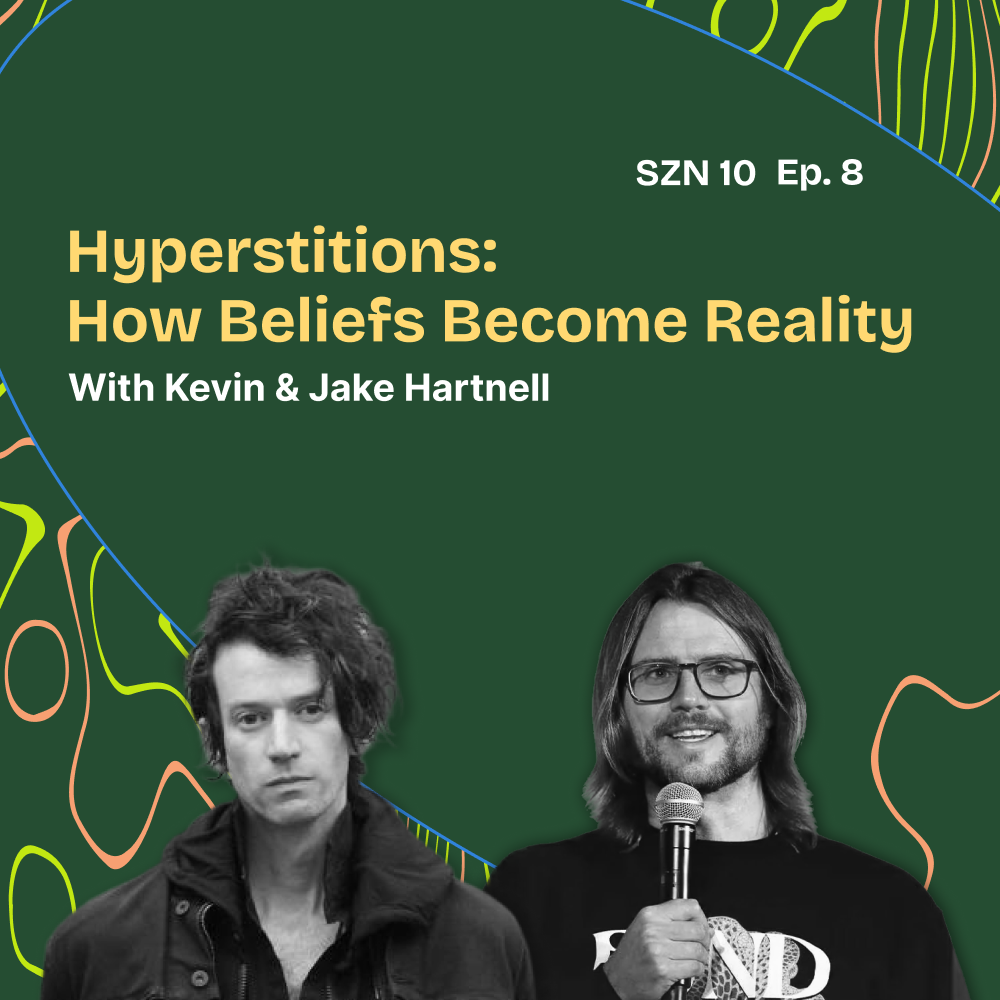
    S.10 Ep.8 Hyperstitions: How Beliefs Become Reality in Networked Systems with Jake Hartnell

    New @greenpillnet pod out today! 🌐 In this episode of the Greenpill Podcast, Kevin Owocki sits down with Jake Hartnell reality engineer, builder, and the mind behind ENOVA to explore the idea of hyperstitions: beliefs and narratives that become real by spreading through networks. Jake explains how hyperstitions operate as a new coordination primitive, why technologies like Bitcoin, Ethereum, and AGI can be seen as successful hyperstitions, and how tools like hyperstition markets blend prediction markets, incentives, and storytelling to drive collective action. They discuss ENOVA, egregores, cybernetic systems, futarchy, and how communities can consciously design narratives that pull the future into the present. A deep and playful conversation about memetics, crypto-economics, and how collective belief can shape the world. 🌱 greenpill.network @owocki @greenpillnet https://x.com/JakeHartnell Some of the materials we mention in the episode: https://x.com/0xEN0VA https://en0va.xyz/hyperstition ⏱️ Timestamps 00:00 – Welcome to a new season of Greenpill 01:55 – Introducing Jake Hartnell & the idea of hyperstitions 02:45 – What is a hyperstition? (simple definition) 04:23 – Examples: AGI, Ethereum & Bitcoin as hyperstitions 06:50 – Everyday hyperstitions: lunch vs parties 08:05 – Network effects & aspirational stories 09:20 – Is Greenpill itself a hyperstition? 10:10 – What Jake is building with ENOVA 11:05 – Hyperstition markets explained 12:35 – The first hyperstition market & Goodhart's Law 14:10 – Donation-based hyperstitions & GG / bioregional funding 16:10 – Incentivizing action, not passive prediction 18:00 – Theory of change & coordination design 19:40 – Hyperstition markets vs hyperstition itself 21:30 – Where to find ENOVA & what's coming next 23:05 – Egregores, cybernetic systems & collective intelligence 26:15 – Making hyperstition markets permissionless 28:00 – Greenpill, regeneration & narrative power 31:55 – Phases of a hyperstition 33:20 – Futarchy & decision-making markets 35:20 – Community as the real coordination engine 36:20 – A future where DAOs work 38:15 – Collective intelligence as political power 39:50 – Closing thoughts & where to follow Jake

Showing 1–20 of 20 episodes