
transcript
show notes
In this podcast episode Pippa chats with Maggie Jarrett from See Saw Wines in Orange NSW.
Read the case study on the Farming Together website.
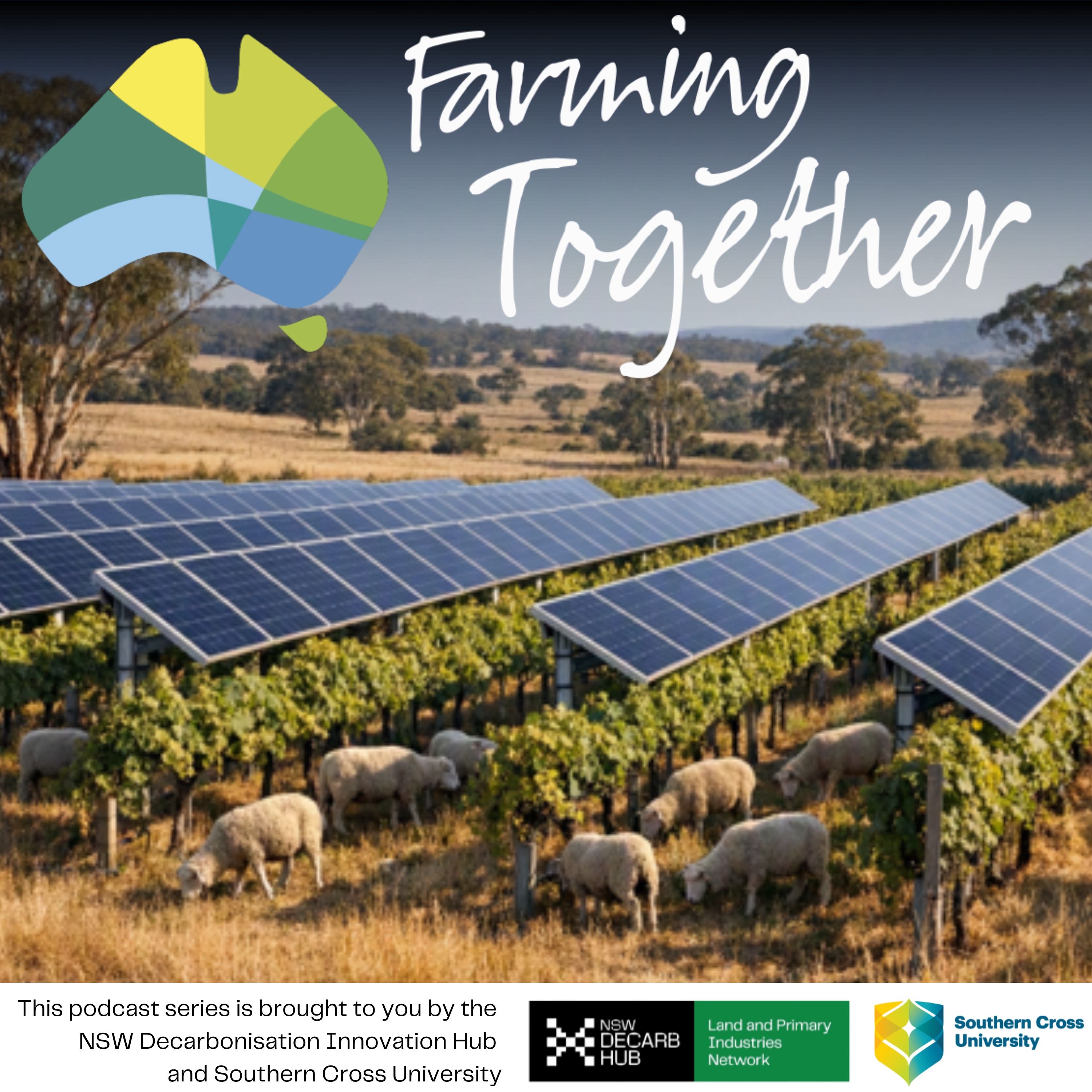
Maggie shares how See Saw Wines is turning a long-standing commitment to organics and soil health into a practical pathway for decarbonisation. You’ll hear how everyday decisions - from solar and lightweight glass to integrating sheep in the vineyard - are helping cut emissions while strengthening resilience and long-term viability.
Practical evidence from Maggie’s vineyard shows their strategies to reduce carbon are increasing soil organic matter, reducing diesel use and reducing emissions. Overall, this is helping to improve the long-term resilience of the farm.
So, enjoy the chat and visit See Saw Wines' website to learn more about their goals of sustainability and low-impact viticulture. You can also visit the Cellar Door for a wine and a snack.
Wine Australia also features the use of floating photovoltaic panels on the See Saw Wines dams.
Other useful links:
Home - Farmers for Climate Action
Clean Energy Finance Corporation Home - Clean Energy Finance Corporation
Sustainable Farms Sustainable Farms: Healthy farmers, Healthy farms, Healthy profits
Nuffield Australia Homepage | Nuffield Australia
This Farming Together episode is one in a short series where we hear from primary producers as they work towards decarbonisation. The project has been funded by the Land and Primary Industries Network of the NSW Decarbonisation Hub. You can learn more about the NSW Decarbonisation Hub at https://www.decarbhub.au/
Disclaimer: This podcast is produced by Southern Cross University (ABN 41 995 651 524) as part of the NSW Decarbonisation Innovation Hub series. It is provided for general information and educational purposes only.
No advice: The content of this podcast does not constitute professional, agronomic, financial, legal, environmental, business or investment advice and must not be relied upon as such. It does not consider your individual objectives, circumstances or needs. You should seek independent advice from a suitably qualified professional before acting on any information discussed.
Guest and third‑party views: The views, opinions, statements and experiences expressed by guests and other contributors are their own and do not necessarily reflect those of Southern Cross University, the NSW Decarbonisation Innovation Hub, or their staff, partners, funders or related parties. Southern Cross University does not verify, adopt or endorse statements made by guests.
No endorsement: References to specific tools, technologies, products, services, suppliers or organisations are based on a guest’s own experience and are provided for illustration only. They do not constitute an endorsement, recommendation, approval or warranty by Southern Cross University, and no commercial relationship should be inferred.
No warranty / results may vary: While reasonable care is taken in producing this podcast, Southern Cross University makes no representation or warranty as to the accuracy, completeness, currency or reliability of the information. Agricultural operations vary widely, and outcomes described by guests may not be achievable, replicable or suitable in other settings.
External links: This podcast and its show notes may contain links to third‑party websites or resources provided for convenience only. Southern Cross University does not control and is not responsible for the content, availability or accuracy of those external resources.
Limitation of liability: To the maximum extent permitted by law, Southern Cross University and the NSW Decarbonisation Innovation Hub exclude all liability for any loss, damage, cost or expense (including indirect or consequential loss) arising from any use of, or reliance on, the information in this podcast. Nothing in this disclaimer excludes, restricts or modifies any consumer guarantee, right or remedy that cannot lawfully be excluded under the Australian Consumer Law or other applicable law.
Recording date: Information in this podcast was accurate at the time of recording. Circumstances, research findings, technologies and regulatory settings may have changed since that time.


