Skip to content
Artwork for Dr. Z's Podcasts
Dr. Z's Podcasts · July 12 · 24 min

Network+ - Domain 04 - Network Security

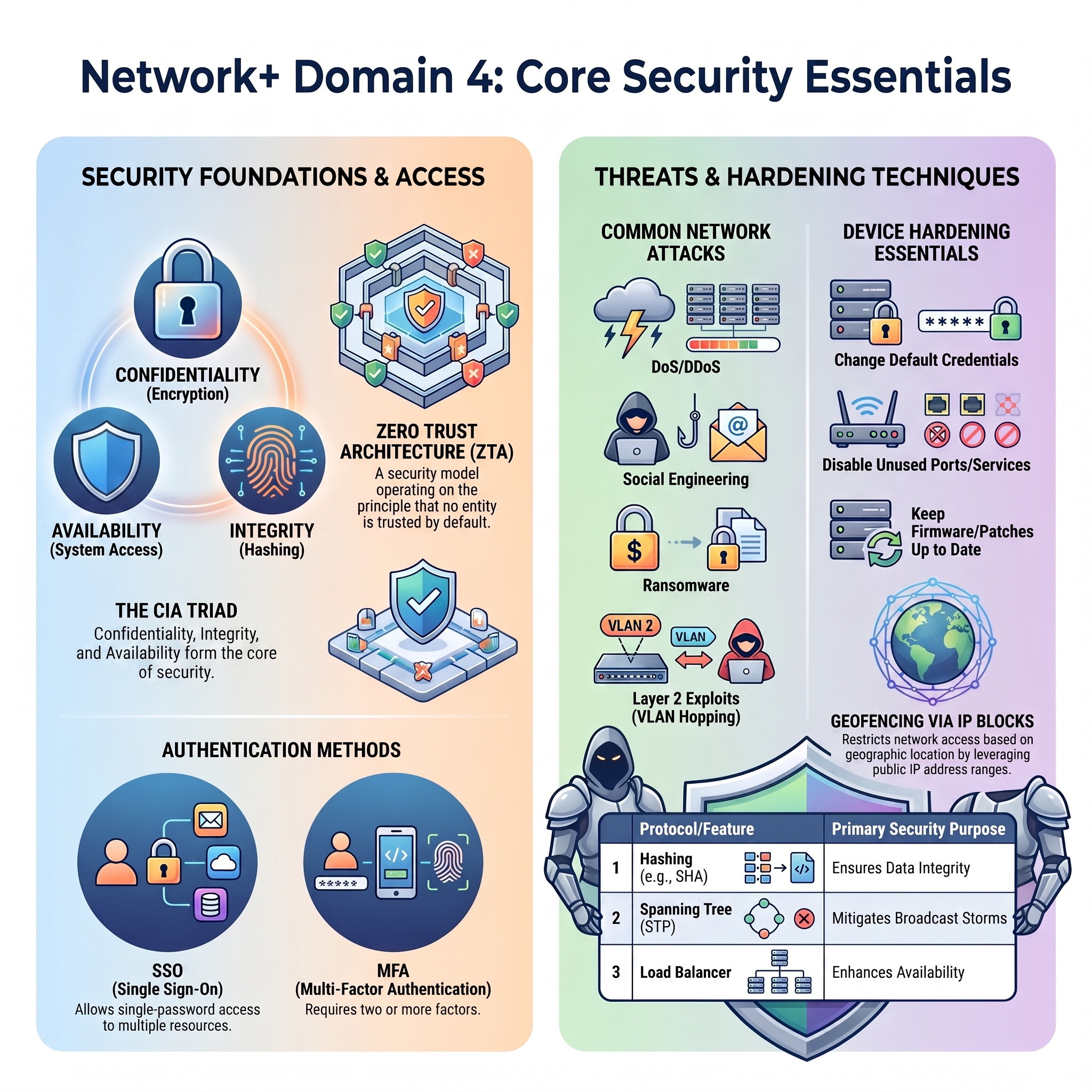
Category: Network+ (S121) This podcast focuses on safeguarding network infrastructure, traffic, and data assets. The Network+ Domain 4 is anchored by the CIA Triad: Confidentiality (keeping data private using encryption and multi-factor authentication), Integrity (ensuring accuracy using hashing and digital signatures), and Availability (maintaining system uptime via redundancies). Modern networks also incorporate Zero Trust Architecture, which assumes no default trust and mandates policy-based authentication and least-privilege access. Administrators must defend against diverse network attacks. These include social engineering (such as phishing), malware (such as human-activated viruses and self-replicating worms), and technology-based exploits (such as SYN floods, Smurf attacks, rogue access points, evil twins, and VLAN hopping). To mitigate these threats, robust hardening techniques must be implemented. Essential controls include deploying stateful firewalls that track connection states, disabling unused switch ports, implementing port security by binding authorized MAC addresses, and leveraging DHCP snooping to block rogue servers. -Dr. Z

0:00-24:49

transcript

No transcript — this publisher did not publish one.

show notes

Category: Network+ (S121)

This podcast focuses on safeguarding network infrastructure, traffic, and data assets. The Network+ Domain 4 is anchored by the CIA Triad: Confidentiality (keeping data private using encryption and multi-factor authentication), Integrity (ensuring accuracy using hashing and digital signatures), and Availability (maintaining system uptime via redundancies). Modern networks also incorporate Zero Trust Architecture, which assumes no default trust and mandates policy-based authentication and least-privilege access.

Administrators must defend against diverse network attacks. These include social engineering (such as phishing), malware (such as human-activated viruses and self-replicating worms), and technology-based exploits (such as SYN floods, Smurf attacks, rogue access points, evil twins, and VLAN hopping).

To mitigate these threats, robust hardening techniques must be implemented. Essential controls include deploying stateful firewalls that track connection states, disabling unused switch ports, implementing port security by binding authorized MAC addresses, and leveraging DHCP snooping to block rogue servers. -Dr. Z