Skip to content
Artwork for Deep Dive
Deep Dive · July 25 · 10 min

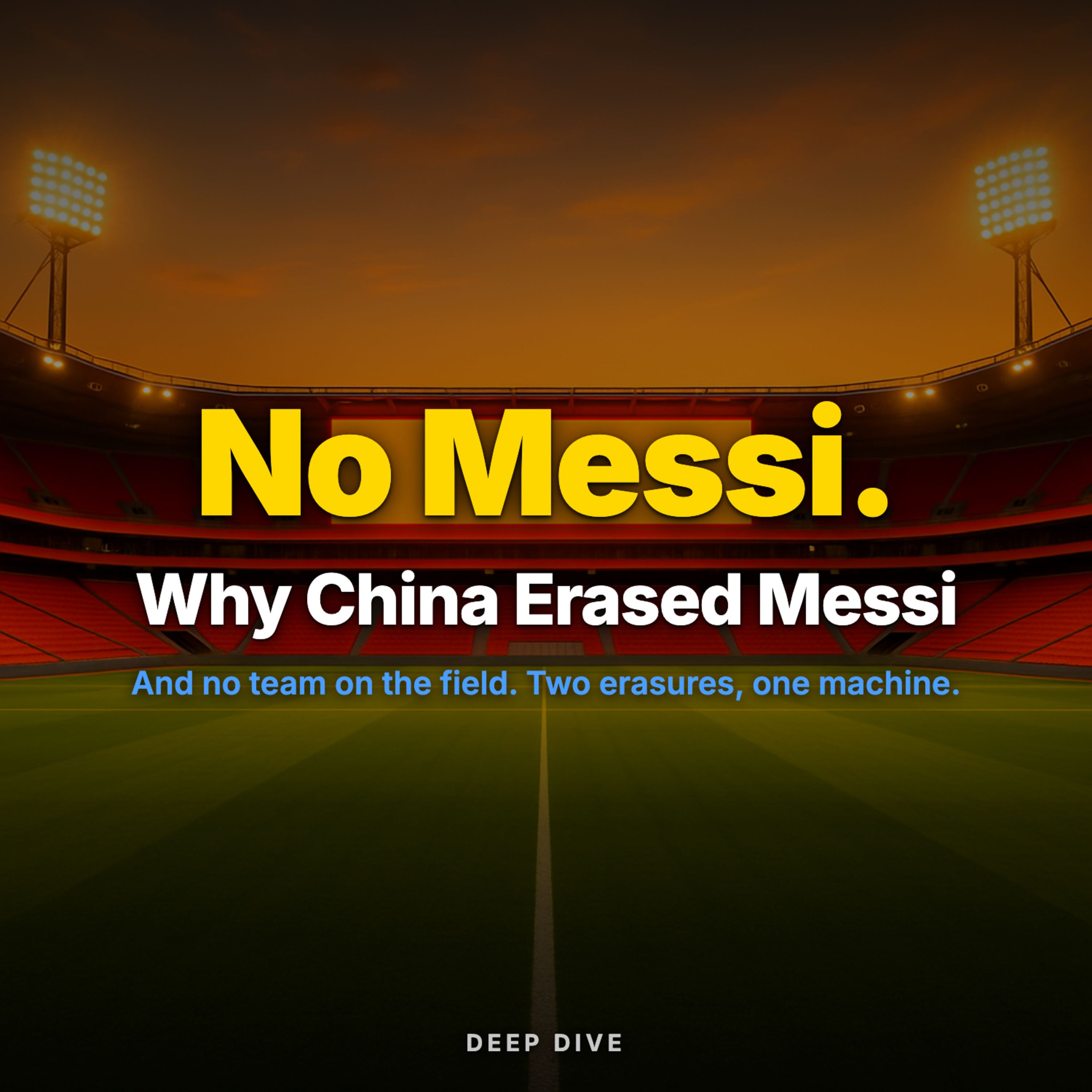
Why China Erased Messi

In June 2026, Lionel Messi broke the World Cup's all-time scoring record. In China, one outlet — Vision Times — reported the state broadcaster quietly scrubbed him from its screens: a trophy clip swapped out of a montage. That same week, China had no team in the tournament. Two erasures, one week. This episode argues they came from the same machine. The Messi story starts in Hong Kong in 2024, when he stayed on the bench for an exhibition and played in Tokyo three days later. The Global Times floated "external forces." An anti-Messi hashtag drew 360 million views in a week. China then cancelled both of Argentina's upcoming friendlies — one host city citing "reasons known to all" — shortly after Argentina's president, Javier Milei, snubbed Beijing. It's the playbook China ran on the NBA in 2019, and on Arsenal after Mesut Ozil. But the honest word is not "banned." The scrubbing is a single source; the "avoid close-ups" directive is a rumor; and it wasn't consistent — the same Global Times praised Messi's "effortless elegance" that week, and CCTV aired all 104 matches. The accurate word is muted. The machine doesn't need a ban — it just needs to look away. Then the second erasure. One World Cup appearance ever (2002, zero goals). A 7-0 loss to Japan. Xi Jinping's 2016 plan for a soccer superpower by 2050 — 70,000 pitches, 50 million players, co-written by the Education Ministry. Brazilian-born players naturalized with no Chinese ancestry, then a 3-1 loss to Vietnam. Coach Li Tie sentenced to 20 years over roughly 120 million yuan in bribes; the football association chief given life. At least 39 pro clubs folded since 2020. The structural answer: a decade in, China had ~109,200 registered youth players. Germany, Brazil and Italy each have over a million. You can direct capital at chips, rail and solar. You cannot decree what soccer runs on — millions of kids playing pickup, thousands of clubs failing and trying. One line this episode will not cross: this is not about Chinese people lacking creativity. The same country supplies a quarter of the world's top AI researchers. The talent is there; the system channels it toward what can be measured. The counterweight is Rowan Simons, who spent 30 years building grassroots football inside China and rejects the censorship frame outright: scandals aren't censored there, and the real problem is the missing pyramid — "you can't build it top-down." Then the proof: after the pro league collapsed, an amateur city league in Jiangsu drew 60,000 to a match and 11 billion views online. One read of the public record, as of June 2026. RELATED EPISODES The China-AI arc (DeepSeek / the chip war) — the COUNTER-EVIDENCE that China innovates: the same country that 'rote-learns' supplies a quarter of the world's top AI researchers. Proof it's the system, not the people. CHAPTERS 00:00 Two erasures in one week 00:49 Roadmap, and the single-source caveat 01:23 Hong Kong, 2024: the bench and the backlash 02:09 The punishment: Argentina's cancelled friendlies 02:58 What was actually scrubbed — and what wasn't 03:44 The empty slot: no team in the tournament 04:15 Xi's decree: soccer superpower by 2050 05:15 The money that got stolen 06:24 Why top-down can't build a team 07:19 You can't drill improvisation 07:56 The line this episode won't cross 08:32 Rowan Simons: the missing pyramid 09:43 Three predictions, and the close SOURCES Vision Times — the June 2026 broadcaster-scrub report (SINGLE SOURCE) Global Times — the 2024 "external forces" framing; the "effortless elegance" praise Hong Kong Free Press / CNN / ESPN — the Feb 2024 Inter Miami exhibition Xinhua & Caixin Global — Li Tie's sentence, the ~120M yuan finding, CFA life bans Sixth Tone / Caixin — youth-registration counts, the grassroots collapse Al Jazeera / CNBC / Fortune — Evergrande and the club collapse Rowan Simons, "Bamboo Goalposts" — grassroots football in China MIT Technology Review — China's share of top AI researchers
0:00-10:44

transcript

No transcript — this publisher did not publish one.

show notes

In June 2026, Lionel Messi broke the World Cup's all-time scoring record. In China, one outlet — Vision Times — reported the state broadcaster quietly scrubbed him from its screens: a trophy clip swapped out of a montage. That same week, China had no team in the tournament.


Two erasures, one week. This episode argues they came from the same machine.


The Messi story starts in Hong Kong in 2024, when he stayed on the bench for an exhibition and played in Tokyo three days later. The Global Times floated "external forces." An anti-Messi hashtag drew 360 million views in a week. China then cancelled both of Argentina's upcoming friendlies — one host city citing "reasons known to all" — shortly after Argentina's president, Javier Milei, snubbed Beijing. It's the playbook China ran on the NBA in 2019, and on Arsenal after Mesut Ozil.


But the honest word is not "banned." The scrubbing is a single source; the "avoid close-ups" directive is a rumor; and it wasn't consistent — the same Global Times praised Messi's "effortless elegance" that week, and CCTV aired all 104 matches. The accurate word is muted. The machine doesn't need a ban — it just needs to look away.


Then the second erasure. One World Cup appearance ever (2002, zero goals). A 7-0 loss to Japan. Xi Jinping's 2016 plan for a soccer superpower by 2050 — 70,000 pitches, 50 million players, co-written by the Education Ministry. Brazilian-born players naturalized with no Chinese ancestry, then a 3-1 loss to Vietnam. Coach Li Tie sentenced to 20 years over roughly 120 million yuan in bribes; the football association chief given life. At least 39 pro clubs folded since 2020.


The structural answer: a decade in, China had ~109,200 registered youth players. Germany, Brazil and Italy each have over a million. You can direct capital at chips, rail and solar. You cannot decree what soccer runs on — millions of kids playing pickup, thousands of clubs failing and trying.


One line this episode will not cross: this is not about Chinese people lacking creativity. The same country supplies a quarter of the world's top AI researchers. The talent is there; the system channels it toward what can be measured.


The counterweight is Rowan Simons, who spent 30 years building grassroots football inside China and rejects the censorship frame outright: scandals aren't censored there, and the real problem is the missing pyramid — "you can't build it top-down." Then the proof: after the pro league collapsed, an amateur city league in Jiangsu drew 60,000 to a match and 11 billion views online.


One read of the public record, as of June 2026.


RELATED EPISODES

The China-AI arc (DeepSeek / the chip war) — the COUNTER-EVIDENCE that China innovates: the same country that 'rote-learns' supplies a quarter of the world's top AI researchers. Proof it's the system, not the people.


CHAPTERS

00:00 Two erasures in one week

00:49 Roadmap, and the single-source caveat

01:23 Hong Kong, 2024: the bench and the backlash

02:09 The punishment: Argentina's cancelled friendlies

02:58 What was actually scrubbed — and what wasn't

03:44 The empty slot: no team in the tournament

04:15 Xi's decree: soccer superpower by 2050

05:15 The money that got stolen

06:24 Why top-down can't build a team

07:19 You can't drill improvisation

07:56 The line this episode won't cross

08:32 Rowan Simons: the missing pyramid

09:43 Three predictions, and the close


SOURCES

Vision Times — the June 2026 broadcaster-scrub report (SINGLE SOURCE)

Global Times — the 2024 "external forces" framing; the "effortless elegance" praise

Hong Kong Free Press / CNN / ESPN — the Feb 2024 Inter Miami exhibition

Xinhua & Caixin Global — Li Tie's sentence, the ~120M yuan finding, CFA life bans

Sixth Tone / Caixin — youth-registration counts, the grassroots collapse

Al Jazeera / CNBC / Fortune — Evergrande and the club collapse

Rowan Simons, "Bamboo Goalposts" — grassroots football in China

MIT Technology Review — China's share of top AI researchers