Skip to content
Artwork for Deep Dive
Deep Dive · July 31 · 35 min

How Much Ozempic Actually Costs

Nobody is supposed to pay the sticker price on Ozempic. So who does? On July 1st, 2026, Medicare started offering Wegovy for a $50 copay — through a program where having type-2 diabetes disqualifies you, the poorest enrollees get no subsidy, and which exists only because every private drug plan refused the deal. None of it makes sense until you see what a drug's list price actually is — and who gets billed off it. This episode follows the $1,349 sticker through the machine that sets it: the audited 70 cents of every US dollar Novo Nordisk gives back, the rebate guarantees that leave middlemen contractually short a falling list price, and the Senate investigation that concluded — against the obvious villain story — that PBMs are "not the reason" these prices are high. Then it finds the people the sticker lands on: the patient inside her deductible, billed off $1,349 for the same pen the uninsured buyer gets for $349 at the same counter, same day. Almost 4 times more, for having insurance. That arithmetic is the episode. Also inside: at least eight defensible answers to "what does Ozempic actually cost" — $1,349 on paper, $274 for Medicare from 2027, $199 on a federal discount storefront, about $130 at a Danish pharmacy, $16 to $48 in India since its patent died in March; the American cash price and the Danish retail price landing about one percent apart; North Carolina's board deck with "100% rebate loss" beside nearly every cost-control option; Delaware's copay set by a rebate cliff; Pennsylvania cutting the drug, then budgeting $84 million to replace the rebates it had been collecting on a price nobody paid; Caremark dropping Zepbound for roughly 25 to 30 million people and reinstating it thirteen months later; the compounding window that closed because the statute never cared about price; and the patent cliff Novo is already re-pricing against — including the Canadian patent it lost over a 450-dollar maintenance fee. RELATED EPISODE • Why Home Insurance Got Cheaper in Florida and Worse in California — when every private payer exits a risk, it doesn't vanish; it lands on the public balance sheet. CHAPTERS 00:00 The Medicare Bridge — the cold open 02:43 The machine that sets the sticker 06:31 The Senate's opposite verdict 07:38 Caremark pulls Zepbound — the crank turns again 10:52 Who pays the sticker — the 3.9x arithmetic 12:17 Novo names the victim class 14:55 The wall: eight answers 19:26 $349 vs Copenhagen — the convergence 20:14 Pricing a prevented heart attack 21:27 North Carolina votes to walk 23:20 Pennsylvania's $84M artifact 24:02 ICER's reversal — and the Bridge returns 26:40 The compounding window 29:46 The patent cliff 34:02 Three prices, one day — the close SOURCES Novo Nordisk Annual Report 2025 (note 2.1), SEC filings & press releases (Nov 2025 / Feb 2026) Senate HELP majority staff report & Sept 2024 hearing (official transcript) FTC insulin complaint; Express Scripts & Caremark settlement releases (2026) CMS Medicare GLP-1 Bridge pages, HPMS FAQs & prescriber fact sheet KFF: health tracking poll (Nov 2025), employer benefits survey, Medicaid GLP-1 tracker USC Schaeffer Center (rebate-list elasticity); Hernandez & Sullivan (Obesity, 2024) ICER 2025 assessment; SELECT trial (NEJM); JMCP copay-tier persistence study NC State Health Plan board deck; Delaware SEBC materials; PA Medicaid bulletin & budget hearing Truveta prescribing/switching analyses; CVS Health releases (May 2025 / May 2026) TrumpRx.gov (fetched July 2026); Danish Medicines Agency price register; House Oversight written testimony (2024) ——— This episode discusses drug list prices, company revenues, pending regulatory decisions, and litigation involving public companies for informational purposes only. It is not investment, medical, or insurance advice. Prices and figures are as of late July 2026, trace to the cited public sources, and may change quickly as list-price cuts, negotiated prices, and generic entry take effect.
0:00-35:45

transcript

No transcript — this publisher did not publish one.

show notes

Nobody is supposed to pay the sticker price on Ozempic. So who does?


On July 1st, 2026, Medicare started offering Wegovy for a $50 copay — through a program where having type-2 diabetes disqualifies you, the poorest enrollees get no subsidy, and which exists only because every private drug plan refused the deal. None of it makes sense until you see what a drug's list price actually is — and who gets billed off it.


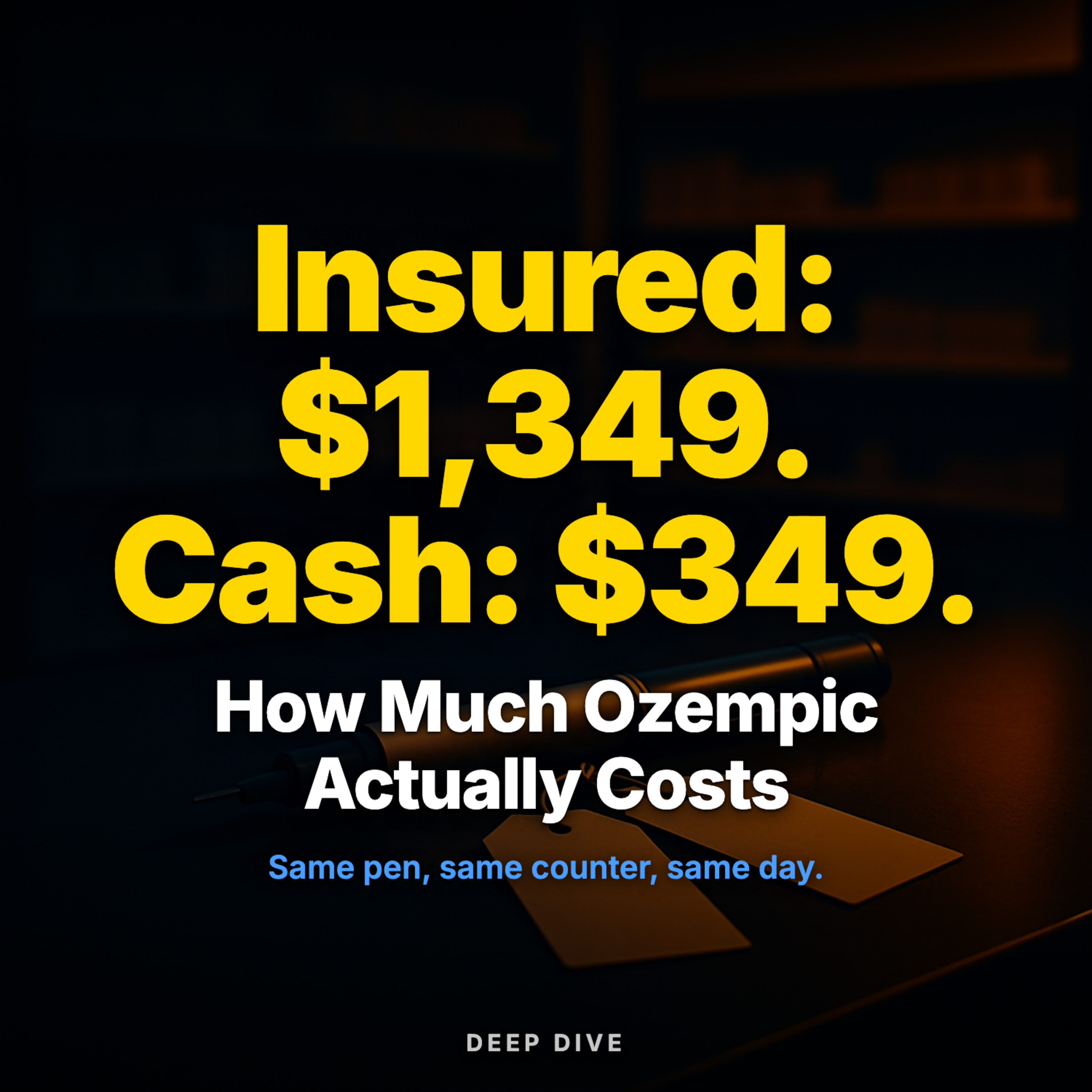
This episode follows the $1,349 sticker through the machine that sets it: the audited 70 cents of every US dollar Novo Nordisk gives back, the rebate guarantees that leave middlemen contractually short a falling list price, and the Senate investigation that concluded — against the obvious villain story — that PBMs are "not the reason" these prices are high. Then it finds the people the sticker lands on: the patient inside her deductible, billed off $1,349 for the same pen the uninsured buyer gets for $349 at the same counter, same day. Almost 4 times more, for having insurance. That arithmetic is the episode.


Also inside: at least eight defensible answers to "what does Ozempic actually cost" — $1,349 on paper, $274 for Medicare from 2027, $199 on a federal discount storefront, about $130 at a Danish pharmacy, $16 to $48 in India since its patent died in March; the American cash price and the Danish retail price landing about one percent apart; North Carolina's board deck with "100% rebate loss" beside nearly every cost-control option; Delaware's copay set by a rebate cliff; Pennsylvania cutting the drug, then budgeting $84 million to replace the rebates it had been collecting on a price nobody paid; Caremark dropping Zepbound for roughly 25 to 30 million people and reinstating it thirteen months later; the compounding window that closed because the statute never cared about price; and the patent cliff Novo is already re-pricing against — including the Canadian patent it lost over a 450-dollar maintenance fee.


RELATED EPISODE

• Why Home Insurance Got Cheaper in Florida and Worse in California — when every private payer exits a risk, it doesn't vanish; it lands on the public balance sheet.


CHAPTERS

00:00 The Medicare Bridge — the cold open

02:43 The machine that sets the sticker

06:31 The Senate's opposite verdict

07:38 Caremark pulls Zepbound — the crank turns again

10:52 Who pays the sticker — the 3.9x arithmetic

12:17 Novo names the victim class

14:55 The wall: eight answers

19:26 $349 vs Copenhagen — the convergence

20:14 Pricing a prevented heart attack

21:27 North Carolina votes to walk

23:20 Pennsylvania's $84M artifact

24:02 ICER's reversal — and the Bridge returns

26:40 The compounding window

29:46 The patent cliff

34:02 Three prices, one day — the close


SOURCES

Novo Nordisk Annual Report 2025 (note 2.1), SEC filings & press releases (Nov 2025 / Feb 2026)

Senate HELP majority staff report & Sept 2024 hearing (official transcript)

FTC insulin complaint; Express Scripts & Caremark settlement releases (2026)

CMS Medicare GLP-1 Bridge pages, HPMS FAQs & prescriber fact sheet

KFF: health tracking poll (Nov 2025), employer benefits survey, Medicaid GLP-1 tracker

USC Schaeffer Center (rebate-list elasticity); Hernandez & Sullivan (Obesity, 2024)

ICER 2025 assessment; SELECT trial (NEJM); JMCP copay-tier persistence study

NC State Health Plan board deck; Delaware SEBC materials; PA Medicaid bulletin & budget hearing

Truveta prescribing/switching analyses; CVS Health releases (May 2025 / May 2026)

TrumpRx.gov (fetched July 2026); Danish Medicines Agency price register; House Oversight written testimony (2024)


———

This episode discusses drug list prices, company revenues, pending regulatory decisions, and litigation involving public companies for informational purposes only. It is not investment, medical, or insurance advice. Prices and figures are as of late July 2026, trace to the cited public sources, and may change quickly as list-price cuts, negotiated prices, and generic entry take effect.