
Skip to content
Artwork for Deep Dive
Deep Dive · June 19 · 12 min

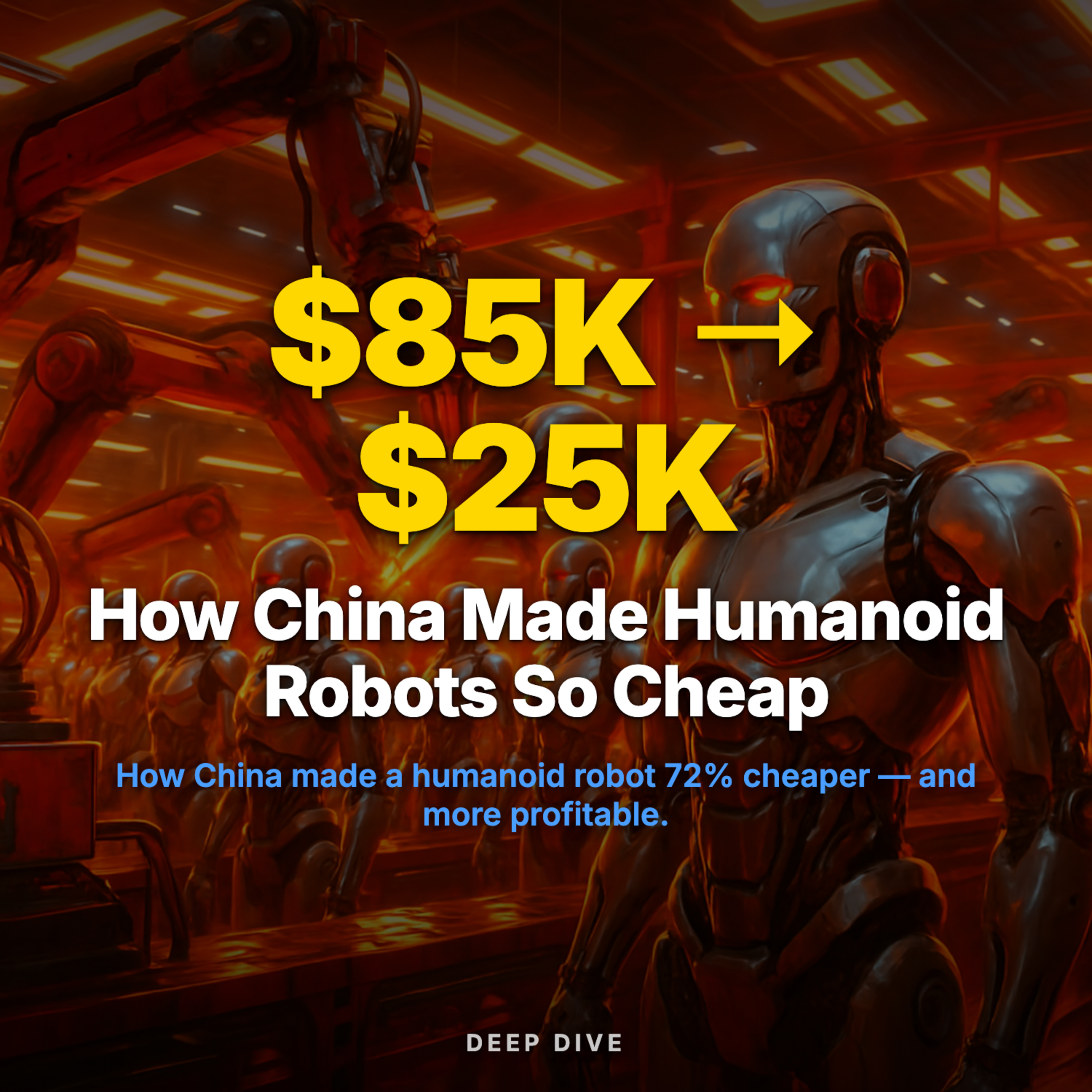
How China Made Humanoid Robots So Cheap

A humanoid robot got 72% cheaper in two years — Unitree's average price fell from about $85,000 to $25,000 — while the maker's gross margin went UP, from ~44% to ~60%. Falling prices are supposed to crush margins. This one expanded them. The answer is in the title: the cheap part isn't the robot — it's the country it's built in. A humanoid is a bag of expensive joints wrapped in cheap plastic, and Unitree makes those joints itself, riding the same motor-battery-sensor supply chain China mastered building electric cars. McKinsey estimates rebuilding Tesla's Optimus without Chinese suppliers would roughly triple the parts bill — from about $46,000 to $131,000. The body is Chinese. But we build it through the hard question: do these cheap robots actually do any work? Mostly — not yet. About three-quarters of its sales go to research labs and schools ("dancing, not working"), and even Elon Musk admits Optimus is "still in the R&D phase… not in usage in our factories in a material way." A lot of what looks autonomous is a human in another room with a controller. So which is it — a breakthrough, or an expensive parlor trick? Both. China built the cheapest body in the world; the brain — the AI — isn't ready. Unitree's Wang Xingxing and Figure's Brett Adcock reconcile it, and we close on three dated predictions. Not investment advice — one read of the public record, as of June 2026. RELATED EPISODES The Humanoid Robot Race: Who's Actually Shipping, and What Really Breaks First — established China ~80% of output, the '14 Swiss screws' chokepoint, and 'the most valuable worker is the person watching the robot.' This episode extends it: output share ~80%→~90%, plus the per-component BOM mechanism + QDD-vs-harmonic choice + the IPO financials EP20 couldn't access. How Close Are We to Self-Driving Cars in 2026? — the Waymo logic (a huge valuation on tiny revenue = paying for the cost curve to keep bending down) that rhymes with Figure's ~$39B-on-~zero-revenue. CHAPTERS 00:00 Why China Made Humanoid Robots So Cheap 01:11 The numbers: 72% cheaper, and more profitable 02:54 Inside the robot — the actuators are the cost 04:09 The moat: why the body is Chinese 05:27 Who's winning — China vs the West 07:05 The catch — do they actually work? 09:32 Breakthrough or parlor trick — the two founders 11:10 Three predictions 11:59 The body's cheap; the brain isn't ready SOURCES Unitree STAR Market IPO prospectus (filed Mar 2026) + SSE/Caixin: 2025 revenue ¥1.71B (+335% YoY), gross margin 60.27% (vs 44.22% in 2023), GAAP net profit ¥288M. Rest of World (Feb 2026): Unitree humanoid avg price ¥593K→¥168K (~$85K→$25K, −72%); ~5,500 units in 2025; humanoids 1.9%→51.5% of revenue. Robotopian G1 teardown + hellochinatech: powered joints ~66% of the bill of materials, compute ~3%; self-developed motors; 'reducing cost faster than reducing price.' McKinsey, 'China's humanoid robot edge' (Apr 2026): rebuilding Tesla's Optimus without Chinese suppliers ~$46,000→~$131,000; China ~90% of permanent-magnet processing. Omdia via SCMP (2025): 13,318 humanoids shipped, Chinese firms ~87–90%, Tesla & Figure ~150 each. The Robot Report + 36Kr: ~74% research/education vs ~9% industrial ('dancing, not working'); UBTech loss-making. Electrek (Jan 28 2026): Musk — Optimus 'still in the R&D phase… not in usage in our factories in a material way.' Figure/BMW Spartanburg pilot; Bessemer + 1X (Børnich) on teleoperation. Named CEO interviews: Brett Adcock (Diamandis, Feb 2026) — robots to '$10–20,000,' 'we tried to buy the motors and basically failed'; Wang Xingxing (World Robot Conference) — hardware 'sufficient,' the AI 'completely insufficient.' ——— This episode discusses company revenues, gross margins, a pending IPO, private-startup valuations, and market-share and cost estimates for informational purposes only. It is not investment advice. All figures are as of June 2026, trace to the cited public sources, and may change quickly as prices and shipments move.

0:00-12:38

transcript

No transcript — this publisher did not publish one.

show notes

A humanoid robot got 72% cheaper in two years — Unitree's average price fell from about $85,000 to $25,000 — while the maker's gross margin went UP, from ~44% to ~60%. Falling prices are supposed to crush margins. This one expanded them.


The answer is in the title: the cheap part isn't the robot — it's the country it's built in. A humanoid is a bag of expensive joints wrapped in cheap plastic, and Unitree makes those joints itself, riding the same motor-battery-sensor supply chain China mastered building electric cars. McKinsey estimates rebuilding Tesla's Optimus without Chinese suppliers would roughly triple the parts bill — from about $46,000 to $131,000. The body is Chinese.


But we build it through the hard question: do these cheap robots actually do any work? Mostly — not yet. About three-quarters of its sales go to research labs and schools ("dancing, not working"), and even Elon Musk admits Optimus is "still in the R&D phase… not in usage in our factories in a material way." A lot of what looks autonomous is a human in another room with a controller.


So which is it — a breakthrough, or an expensive parlor trick? Both. China built the cheapest body in the world; the brain — the AI — isn't ready. Unitree's Wang Xingxing and Figure's Brett Adcock reconcile it, and we close on three dated predictions.


Not investment advice — one read of the public record, as of June 2026.


RELATED EPISODES

The Humanoid Robot Race: Who's Actually Shipping, and What Really Breaks First — established China ~80% of output, the '14 Swiss screws' chokepoint, and 'the most valuable worker is the person watching the robot.' This episode extends it: output share ~80%→~90%, plus the per-component BOM mechanism + QDD-vs-harmonic choice + the IPO financials EP20 couldn't access.

How Close Are We to Self-Driving Cars in 2026? — the Waymo logic (a huge valuation on tiny revenue = paying for the cost curve to keep bending down) that rhymes with Figure's ~$39B-on-~zero-revenue.


CHAPTERS

00:00 Why China Made Humanoid Robots So Cheap

01:11 The numbers: 72% cheaper, and more profitable

02:54 Inside the robot — the actuators are the cost

04:09 The moat: why the body is Chinese

05:27 Who's winning — China vs the West

07:05 The catch — do they actually work?

09:32 Breakthrough or parlor trick — the two founders

11:10 Three predictions

11:59 The body's cheap; the brain isn't ready


SOURCES

Unitree STAR Market IPO prospectus (filed Mar 2026) + SSE/Caixin: 2025 revenue ¥1.71B (+335% YoY), gross margin 60.27% (vs 44.22% in 2023), GAAP net profit ¥288M.

Rest of World (Feb 2026): Unitree humanoid avg price ¥593K→¥168K (~$85K→$25K, −72%); ~5,500 units in 2025; humanoids 1.9%→51.5% of revenue.

Robotopian G1 teardown + hellochinatech: powered joints ~66% of the bill of materials, compute ~3%; self-developed motors; 'reducing cost faster than reducing price.'

McKinsey, 'China's humanoid robot edge' (Apr 2026): rebuilding Tesla's Optimus without Chinese suppliers ~$46,000→~$131,000; China ~90% of permanent-magnet processing.

Omdia via SCMP (2025): 13,318 humanoids shipped, Chinese firms ~87–90%, Tesla & Figure ~150 each. The Robot Report + 36Kr: ~74% research/education vs ~9% industrial ('dancing, not working'); UBTech loss-making.

Electrek (Jan 28 2026): Musk — Optimus 'still in the R&D phase… not in usage in our factories in a material way.' Figure/BMW Spartanburg pilot; Bessemer + 1X (Børnich) on teleoperation.

Named CEO interviews: Brett Adcock (Diamandis, Feb 2026) — robots to '$10–20,000,' 'we tried to buy the motors and basically failed'; Wang Xingxing (World Robot Conference) — hardware 'sufficient,' the AI 'completely insufficient.'


———

This episode discusses company revenues, gross margins, a pending IPO, private-startup valuations, and market-share and cost estimates for informational purposes only. It is not investment advice. All figures are as of June 2026, trace to the cited public sources, and may change quickly as prices and shipments move.