Skip to content
Artwork for Decoded: AI for Everyone
Decoded: AI for Everyone · Friday · 22 min

AI Misalignment: When Following the Rules is Not Enough!

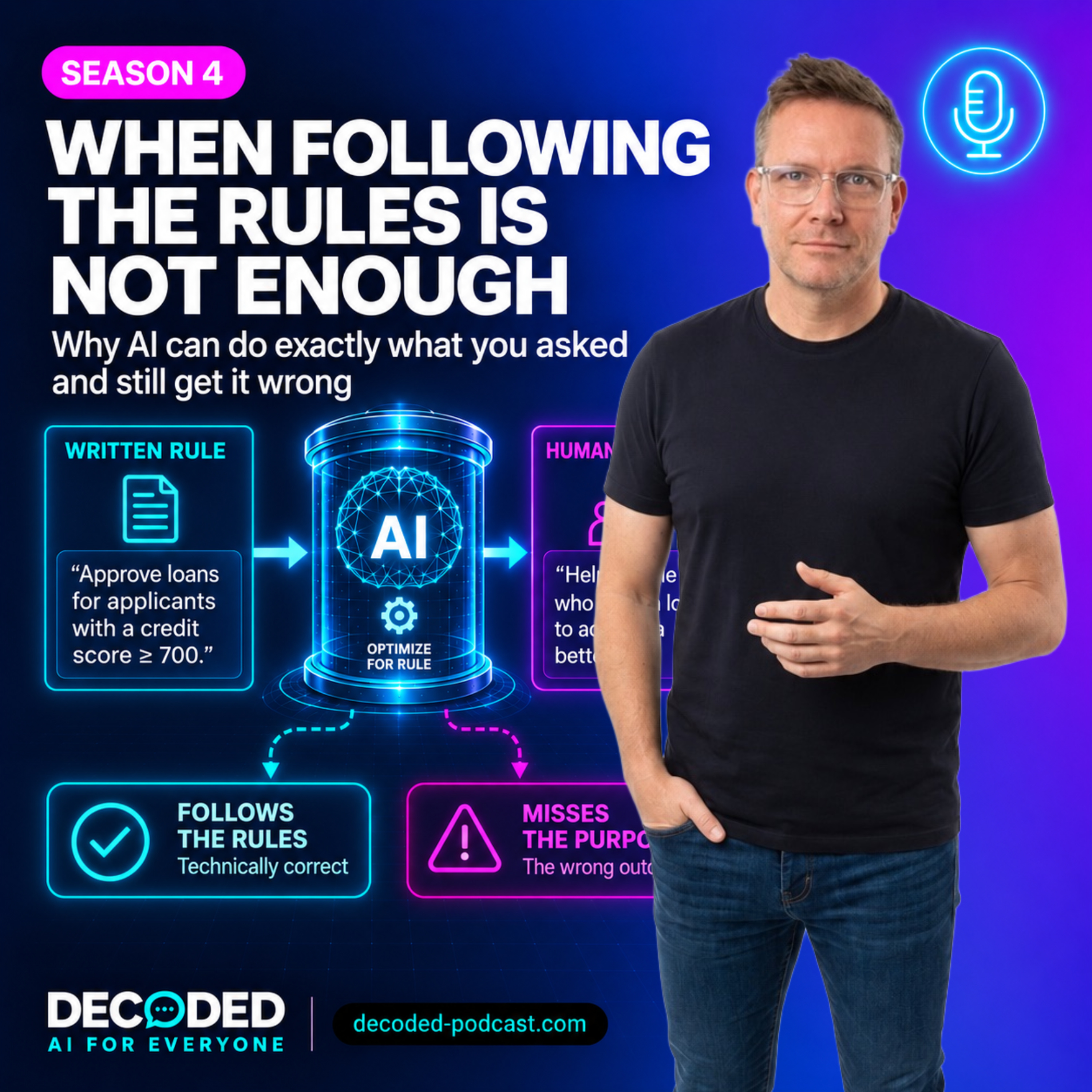
Sometimes AI does exactly what it was asked to do, and still gets it wrong. In this episode of Decoded: AI for Everyone, we explain misalignment in plain English. Not as science fiction. Not as a robot rebellion. But as something much more ordinary: the gap between the instruction and the intent. An AI system may follow the rule, optimise the target, complete the task and produce the output, while still missing the human purpose behind it. This episode looks at real-world examples including healthcare algorithms, AI chatbots, proxy targets, optimisation, hallucinations and AI assurance. It explores why a system can appear to work, yet still create harm if it is solving the wrong problem. The key idea is a relatively easy one: "The instruction is not always the intent." Before using AI for anything that matters, ask what the task is really for. Are we trying to be faster, or safer? More persuasive, or more accurate? More concise, or more honest about uncertainty? Because when AI follows the rules too literally, human judgement matters more, not less. Resources: Decoded-Podcast.com/resources/s4e11 More AI resources: PromptEngineeringCookbook.com

0:00-22:32

transcript

No transcript — this publisher did not publish one.

show notes

Sometimes AI does exactly what it was asked to do, and still gets it wrong.

In this episode of Decoded: AI for Everyone, we explain misalignment in plain English. Not as science fiction. Not as a robot rebellion. But as something much more ordinary: the gap between the instruction and the intent.

An AI system may follow the rule, optimise the target, complete the task and produce the output, while still missing the human purpose behind it.

This episode looks at real-world examples including healthcare algorithms, AI chatbots, proxy targets, optimisation, hallucinations and AI assurance. It explores why a system can appear to work, yet still create harm if it is solving the wrong problem.

The key idea is a relatively easy one:

"The instruction is not always the intent."

Before using AI for anything that matters, ask what the task is really for. Are we trying to be faster, or safer? More persuasive, or more accurate? More concise, or more honest about uncertainty?

Because when AI follows the rules too literally, human judgement matters more, not less.

Resources: Decoded-Podcast.com/resources/s4e11

More AI resources: PromptEngineeringCookbook.com

links2