CyberCode Academy · October 3 · 25 min
Course 45 - IE Data Center Network Design | Episode 1: Layer 2 Data Center Design
0:00-25:35
transcript
show notes
Layer 2 Data Center Design & Endpoint MobilityEpisode OverviewModern data center networks must do more than simply connect servers. They must support workload mobility, continuous availability, scalable architectures, and intelligent integration of network services.In this episode, we explore the architectural principles behind high-performance Layer 2 and data center fabrics, beginning with the limitations of traditional Spanning Tree Protocol and progressing toward Virtual Port Channels, leaf-spine architectures, VXLAN, ECMP, and Layer 4–7 service integration.The goal is to understand how modern data center designs preserve the benefits of Layer 2 connectivity while introducing the scalability, redundancy, and fast convergence associated with Layer 3 architectures.1. Defining the Data Center Network Design GoalsA modern data center architecture should address three fundamental requirements.Endpoint and Workload MobilityVirtual machines and other workloads may need to move between physical hosts or network locations without requiring major changes to their network identity.The underlying network therefore needs to maintain connectivity while workloads move across the infrastructure.High AvailabilityCritical network paths should avoid single points of failure.Ideally, redundant links should not sit idle waiting for a failure. An active-active architecture allows available bandwidth to be used while maintaining redundancy.Services AwarenessApplications frequently depend on network services such as:
- Firewalls.
- Load balancers.
- Proxy servers.
- Other Layer 4–7 services.
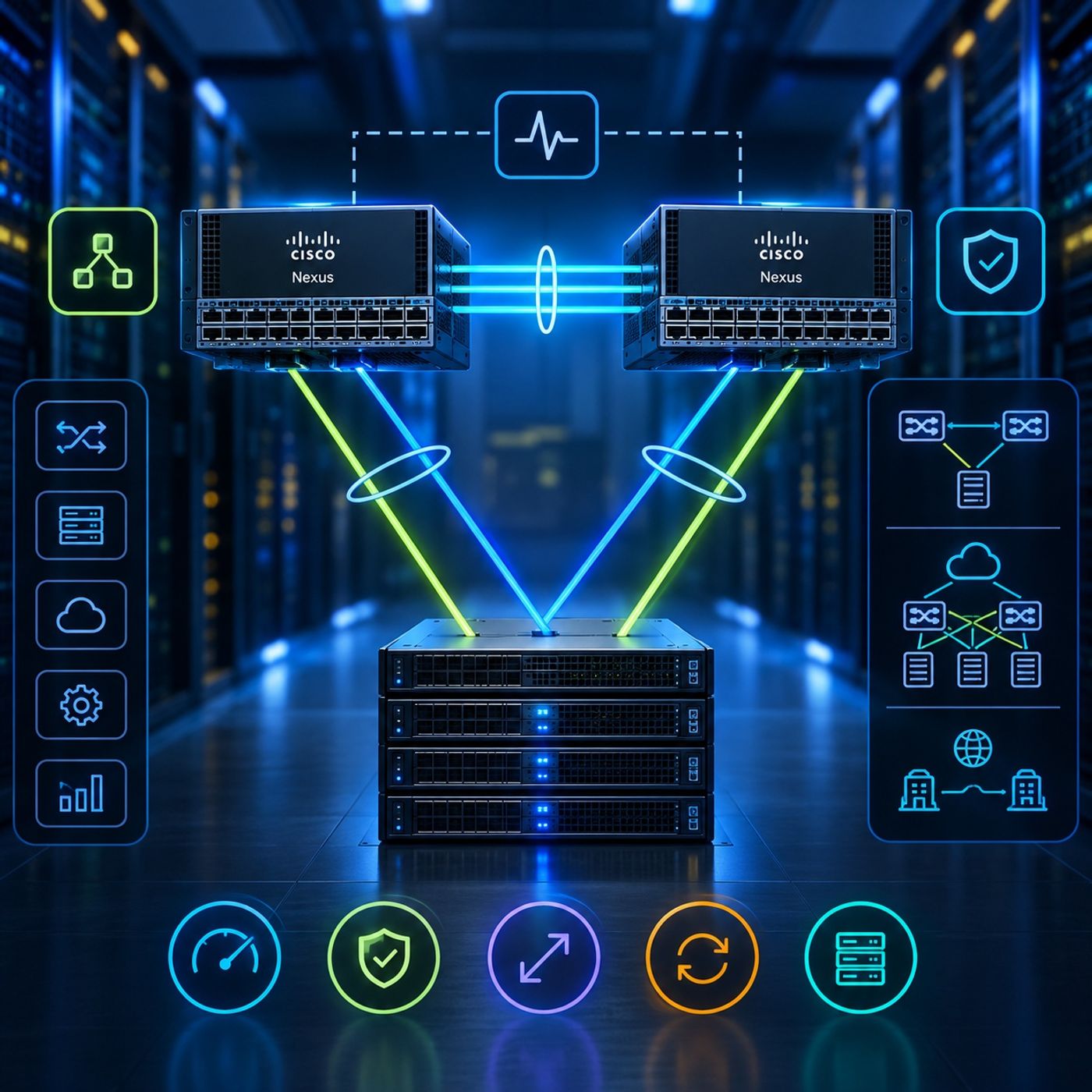
The network architecture must provide a clean mechanism for integrating these services into traffic flows.2. Understanding the Limitations of Spanning TreeTraditional Spanning Tree Protocol (STP) was designed to prevent Layer 2 switching loops by placing redundant paths into a blocked state.While this provides loop prevention, it introduces several challenges in modern data centers.Redundant links may remain unused during normal operation, resulting in inefficient bandwidth utilization.STP convergence can also introduce disruption during topology changes. Changes may trigger Topology Change Notifications (TCNs) and associated MAC-table behavior, potentially causing temporary flooding while the network relearns forwarding information.Another concern is that traditional Layer 2 designs can become increasingly difficult to scale as the number of endpoints and redundant paths grows.These limitations motivate architectures that can use multiple physical paths simultaneously.3. Virtual Port ChannelsVirtual Port Channels (vPC) provide a mechanism for presenting multiple physical switches as a logical port-channel endpoint from the perspective of connected devices.This allows a downstream device to establish links toward two switches while treating them as a single logical connection.The result can be represented conceptually as:Traditional Redundancy:
Active Link + Standby LinkvPC-Based Design:
Active Link + Active LinkBoth paths can therefore participate in forwarding while providing redundancy if one physical connection or switch becomes unavailable.4. Back-to-Back vPC ArchitecturesThe vPC concept can also be extended through back-to-back vPC designs, allowing multiple network devices to participate in highly available Layer 2 connectivity.The objective is to transform physical topologies that would traditionally require STP to block redundant paths into architectures where those paths can actively contribute to forwarding.This approach helps address two competing requirements:Redundancy + Bandwidth UtilizationInstead of maintaining unused physical links solely for failover, the architecture can make better use of available network capacity.5. Moving Toward Leaf-Spine ArchitecturesAs data centers scale, traditional hierarchical designs can become difficult to manage and expand.The leaf-spine architecture addresses this challenge by creating a predictable, horizontally scalable topology.In a typical fabric:
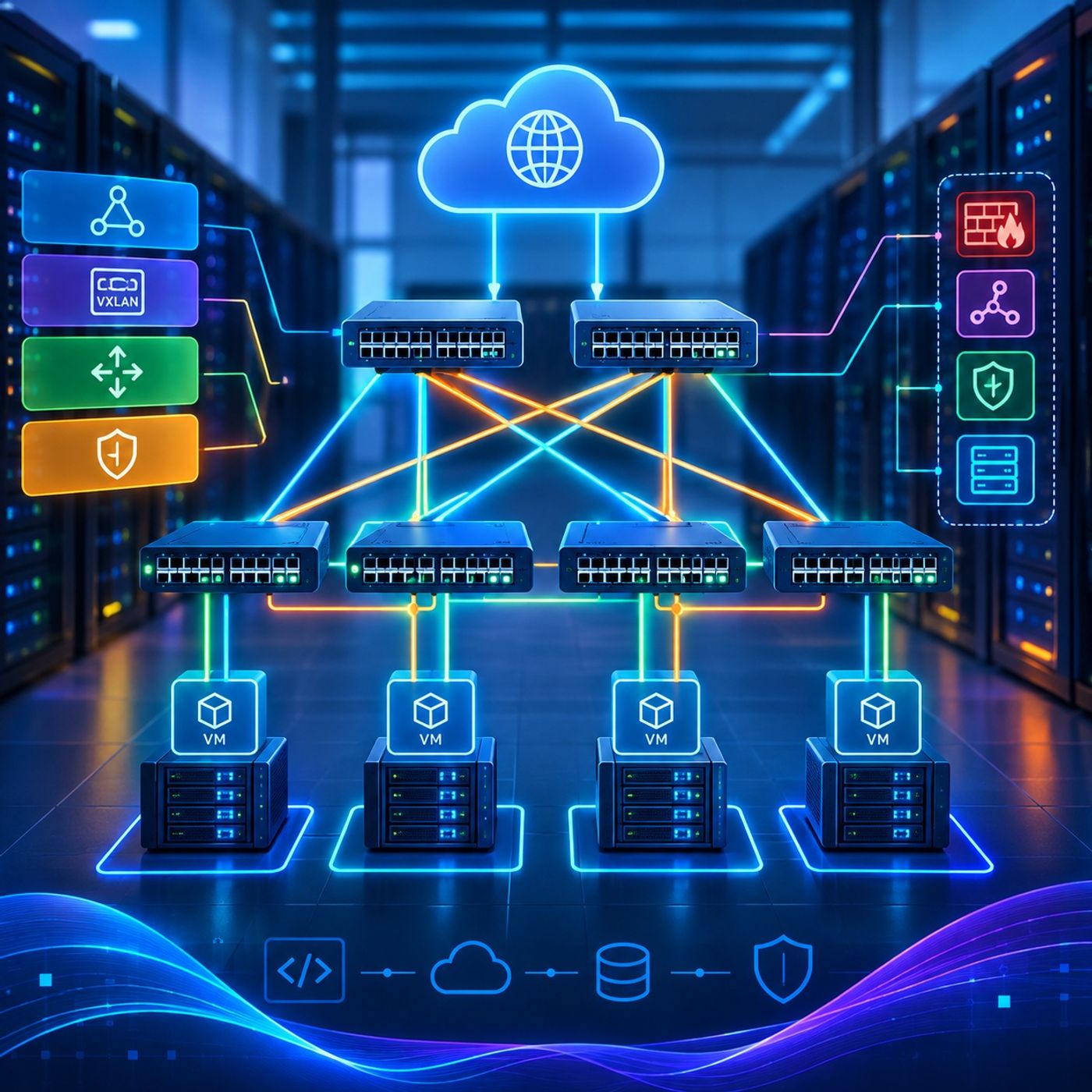
- Leaf switches connect servers and endpoints.
- Spine switches provide the high-speed interconnection between leaf switches.
- Multiple equal-cost paths are available between network endpoints.
This creates a highly predictable forwarding environment in which additional capacity can be introduced by expanding the fabric.6. Equal-Cost MultipathingEqual-Cost Multipathing (ECMP) allows traffic to use multiple paths with equivalent routing costs.Rather than relying on a single preferred path while keeping alternatives idle, ECMP can distribute traffic across available paths.This provides several benefits:
- Better utilization of network links.
- Greater aggregate bandwidth.
- Redundancy across multiple paths.
- Scalable horizontal expansion.
- Faster recovery when a path becomes unavailable.
The architecture therefore shifts redundancy from blocked Layer 2 links toward active Layer 3 paths.7. VXLAN: Extending Layer 2 Across Layer 3One of the central technologies in modern data center fabrics is Virtual Extensible LAN (VXLAN).VXLAN encapsulates an Ethernet frame inside a UDP-based Layer 3 packet, allowing Layer 2 network segments to be extended across a routed IP fabric.Conceptually:Original Ethernet Frame → VXLAN Encapsulation → UDP/IP Transport → VXLAN Decapsulation → Original Ethernet FrameThis enables workloads located on different physical portions of the data center to maintain Layer 2 connectivity while the underlying transport network operates using Layer 3 routing.8. Preserving Workload Mobility with VXLANVXLAN helps address one of the fundamental data center requirements: endpoint mobility.A virtual machine can potentially move between hosts while maintaining its logical network segment, even when those hosts are connected through different portions of the physical infrastructure.At the same time, the underlying fabric can benefit from:
- Layer 3 routing.
- ECMP.
- Fast convergence.
- Multiple active paths.
- Greater scalability than traditional large Layer 2 domains.
This creates an important architectural separation:Logical Network Segmentation ≠ Physical Network TopologyThe logical Layer 2 environment can extend across a Layer 3 transport fabric.9. Fast Convergence and Failure RecoveryHigh availability depends not only on redundant paths, but also on how quickly the network can detect and respond to failures.Modern data center fabrics can combine routing protocols such as:
- OSPF
- BGP
with mechanisms such as Bidirectional Forwarding Detection (BFD).BFD can accelerate failure detection, allowing routing decisions to react much more quickly than relying solely on conventional protocol timers.Additional mechanisms, including appropriate link debounce tuning, can help prevent unnecessary instability caused by transient link conditions.The overall objective is rapid convergence while minimizing disruption to active traffic.10. Integrating Layer 4–7 Network ServicesData center traffic frequently needs to pass through services that operate above Layer 3.Examples include:
- Firewalls.
- Load balancers.
- Proxy servers.
- Application delivery services.
Rather than treating these systems as disconnected components, modern architectures can incorporate them directly into the fabric.This leads to the concept of services leaves.11. Services Leaf ArchitectureDedicated switches can be connected to the spine layer to provide a specialized location for network services.For example, platforms such as Cisco Nexus 9000-series switches can participate in architectures where firewalls and load balancers are connected through dedicated service-oriented portions of the fabric.A simplified model is:Leaf Layer → Spine Layer → Services Leaf → Security or Application ServiceThis provides a structured way to integrate security and application-delivery services without disrupting the scalability of the primary leaf-spine fabric.12. Service Graphs and Traffic SteeringModern data center platforms can also provide mechanisms for intelligently directing traffic through required services.In Cisco ACI, service graphs can define how traffic should traverse devices such as firewalls or load balancers.Instead of manually configuring every individual traffic path, the infrastructure can use policy-driven service insertion and traffic steering.This creates a model where:Application Policy → Traffic Classification → Service Insertion → ForwardingThe result is a more centralized and programmable approach to service integration.13. VXLAN EVPN and Service GatewaysAnother important architecture combines VXLAN with Ethernet Virtual Private Network (EVPN) control-plane technologies.VXLAN provides the data-plane encapsulation, while EVPN can provide control-plane mechanisms for distributing information about endpoints and network reachability.Firewalls and other services can then be integrated into the fabric as gateways or service points, supporting both:East-West TrafficTraffic moving between workloads within the data center.North-South TrafficTraffic moving between the data center and external networks.This allows security inspection and traffic-policy enforcement to become part of the broader fabric architecture.14. Comparing Traditional and Modern Data Center DesignsThe architectural progression can be summarized as follows:Traditional Layer 2Layer 2 Switching → STP → Blocked Redundant Paths → Slower ConvergencevPC-Based DesignDual Switches → Logical Port Channels → Active-Active ConnectivityLeaf-Spine FabricLeaf-Spine → Layer 3 Rout
You can listen and download our episodes for free on more than 10 different platforms:
https://linktr.ee/cybercode_academy
- Firewalls.
- Load balancers.
- Proxy servers.
- Other Layer 4–7 services.
The network architecture must provide a clean mechanism for integrating these services into traffic flows.2. Understanding the Limitations of Spanning TreeTraditional Spanning Tree Protocol (STP) was designed to prevent Layer 2 switching loops by placing redundant paths into a blocked state.While this provides loop prevention, it introduces several challenges in modern data centers.Redundant links may remain unused during normal operation, resulting in inefficient bandwidth utilization.STP convergence can also introduce disruption during topology changes. Changes may trigger Topology Change Notifications (TCNs) and associated MAC-table behavior, potentially causing temporary flooding while the network relearns forwarding information.Another concern is that traditional Layer 2 designs can become increasingly difficult to scale as the number of endpoints and redundant paths grows.These limitations motivate architectures that can use multiple physical paths simultaneously.3. Virtual Port ChannelsVirtual Port Channels (vPC) provide a mechanism for presenting multiple physical switches as a logical port-channel endpoint from the perspective of connected devices.This allows a downstream device to establish links toward two switches while treating them as a single logical connection.The result can be represented conceptually as:Traditional Redundancy:
Active Link + Standby LinkvPC-Based Design:
Active Link + Active LinkBoth paths can therefore participate in forwarding while providing redundancy if one physical connection or switch becomes unavailable.4. Back-to-Back vPC ArchitecturesThe vPC concept can also be extended through back-to-back vPC designs, allowing multiple network devices to participate in highly available Layer 2 connectivity.The objective is to transform physical topologies that would traditionally require STP to block redundant paths into architectures where those paths can actively contribute to forwarding.This approach helps address two competing requirements:Redundancy + Bandwidth UtilizationInstead of maintaining unused physical links solely for failover, the architecture can make better use of available network capacity.5. Moving Toward Leaf-Spine ArchitecturesAs data centers scale, traditional hierarchical designs can become difficult to manage and expand.The leaf-spine architecture addresses this challenge by creating a predictable, horizontally scalable topology.In a typical fabric:
- Leaf switches connect servers and endpoints.
- Spine switches provide the high-speed interconnection between leaf switches.
- Multiple equal-cost paths are available between network endpoints.
This creates a highly predictable forwarding environment in which additional capacity can be introduced by expanding the fabric.6. Equal-Cost MultipathingEqual-Cost Multipathing (ECMP) allows traffic to use multiple paths with equivalent routing costs.Rather than relying on a single preferred path while keeping alternatives idle, ECMP can distribute traffic across available paths.This provides several benefits:
- Better utilization of network links.
- Greater aggregate bandwidth.
- Redundancy across multiple paths.
- Scalable horizontal expansion.
- Faster recovery when a path becomes unavailable.
The architecture therefore shifts redundancy from blocked Layer 2 links toward active Layer 3 paths.7. VXLAN: Extending Layer 2 Across Layer 3One of the central technologies in modern data center fabrics is Virtual Extensible LAN (VXLAN).VXLAN encapsulates an Ethernet frame inside a UDP-based Layer 3 packet, allowing Layer 2 network segments to be extended across a routed IP fabric.Conceptually:Original Ethernet Frame → VXLAN Encapsulation → UDP/IP Transport → VXLAN Decapsulation → Original Ethernet FrameThis enables workloads located on different physical portions of the data center to maintain Layer 2 connectivity while the underlying transport network operates using Layer 3 routing.8. Preserving Workload Mobility with VXLANVXLAN helps address one of the fundamental data center requirements: endpoint mobility.A virtual machine can potentially move between hosts while maintaining its logical network segment, even when those hosts are connected through different portions of the physical infrastructure.At the same time, the underlying fabric can benefit from:
- Layer 3 routing.
- ECMP.
- Fast convergence.
- Multiple active paths.
- Greater scalability than traditional large Layer 2 domains.
This creates an important architectural separation:Logical Network Segmentation ≠ Physical Network TopologyThe logical Layer 2 environment can extend across a Layer 3 transport fabric.9. Fast Convergence and Failure RecoveryHigh availability depends not only on redundant paths, but also on how quickly the network can detect and respond to failures.Modern data center fabrics can combine routing protocols such as:
- OSPF
- BGP
with mechanisms such as Bidirectional Forwarding Detection (BFD).BFD can accelerate failure detection, allowing routing decisions to react much more quickly than relying solely on conventional protocol timers.Additional mechanisms, including appropriate link debounce tuning, can help prevent unnecessary instability caused by transient link conditions.The overall objective is rapid convergence while minimizing disruption to active traffic.10. Integrating Layer 4–7 Network ServicesData center traffic frequently needs to pass through services that operate above Layer 3.Examples include:
- Firewalls.
- Load balancers.
- Proxy servers.
- Application delivery services.
Rather than treating these systems as disconnected components, modern architectures can incorporate them directly into the fabric.This leads to the concept of services leaves.11. Services Leaf ArchitectureDedicated switches can be connected to the spine layer to provide a specialized location for network services.For example, platforms such as Cisco Nexus 9000-series switches can participate in architectures where firewalls and load balancers are connected through dedicated service-oriented portions of the fabric.A simplified model is:Leaf Layer → Spine Layer → Services Leaf → Security or Application ServiceThis provides a structured way to integrate security and application-delivery services without disrupting the scalability of the primary leaf-spine fabric.12. Service Graphs and Traffic SteeringModern data center platforms can also provide mechanisms for intelligently directing traffic through required services.In Cisco ACI, service graphs can define how traffic should traverse devices such as firewalls or load balancers.Instead of manually configuring every individual traffic path, the infrastructure can use policy-driven service insertion and traffic steering.This creates a model where:Application Policy → Traffic Classification → Service Insertion → ForwardingThe result is a more centralized and programmable approach to service integration.13. VXLAN EVPN and Service GatewaysAnother important architecture combines VXLAN with Ethernet Virtual Private Network (EVPN) control-plane technologies.VXLAN provides the data-plane encapsulation, while EVPN can provide control-plane mechanisms for distributing information about endpoints and network reachability.Firewalls and other services can then be integrated into the fabric as gateways or service points, supporting both:East-West TrafficTraffic moving between workloads within the data center.North-South TrafficTraffic moving between the data center and external networks.This allows security inspection and traffic-policy enforcement to become part of the broader fabric architecture.14. Comparing Traditional and Modern Data Center DesignsThe architectural progression can be summarized as follows:Traditional Layer 2Layer 2 Switching → STP → Blocked Redundant Paths → Slower ConvergencevPC-Based DesignDual Switches → Logical Port Channels → Active-Active ConnectivityLeaf-Spine FabricLeaf-Spine → Layer 3 Rout
You can listen and download our episodes for free on more than 10 different platforms:
https://linktr.ee/cybercode_academy
links1