CyberCode Academy · Thursday · 12 min
Course 44 - RH Security Specialist | Episode 4: Performance, Security & Mount Options
0:00-12:02
transcript
show notes
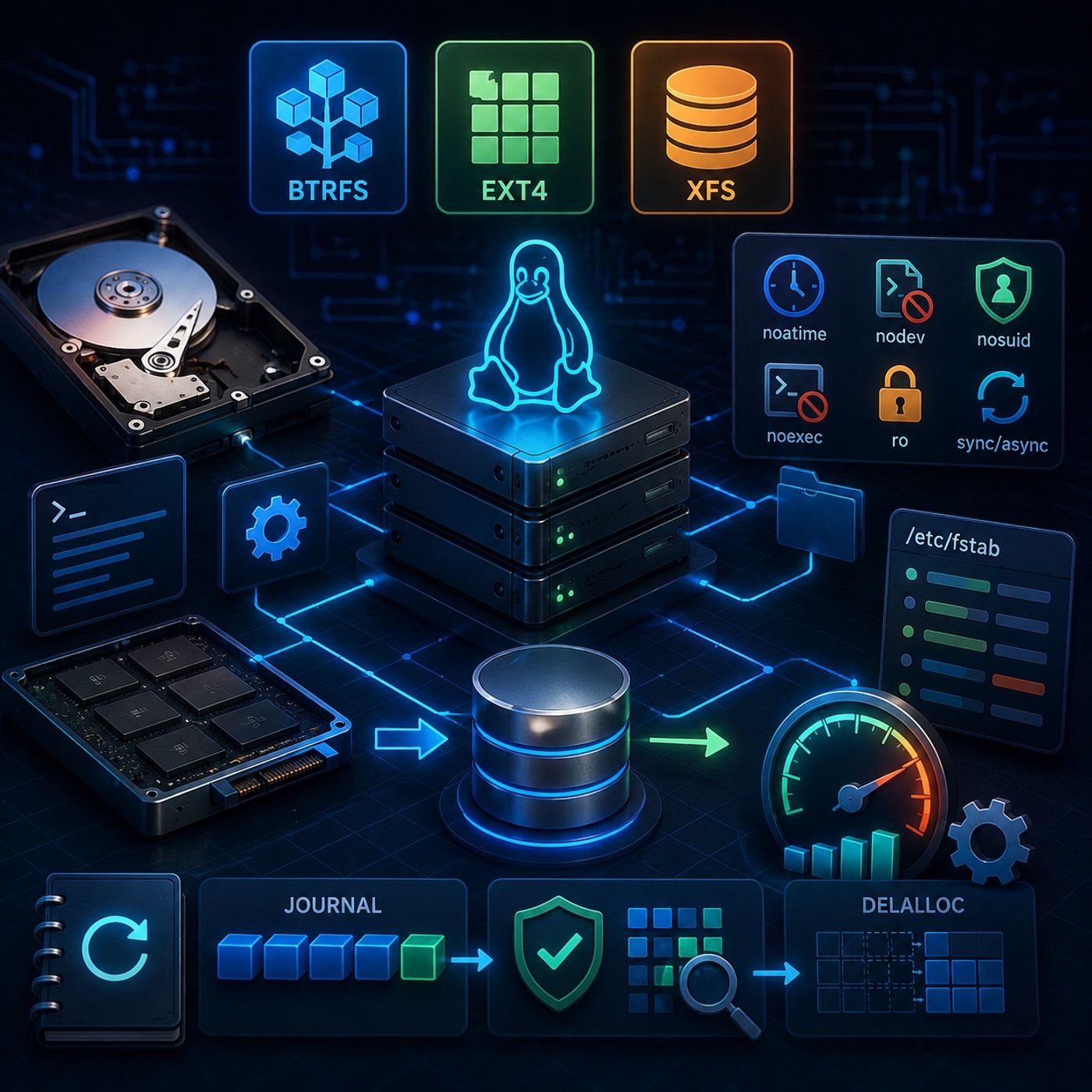
Linux storage management goes far beyond formatting a disk and mounting it. Understanding how modern Linux file systems work—and how their configuration affects security, reliability, and performance—is an essential skill for system administrators and security professionals.In this episode, we move from the architectural foundations of Linux file systems into practical storage administration and advanced performance tuning. We compare Btrfs, ext4, and XFS, examine how storage devices are provisioned and mounted, and explore how carefully selected mount options can improve both system security and operational efficiency.The episode concludes with a deeper look at ext4 journaling and performance optimization, demonstrating how filesystem-level configuration can influence reliability, recovery behavior, and write performance.1. Understanding the Major Linux File SystemsWe begin by comparing three important file systems commonly encountered in Linux environments:BtrfsBtrfs is a modern Copy-on-Write filesystem built around B-tree structures. We examine its architectural approach and how Copy-on-Write can provide advanced storage-management capabilities.ext4ext4 is one of the most widely used Linux file systems, known for its stability, maturity, and broad compatibility.We explore its design characteristics, storage capabilities, and why it remains a dependable choice across many Linux environments.XFSWe also examine XFS, which has historically been an important filesystem choice in enterprise Linux environments, particularly where scalability and high-performance storage are priorities.Comparing these filesystems provides a foundation for understanding why administrators may choose one over another depending on workload, compatibility requirements, scalability, and performance objectives.2. Provisioning and Formatting StorageThe theoretical comparison is followed by hands-on storage administration.We examine the process of preparing a virtual disk and turning raw storage into a usable Linux filesystem.The workflow covers:
You can listen and download our episodes for free on more than 10 different platforms:
https://linktr.ee/cybercode_academy
- Identifying available storage devices.
- Preparing a virtual disk for filesystem use.
- Formatting storage using appropriate mkfs utilities.
- Creating filesystems such as ext4 and XFS.
- Mounting filesystems for immediate use.
- Understanding the relationship between block devices, filesystems, and mount points.
- Device identification.
- Mount points.
- Filesystem types.
- Mount options.
- Persistent filesystem configuration.
- The importance of validating mount configurations before rebooting.
- Mounting storage as read-only.
- Understanding which operations remain available.
- Observing how write attempts behave.
- Using read-only configurations as part of controlled recovery or investigation workflows.
- Why filesystem corruption can occur during unexpected shutdowns.
- How journaling reduces recovery complexity.
- The relationship between filesystem metadata and journal records.
- How journal integrity affects recovery operations.
- Reliability
- Security
- Performance
- Recoverability
- Compatibility
- Operational simplicity
- The architectural differences between Btrfs, ext4, and XFS.
- The practical characteristics that influence filesystem selection.
- How to prepare and format Linux storage devices.
- How mkfs utilities are used to create filesystems.
- How to configure persistent mounts through /etc/fstab.
- How mount options influence filesystem behavior.
- The security purposes of nodev, nosuid, and noexec.
- The performance and behavioral implications of async, sync, atime, and noatime.
- How read-only ro mounts can support controlled recovery and investigation.
- How ext4 journaling helps protect filesystem consistency.
- The role of journal checksumming in detecting corrupted journal information.
- How write barriers relate to data integrity and storage performance.
- How delayed allocation can influence ext4 write efficiency.
- Why filesystem performance tuning must be evaluated against reliability and hardware guarantees.
You can listen and download our episodes for free on more than 10 different platforms:
https://linktr.ee/cybercode_academy
links1