Skip to content
Artwork for CyberCode Academy
CyberCode Academy · August 19 · 23 min

Course 40 - Web Scraping with Python | Episode 39: Overcoming Challenges and Optimizing Performance

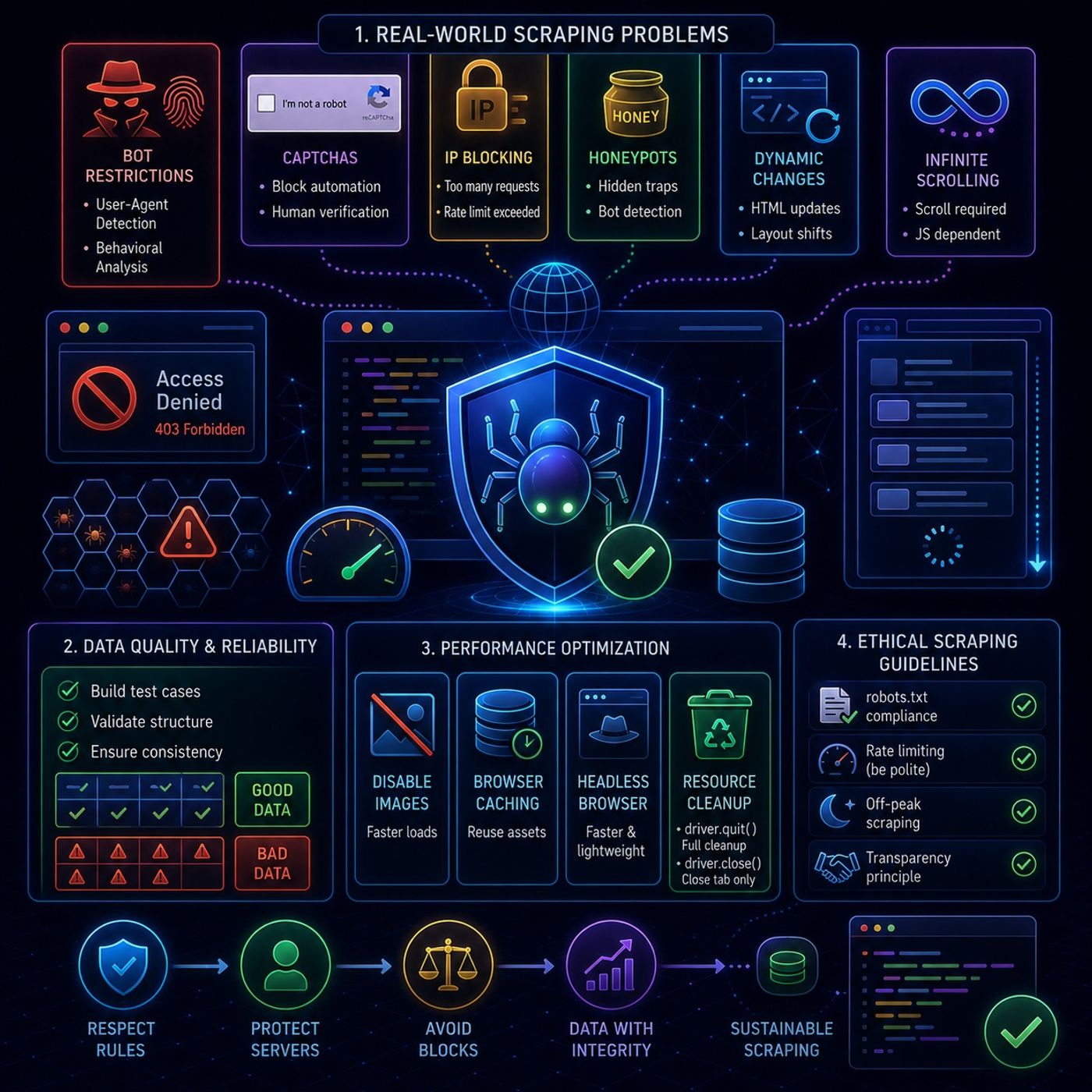
This module is essentially the “real world survival guide” for web scraping — it moves away from pure tooling and focuses on what actually breaks scrapers in production and how to behave responsibly while scraping at scale.🚧 1. Real-World Scraping ProblemsModern websites actively defend themselves against automation, so scraping is rarely “just code and go”.🚫 Bot RestrictionsWebsites may block automated traffic using: User-agent detection (recognizing Selenium / bots) Behavioral analysis (click speed, navigation patterns) 🧩 CAPTCHAsA major anti-bot mechanism: Designed to distinguish humans from automation Often blocks login pages, search pages, or high-value data 🌐 IP BlockingIf you: send too many requests scrape too fast ignore rate limits Then servers may: temporarily block your IP permanently blacklist it 🕳️ HoneypotsHidden traps inside websites: invisible links fake endpoints non-visible HTML elements 👉 If your bot clicks them, it gets flagged instantly.🔄 Dynamic Structure ChangesWebsites constantly evolve: HTML layouts change class names get renamed elements move or get removed This causes:Scrapers to break without warning♾️ Infinite ScrollingInstead of pages, content loads as you scroll: requires scroll automation requires dynamic request handling often tied to JavaScript APIs 🧪 2. Data Quality & ReliabilityScraping is not just about collecting data — it’s about ensuring it’s usable later.Recommended practice: build test cases for scraped output validate structure before saving ensure consistency across runs Why? Because bad scraped data can: corrupt datasets break ML pipelines produce misleading analytics ⚡ 3. Performance Optimization TechniquesThe module introduces practical speed improvements:🖼️ Disable Images prevents browser from loading heavy assets drastically reduces page load time 💾 Browser Caching reuse previously loaded assets avoids redundant downloads 🧠 Headless BrowsersRun Chrome without UI: faster execution lower memory usage ideal for automation servers 🧹 Proper Resource CleanupImportant rule: driver.quit() → closes everything (safe cleanup) driver.close() → closes only current tab 👉 Not quitting properly can leak memory and processes.⚖️ 4. Ethical Scraping GuidelinesThis is the most important conceptual layer.📄 robots.txt compliance defines what bots are allowed to access ignoring it can violate site rules or laws 🧠 Rate limiting (be a “polite bot”) avoid rapid-fire requests prevent server overload 🕒 Off-peak scraping run jobs during low traffic hours reduces impact on real users 🎭 Transparency principleA “good bot” should: not disguise malicious intent not impersonate real users behave predictably and responsibly 🧠 Core Philosophy of the ModuleScraping is not just a technical task — it’s a system interaction problem with ethical constraintsSo you need three layers: Technical robustness (avoid breaks) Performance efficiency (don’t waste resources) Ethical compliance (don’t abuse systems) 🔥 Final TakeawayModern scraping isn’t about “how to extract data” anymore.It’s about:how to extract data without breaking systems, getting blocked, or violating rules You can listen and download our episodes for free on more than 10 different platforms: https://linktr.ee/cybercode_academy

0:00-23:44

transcript

No transcript — this publisher did not publish one.

show notes

This module is essentially the “real world survival guide” for web scraping — it moves away from pure tooling and focuses on what actually breaks scrapers in production and how to behave responsibly while scraping at scale.🚧 1. Real-World Scraping ProblemsModern websites actively defend themselves against automation, so scraping is rarely “just code and go”.🚫 Bot RestrictionsWebsites may block automated traffic using:
  • User-agent detection (recognizing Selenium / bots)
  • Behavioral analysis (click speed, navigation patterns)
🧩 CAPTCHAsA major anti-bot mechanism:
  • Designed to distinguish humans from automation
  • Often blocks login pages, search pages, or high-value data
🌐 IP BlockingIf you:
  • send too many requests
  • scrape too fast
  • ignore rate limits
Then servers may:
  • temporarily block your IP
  • permanently blacklist it
🕳️ HoneypotsHidden traps inside websites:
  • invisible links
  • fake endpoints
  • non-visible HTML elements
👉 If your bot clicks them, it gets flagged instantly.🔄 Dynamic Structure ChangesWebsites constantly evolve:
  • HTML layouts change
  • class names get renamed
  • elements move or get removed
This causes:Scrapers to break without warning♾️ Infinite ScrollingInstead of pages, content loads as you scroll:
  • requires scroll automation
  • requires dynamic request handling
  • often tied to JavaScript APIs
🧪 2. Data Quality & ReliabilityScraping is not just about collecting data — it’s about ensuring it’s usable later.Recommended practice:
  • build test cases for scraped output
  • validate structure before saving
  • ensure consistency across runs
Why?
Because bad scraped data can:
  • corrupt datasets
  • break ML pipelines
  • produce misleading analytics
⚡ 3. Performance Optimization TechniquesThe module introduces practical speed improvements:🖼️ Disable Images
  • prevents browser from loading heavy assets
  • drastically reduces page load time
💾 Browser Caching
  • reuse previously loaded assets
  • avoids redundant downloads
🧠 Headless BrowsersRun Chrome without UI:
  • faster execution
  • lower memory usage
  • ideal for automation servers
🧹 Proper Resource CleanupImportant rule:
  • driver.quit() → closes everything (safe cleanup)
  • driver.close() → closes only current tab
👉 Not quitting properly can leak memory and processes.⚖️ 4. Ethical Scraping GuidelinesThis is the most important conceptual layer.📄 robots.txt compliance
  • defines what bots are allowed to access
  • ignoring it can violate site rules or laws
🧠 Rate limiting (be a “polite bot”)
  • avoid rapid-fire requests
  • prevent server overload
🕒 Off-peak scraping
  • run jobs during low traffic hours
  • reduces impact on real users
🎭 Transparency principleA “good bot” should:
  • not disguise malicious intent
  • not impersonate real users
  • behave predictably and responsibly
🧠 Core Philosophy of the ModuleScraping is not just a technical task — it’s a system interaction problem with ethical constraintsSo you need three layers:
  • Technical robustness (avoid breaks)
  • Performance efficiency (don’t waste resources)
  • Ethical compliance (don’t abuse systems)
🔥 Final TakeawayModern scraping isn’t about “how to extract data” anymore.It’s about:how to extract data without breaking systems, getting blocked, or violating rules

You can listen and download our episodes for free on more than 10 different platforms:
https://linktr.ee/cybercode_academy
links1