Skip to content
Artwork for CyberCode Academy
CyberCode Academy · August 11 · 23 min

Course 40 - Web Scraping with Python | Episode 31: From Item Loaders to Pipelines

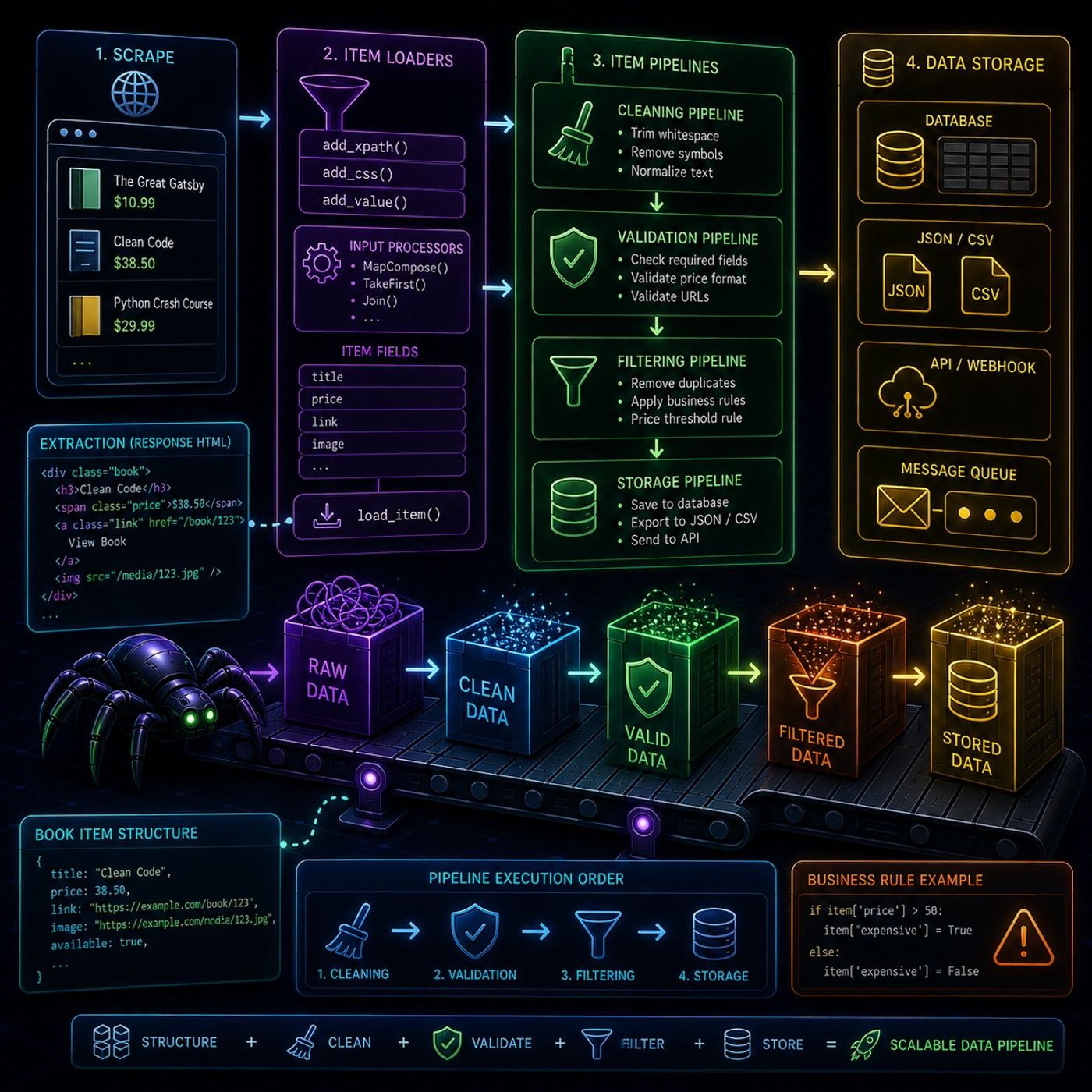
This episode is essentially about turning Scrapy from “just a scraper” into a full data processing system, where extraction, cleaning, validation, and storage are all structured and automated.🕷️ Scrapy Data Population & Processing Pipeline1. 📦 Item Loaders (Structured Data Population)Item Loaders are the layer between raw scraped HTML and structured Scrapy Items.Instead of manually assigning fields, you feed data through controlled methods:🔹 Core methods add_xpath() add_css() add_value() These methods: collect raw extracted values pass them through processors automatically build a clean final item via load_item() 💡 Why this mattersInstead of: messy manual parsing scattered cleaning logic You get:A single controlled pipeline for building structured objects🔄 Item Loader FlowResponse HTML ↓ add_xpath / add_css / add_value ↓ Input Processors (cleaning + normalization) ↓ Item Fields (structured data) ↓ load_item() ⚙️ 2. Item Pipelines (Post-Extraction Processing Layer)Item Pipelines operate after scraping, acting like a processing conveyor belt.Each pipeline class can: modify data validate data reject invalid items store data 🔹 Common Pipeline Responsibilities🧹 Data Cleaning remove unwanted characters normalize formats fix inconsistent values ✅ Validation check price formats validate emails or URLs ensure required fields exist 🚫 Filtering drop invalid or unwanted items block duplicates filter based on business rules 💾 Storage save to database export to JSON / CSV push into APIs 📚 3. Practical Example: Book Scraping SystemThe episode demonstrates a real workflow using a book website.🔹 Data Transformation ExampleMapCompose usageUsed to transform raw fields like: image URLs → full valid URLs book links → normalized links text cleanup (whitespace, symbols) 🔹 Custom Pipeline LogicExample rule:“Flag or drop books where price > threshold”So the pipeline can: mark expensive books exclude them entirely or route them differently 🔹 Pipeline OrderingScrapy allows multiple pipelines:You define execution order in settings:Item Pipeline Order: 1. Cleaning Pipeline 2. Validation Pipeline 3. Filtering Pipeline 4. Storage Pipeline This ensures:Data always flows in a predictable transformation sequence🧠 Key Concept of the EpisodeThe main idea is:Scrapy is not a scraper — it is a data engineering pipeline frameworkYou are not just collecting data, you are: structuring it (Item Loaders) refining it (Processors) validating it (Pipelines) and storing it (Final output layer) 🧩 Mental ModelLayerPurposeItem LoadersBuild structured itemsProcessorsClean + normalize fieldsPipelinesValidate + transform + storeSettingsControl execution order🚀 Big Picture InsightThis episode shows the shift from:❌ “scrape → print data”to:✅ “scrape → structure → clean → validate → store → scale” You can listen and download our episodes for free on more than 10 different platforms: https://linktr.ee/cybercode_academy

0:00-23:40

transcript

No transcript — this publisher did not publish one.

show notes

This episode is essentially about turning Scrapy from “just a scraper” into a full data processing system, where extraction, cleaning, validation, and storage are all structured and automated.🕷️ Scrapy Data Population & Processing Pipeline1. 📦 Item Loaders (Structured Data Population)Item Loaders are the layer between raw scraped HTML and structured Scrapy Items.Instead of manually assigning fields, you feed data through controlled methods:🔹 Core methods
  • add_xpath()
  • add_css()
  • add_value()
These methods:
  • collect raw extracted values
  • pass them through processors automatically
  • build a clean final item via load_item()
💡 Why this mattersInstead of:
  • messy manual parsing
  • scattered cleaning logic
You get:A single controlled pipeline for building structured objects🔄 Item Loader FlowResponse HTML ↓ add_xpath / add_css / add_value ↓ Input Processors (cleaning + normalization) ↓ Item Fields (structured data) ↓ load_item() ⚙️ 2. Item Pipelines (Post-Extraction Processing Layer)Item Pipelines operate after scraping, acting like a processing conveyor belt.Each pipeline class can:
  • modify data
  • validate data
  • reject invalid items
  • store data
🔹 Common Pipeline Responsibilities🧹 Data Cleaning
  • remove unwanted characters
  • normalize formats
  • fix inconsistent values
✅ Validation
  • check price formats
  • validate emails or URLs
  • ensure required fields exist
🚫 Filtering
  • drop invalid or unwanted items
  • block duplicates
  • filter based on business rules
💾 Storage
  • save to database
  • export to JSON / CSV
  • push into APIs
📚 3. Practical Example: Book Scraping SystemThe episode demonstrates a real workflow using a book website.🔹 Data Transformation ExampleMapCompose usageUsed to transform raw fields like:
  • image URLs → full valid URLs
  • book links → normalized links
  • text cleanup (whitespace, symbols)
🔹 Custom Pipeline LogicExample rule:“Flag or drop books where price > threshold”So the pipeline can:
  • mark expensive books
  • exclude them entirely
  • or route them differently
🔹 Pipeline OrderingScrapy allows multiple pipelines:You define execution order in settings:Item Pipeline Order: 1. Cleaning Pipeline 2. Validation Pipeline 3. Filtering Pipeline 4. Storage Pipeline This ensures:Data always flows in a predictable transformation sequence🧠 Key Concept of the EpisodeThe main idea is:Scrapy is not a scraper — it is a data engineering pipeline frameworkYou are not just collecting data, you are:
  • structuring it (Item Loaders)
  • refining it (Processors)
  • validating it (Pipelines)
  • and storing it (Final output layer)
🧩 Mental ModelLayerPurposeItem LoadersBuild structured itemsProcessorsClean + normalize fieldsPipelinesValidate + transform + storeSettingsControl execution order🚀 Big Picture InsightThis episode shows the shift from:❌ “scrape → print data”to:✅ “scrape → structure → clean → validate → store → scale”

You can listen and download our episodes for free on more than 10 different platforms:
https://linktr.ee/cybercode_academy
links1