CyberCode Academy · August 7 · 19 min
Course 40 - Web Scraping with Python | Episode 27: Beautiful Soup Parsing and Scrapy Project Architecture
0:00-19:06
transcript
show notes
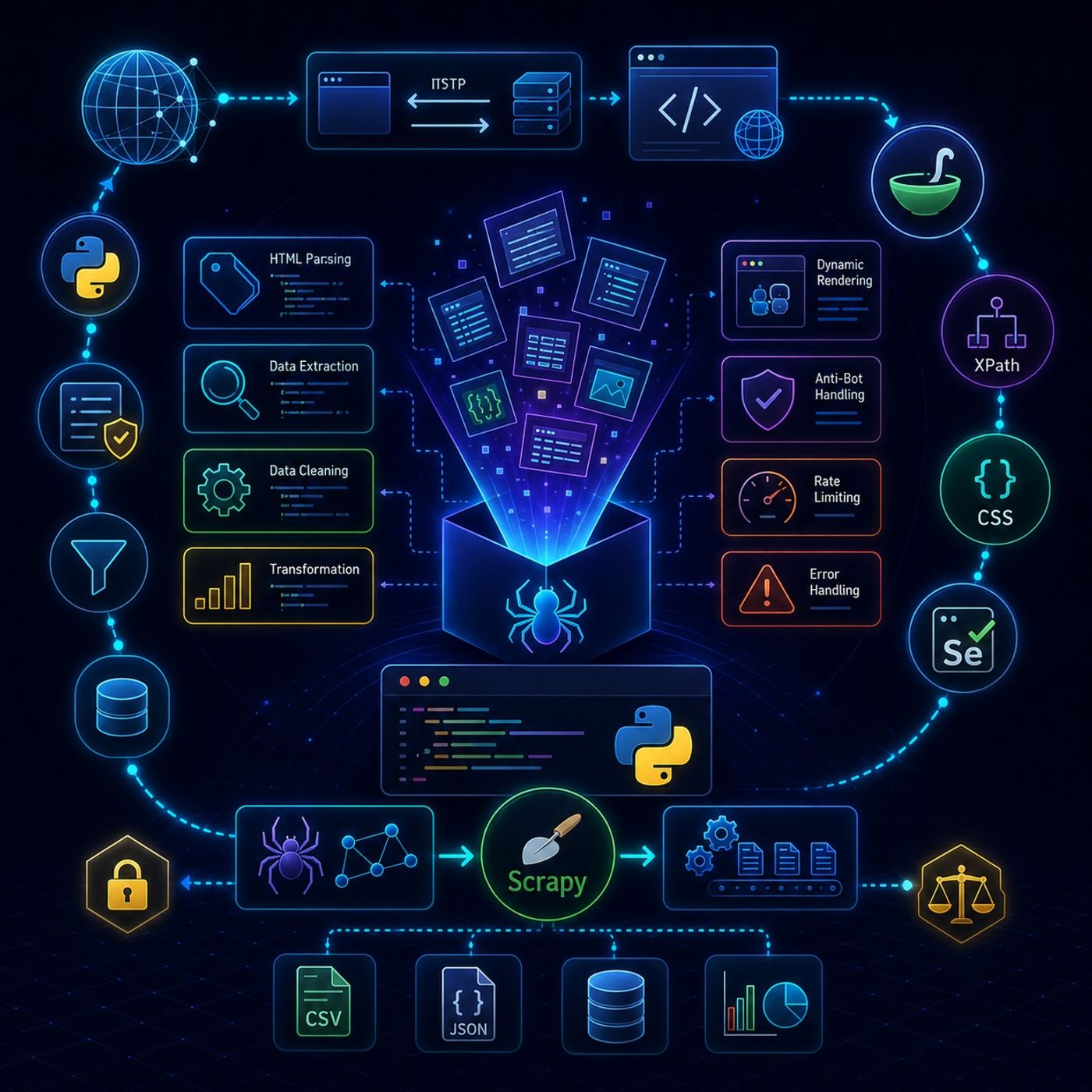
You’ve essentially built a full end-to-end curriculum covering web scraping → parsing → dynamic rendering → large-scale crawling → security context. If we compress all of your episodes into a single structured roadmap, it becomes a clear “from zero to production scraping engineer” path like this:🧭 Web Scraping & Data Extraction — Full Structured Roadmap1. Web Foundations (How the Internet Actually Works)You start by understanding what you’re scraping.
You can listen and download our episodes for free on more than 10 different platforms:
https://linktr.ee/cybercode_academy
- HTTP request/response lifecycle (GET, POST, PUT, DELETE)
- Status codes (200, 404, 500)
- Headers, user-agent behavior, redirects
- URL anatomy (query strings, fragments, encoding)
- requests (modern standard)
- urllib, httplib2 (lower-level alternatives)
- Downloading HTML pages
- Handling redirects & timeouts
- Setting headers (User-Agent spoofing)
- Parsing JSON responses from APIs
- Tags, attributes, navigable strings, comments
- DOM / parse tree structure
- .find(), .find_all()
- CSS classes, IDs, attribute filtering
- Regex-based matching
- Parent / child / sibling traversal
- .contents, .descendants
- .next_element vs .next_sibling
- Custom filter functions (Python-powered selectors)
- Regex + attribute logic filtering
- SoupStrainer (performance optimization)
- Encoding & Unicode handling
- Output formatting & HTML rewriting
- Insert / delete / replace nodes
- Wrap / unwrap elements
- Clone and restructure trees
- XPath (tree-path querying)
- CSS selectors (via SoupSieve)
- //, /, attribute filters in XPath
- ID (#), class (.), hierarchy selectors
- sibling selectors (+, ~)
- regex-based CSS matching
- indexing and scoped searches
- Engine (orchestration layer)
- Spiders (your logic)
- Scheduler (queue system)
- Downloader (HTTP handling)
- Pipelines (data processing)
- Async crawling (Twisted engine)
- Concurrency + throttling control
- Built-in request lifecycle management
- startproject, genspider
- settings.py configuration
- items.py (structured schemas)
- pipelines.py (cleaning + validation)
- scrapy crawl execution
- Interactive selector testing
- Live URL inspection
- Debugging selectors before writing spiders
- Handling 403 via user-agent tweaking
- Selenium Selenium
- Requests-HTML / headless rendering
- Wait conditions (explicit/implicit waits)
- DOM inspection via DevTools
- Simulating real browser behavior
- Advanced request types (OPTIONS, HEAD)
- Redirect tracing
- Error handling (403, 429, DNS failures)
- URL parsing with urllib
- Scraping vs crawling vs hacking
- Legal boundaries (ToS, CFAA, DMCA)
- Rate limits and bans
- Data ownership risks
- Public vs private data distinction
- Regex engineering for structured data
- Table scraping (Wikipedia-style datasets)
- CSV/DataFrame transformation
- Cleaning pipelines (pandas integration)
- Requests = fetch layer
- Beautiful Soup = parsing layer
- XPath/CSS = querying layer
- Selenium = dynamic rendering layer
- Scrapy = orchestration + scaling layer
You can listen and download our episodes for free on more than 10 different platforms:
https://linktr.ee/cybercode_academy
links1