Skip to content
Artwork for CyberCode Academy
CyberCode Academy Β· August 6 Β· 22 min

Course 40 - Web Scraping with Python | Episode 26: Framework Overview and Core Architecture

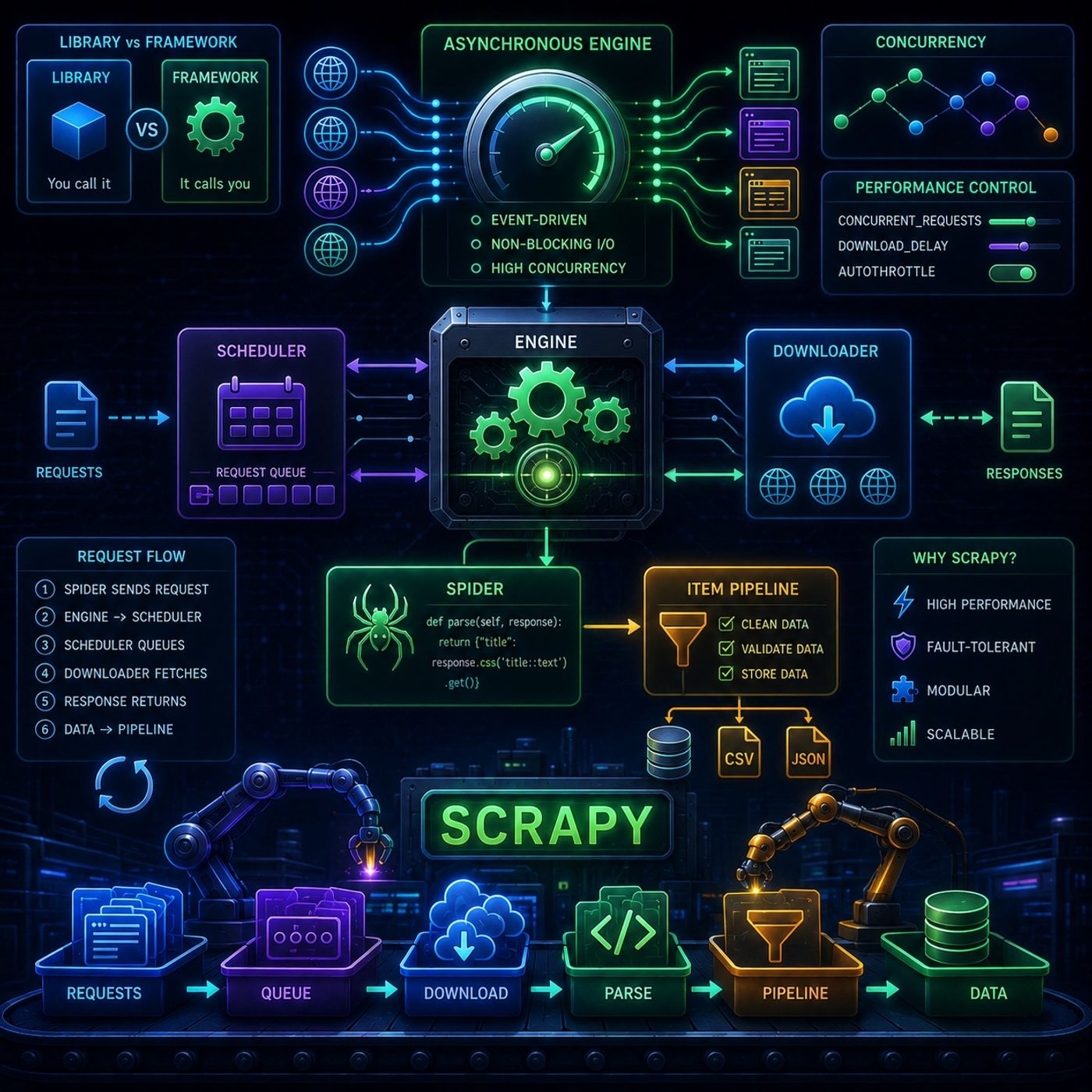
In this lesson, you’ll learn about: what makes Scrapy a framework (not just a library), how its asynchronous engine works, and how its core components cooperate to deliver fast, scalable web scraping1. Library vs Framework (Core Concept)πŸ”Ή Who Controls the Flow?πŸ”Ή Key Difference Library β†’ you call it when needed Framework β†’ it calls your code πŸ‘‰ Key Insight Scrapy is a framework because it controls execution (Inversion of Control)2. Asynchronous Power (Why Scrapy is Fast)πŸ”Ή Event-Driven ArchitectureπŸ”Ή What Makes It Powerful Uses event-driven networking Handles many requests simultaneously Doesn’t wait (non-blocking I/O) πŸ‘‰ Key Insight Scrapy doesn’t scrape pages one-by-oneβ€”it handles many at once3. Scrapy Architecture (Big Picture)πŸ”Ή How Components Interact4. Core Components ExplainedπŸ”Ή 1. Engine Central controller Manages request/response flow πŸ”Ή 2. Spiders Your custom logic Extract data from responses def parse(self, response): return {"title": response.css("title::text").get()} πŸ”Ή 3. Scheduler Queues requests Decides what to crawl next πŸ”Ή 4. Downloader Sends HTTP requests Retrieves web pages πŸ”Ή 5. Item Pipeline Cleans data Validates data Saves data (DB, CSV, etc.) πŸ‘‰ Key Insight Each component has one responsibility β†’ modular & scalable5. Request Flow (Step-by-Step) Spider sends request Engine forwards to Scheduler Scheduler queues it Downloader fetches page Response returns to Spider Data sent to Pipeline πŸ‘‰ This loop continues asynchronously for thousands of requests6. Fine-Grained ControlπŸ”Ή Performance TuningπŸ”Ή Key Controls Limit concurrent requests Control request delays Enable auto-throttling πŸ”Ή Example SettingsCONCURRENT_REQUESTS = 16 DOWNLOAD_DELAY = 1 AUTOTHROTTLE_ENABLED = True πŸ‘‰ Key Insight Speed without control = getting blocked7. Why Scrapy is Production-Ready ⚑ High performance (async) πŸ”„ Fault-tolerant (handles failures) 🧱 Modular architecture 🎯 Precise data pipelines 8. Mental ModelThink of Scrapy as a factory: 🏭 Engine β†’ manager πŸ•· Spider β†’ worker extracting data πŸ“¦ Scheduler β†’ task queue 🌐 Downloader β†’ fetcher 🧹 Pipeline β†’ cleaner & packager Final TakeawayScrapy isn’t just a toolβ€”it’s a complete scraping system.You gain: Massive speed via asynchronous processing Clean architecture for scaling Full control over performance and behavior πŸ‘‰ That’s why Scrapy is used for large-scale, professional-grade data extraction You can listen and download our episodes for free on more than 10 different platforms: https://linktr.ee/cybercode_academy

0:00-22:01

transcript

No transcript β€” this publisher did not publish one.

show notes

In this lesson, you’ll learn about: what makes Scrapy a framework (not just a library), how its asynchronous engine works, and how its core components cooperate to deliver fast, scalable web scraping1. Library vs Framework (Core Concept)πŸ”Ή Who Controls the Flow?πŸ”Ή Key Difference
  • Library β†’ you call it when needed
  • Framework β†’ it calls your code
πŸ‘‰ Key Insight
Scrapy is a framework because it controls execution (Inversion of Control)2. Asynchronous Power (Why Scrapy is Fast)πŸ”Ή Event-Driven ArchitectureπŸ”Ή What Makes It Powerful
  • Uses event-driven networking
  • Handles many requests simultaneously
  • Doesn’t wait (non-blocking I/O)
πŸ‘‰ Key Insight
Scrapy doesn’t scrape pages one-by-oneβ€”it handles many at once3. Scrapy Architecture (Big Picture)πŸ”Ή How Components Interact4. Core Components ExplainedπŸ”Ή 1. Engine
  • Central controller
  • Manages request/response flow
πŸ”Ή 2. Spiders
  • Your custom logic
  • Extract data from responses
def parse(self, response): return {"title": response.css("title::text").get()} πŸ”Ή 3. Scheduler
  • Queues requests
  • Decides what to crawl next
πŸ”Ή 4. Downloader
  • Sends HTTP requests
  • Retrieves web pages
πŸ”Ή 5. Item Pipeline
  • Cleans data
  • Validates data
  • Saves data (DB, CSV, etc.)
πŸ‘‰ Key Insight
Each component has one responsibility β†’ modular & scalable5. Request Flow (Step-by-Step)
  1. Spider sends request
  2. Engine forwards to Scheduler
  3. Scheduler queues it
  4. Downloader fetches page
  5. Response returns to Spider
  6. Data sent to Pipeline
πŸ‘‰ This loop continues asynchronously for thousands of requests6. Fine-Grained ControlπŸ”Ή Performance TuningπŸ”Ή Key Controls
  • Limit concurrent requests
  • Control request delays
  • Enable auto-throttling
πŸ”Ή Example SettingsCONCURRENT_REQUESTS = 16 DOWNLOAD_DELAY = 1 AUTOTHROTTLE_ENABLED = True πŸ‘‰ Key Insight
Speed without control = getting blocked7. Why Scrapy is Production-Ready
  • ⚑ High performance (async)
  • πŸ”„ Fault-tolerant (handles failures)
  • 🧱 Modular architecture
  • 🎯 Precise data pipelines
8. Mental ModelThink of Scrapy as a factory:
  • 🏭 Engine β†’ manager
  • πŸ•· Spider β†’ worker extracting data
  • πŸ“¦ Scheduler β†’ task queue
  • 🌐 Downloader β†’ fetcher
  • 🧹 Pipeline β†’ cleaner & packager
Final TakeawayScrapy isn’t just a toolβ€”it’s a complete scraping system.You gain:
  • Massive speed via asynchronous processing
  • Clean architecture for scaling
  • Full control over performance and behavior
πŸ‘‰ That’s why Scrapy is used for large-scale, professional-grade data extraction

You can listen and download our episodes for free on more than 10 different platforms:
https://linktr.ee/cybercode_academy
links1