Skip to content
Artwork for Cyber Focus: Cybersecurity, National Security, and Critical Infrastructure
GovernmentTechnology

Cyber Focus: Cybersecurity, National Security, and Critical Infrastructure

Frank Cilluffo / McCrary Institute

As cyber threats evolve faster than policy, Cyber Focus delivers executive-level briefings on cybersecurity, national security, and critical infrastructure. From the McCrary Institute for Cyber and Critical Infrastructure Security at Auburn University, host Frank Cilluffo speaks with senior leaders across government, industry, and the intelligence community about ransomware, state-sponsored threats, AI, and the systems we all rely on—energy, water, telecom, and supply chains. Each episode focuses on real-world risk tradeoffs and practical steps organizations can take to strengthen resilience.

  • 20 episodes
  • Updated Tuesday
  • weekly
  • 34 min on average

Episodes 20

  • S3 · E32Tuesday · 36 min

    How Do You Rebuild Systems That Can't Go Offline? with Peraton's Tom Afferton

    Tom Afferton [00:00:00]: If you're introducing security controls or a maintenance activity or modernization that interrupts that operation, then you're no better off than if there was a cyber interruption. Frank Cilluffo [00:00:16]: Welcome to Cyber Focus from the McCrary Institute, where we explore the people and ideas shaping and defending our digital world. I'm your host, Frank Cilluffo, and this week I have the privilege to sit down with Tom Afferton. Tom is president of the Cyber and Intelligence Service at Peraton, where he oversees a number of the most mission-critical entities inside the US government and has been there for a number of years. Prior to that, he also was at AT&T and many years at Northrop Grumman. Tom, thank you so much for joining us today. Tom Afferton [00:00:50]: Happy to be here. Frank Cilluffo [00:00:50]: So I thought I'd start at the beginning, and a lot of your clients are mission-critical. Tom Afferton [00:00:57]: Yes. Frank Cilluffo [00:00:57]: And very different than a traditional IT enterprise. And I'd be curious what that looks like. Why is that different and what your initial thoughts are there? Tom Afferton [00:01:07]: So when we look at a lot of the systems services that we protect, you have to think about the consequences of them not operating. When we think about, you know, a large-scale modernization as well, right, you have to think about the whole point of, of cybersecurity is to protect that institution, to protect its operability. So if you're introducing security controls or a maintenance activity or modernization that interrupts that operation, then you're no better off than if there was a cyber interruption, right? And so when we go through, again, thinking about something like a modernization, we take an approach we call sort of a layered uplift, which is you introduce that new capability in an incremental way. You make sure that it's instrumented so that as you introduce it, you're monitoring, is it doing what you expected it to do? And then over time, it takes on more responsibilities. And then ultimately, you can turn off the legacy environment. Now, there's of course prioritization involved, deciding, you know, where are you going to start? Where are you going to build in that resilience and redundancy? Something that Nick Andersen over at CISA has introduced, the term of ruthless prioritization. Frank Cilluffo [00:02:37]: Mm-hmm. Tom Afferton [00:02:38]: And I think that's helpful. It's helpful when thinking about resilience planning. It's helpful when thinking about planning resources up front, coordination, but it's then also helpful in thinking about incident response. And when I've heard him speak and he's explained it, what he's talking about is going beyond just prioritizing a category of critical infrastructure. It's understanding that, you know, the key mission, the crown jewel that we need to have keep operating, we need to understand the assets associated with it. Frank Cilluffo [00:03:13]: Mm-hmm. Tom Afferton [00:03:14]: So what GPU is that workload or that workflow operating in what cluster and what data centers powered by what part of the grid? And knowing that sort of connection between the critical infrastructure and the mission and the physical and the technical infrastructure allows you to then prioritize. Frank Cilluffo [00:03:32]: Because you really can't pause operations during an upgrade, right? Tom Afferton [00:03:36]: Absolutely. Frank Cilluffo [00:03:37]: So it's a challenge. These are— because you're also behind a number of critical systems that most Americans don't think about every day. Tom Afferton [00:03:44]: That's right. Frank Cilluffo [00:03:45]: One in particular that's gotten a little bit of news, and I know we can't get into great detail here, is FAA and the modernization. Tom Afferton [00:03:51]: Yeah. And that's an interesting one. Peraton's very proud to be part of that. The administration has framed that as one of the most important modernization projects in American history. And part of that is because, you know, our air travel depends upon it, right? It's critical to our economy, but it's also large and complex. One of my colleagues, Justin Sciaccio, is the one leading that for Peraton, and he recently met with stakeholders in the press along with Secretary Duffy to talk about the program. Frank Cilluffo [00:04:23]: Mm-hmm. Tom Afferton [00:04:23]: And what Secretary Duffy explained is that they were looking to do something radically different in terms of program management and bring in an integration partner. And Peraton were— we were fortunate to be selected to do that. And one of the reasons that they selected us is that we've brought a revolutionary agentic AI technology to the equation. Frank Cilluffo [00:04:44]: Mm-hmm. Tom Afferton [00:04:45]: And what Justin has been explaining that we're doing is we are ingesting I think it was like something 5.7 million records of schedule data as well as historical information about projects that have completed, and then have the AI start to do analysis around that so that we can stress test schedules, you know, we can identify gaps and whatnot. And he had this quote that sort of went viral that he said, like, we're not looking to replace the humans. We want to enable them to have superhuman insights. And that's what we're really— what we're finding here. And it's just the schedule, all the interdependencies, all the suppliers, all the different sites. It's just too much for one person to consume. And so providing those insights has been part of the value add there. Frank Cilluffo [00:05:29]: And, you know, you can't escape without us getting into a conversation around AI and agentic AI. Tom Afferton [00:05:34]: Sure. Frank Cilluffo [00:05:36]: What it means for threat hunters. But before jumping there, I mean, you've got technology time cycles that are moving so fast, but a lot of the systems you're dealing with here are in very different timelines. And we've had a number of discussions around the energy sector and grid, and we don't have to go there, but a lot of their OT systems are 25, 30 years old, and they're being netted with IoT devices and it brings about a new attack surface. How do you reconcile sort of that balance between a fast-moving tech cycle and not always so fast critical infrastructure sector? Tom Afferton [00:06:13]: So I'll jump to the answer, but then I want to go back and I will give you an example of the type of work that our folks are doing because I think it illustrates the sort of both ends of the spectrum. Frank Cilluffo [00:06:24]: And your an EE background, right? Tom Afferton [00:06:25]: Right, thank you. Yes. Frank Cilluffo [00:06:26]: Stanford and UVA. Tom Afferton [00:06:27]: So go Hoos. So— Frank Cilluffo [00:06:30]: Blue and orange. You know the history between the football uniforms between Auburn, UVA, and Clemson. Tom Afferton [00:06:27]: No, I don't. Frank Cilluffo [00:06:36]: All right. This is— sorry, but— Tom Afferton [00:06:38]: That's okay. Frank Cilluffo [00:06:39]: We will include this in the episode. So initially, the first football coach at Auburn was a football coach at UVA, brought the uniforms because they were so expensive. And then he went to Clemson and brought the uniforms. That's why it turned less than blue. It was a little more purple. So true story. Tom Afferton [00:06:55]: I did not know that. Frank Cilluffo [00:06:56]: Yeah. Tom Afferton [00:06:57]: So going back to the question about sort of the pace of technology, right? So if, you know, we were to talk 6 months ago, we would have been talking about buying back time to the analysts. And that's still important and something that I do want to talk about. We look now within the age of Mythos and, you know, the ability for agentic AI to produce vulnerabilities at an unprecedented speed and scale, right, the cutting edge is now thinking about automating remediations and sort of the bottleneck has shifted down. But before we go to either of those, I think it's helpful to just have— let's have a practical example. Like, this is a day in the life of some of my folks. Frank Cilluffo [00:07:37]: Mm-hmm. Tom Afferton [00:07:38]: I have some folks that are supporting CISA in the Code and Media Analysis Team, and they are involved with malware analysis and ultimately incident response for critical infrastructure. So without getting into any details, right, one recent situation- they were brought in as a result of some classified intel to take a look at some malware. They did some analysis to determine kind of what vulnerabilities it was associated with. They determined that it was associated with some edge devices and sort of double alarm bells went off because number one, they were edge devices that could be used in a carrier network, that OT was being used, basically programmable logic controllers sitting behind these edge devices that had no inherent security in them. So if you penetrated this edge device, you could get access to the programmable logic controllers and control that environment. And then secondly, these edge devices were also in federal civilian executive branch. So from— and you go back to in a critical environment, what do you need to think about? Well, one is consequences. Frank Cilluffo [00:08:49]: Mm-hmm. Tom Afferton [00:08:49]: So, okay, This has potentially wide-ranging impact. The second then is sort of thinking about it from a risk standpoint. And so now these folks are going off and looking on— they know the right blog posts. There is some of the monitoring that CISA does. Combine that with some tradecraft on the dark web to say, are these exploits being published? You know, are there any IP addresses associated with it? You then enrich that with some of the classified intel to make a decision. Is this something that we really need to focus some energy around in analyzing and potentially producing some remediation? And then you get to that step and now you've got to reproduce it. So a lab environment where we— I call it exploding the malware in a sandbox. Frank Cilluffo [00:09:34]: Mm-hmm. Tom Afferton [00:09:34]: See what it does, what its signatures look like, and then ultimately producing reports. And there's a lot of discussion. You think about who are we reporting to, what are we disclosing on all that. So that whole cycle, right, we have anywhere from 5 to 20 folks. That's it. All of critical infrastructure. So that goes back to what Nick Andersen's talking about, ruthless prioritization, right? So you got to think about consequence. You got to think about that risk. Tom Afferton [00:10:02]: So if we think about now AI in that process, one area is the sensemaking, and that goes back to buying back time from the analysts. All of that monitoring data is coming in from disparate sources. So how do we help them prioritize? Frank Cilluffo [00:10:20]: Mm-hmm. Tom Afferton [00:10:21]: And that can be an initial prioritization, but then you can go back and have the AI running in the background and continuing to correlate. Are new events coming and suddenly this was an isolated thing and now it's not? And so that's something we want to prioritize. We also think about it in terms of malware reporting and again, sensemaking of we're getting all this malware in, what should we prioritize? Frank Cilluffo [00:10:42]: Mm-hmm. Tom Afferton [00:10:43]: If I go to the backend, we think about building that remediation for the vulnerability and can AI help? We've had some really interesting discussions with CISA thinking about what's the right model or engagement with AI, meaning do they engage with tools that are available in, you know, a cloud environment or, going back to exploding it in a sandbox, right, do we have- and we've looked at this and helped them with this, is actually buy some GPUs and have a good old-fashioned on-prem environment that you're not paying for tokens. You bought the GPU and now you have a locally hosted environment that now you can unleash the malware on. So, you know, those are just examples of thinking through the practical day-to-day on where we can help. Frank Cilluffo [00:11:36]: That's actually a really interesting analogy. And something that just dawned on me is these are also lessons from a counter-IED perspective where we're applying in a cyber domain or a BSL-3 kind of lab approach. And, you know, Peraton has visibility across a wide range of customers, not only in the civilian agency department, which we've discussed here, but also the national security and Title 50 intel world. Any lessons from that work that you think pops up loud and clear in a civilian environment? Tom Afferton [00:12:16]: So one area that— it's interesting, as we brought the company together and as we brought my organization together, it was, you know, one of the first times— at the time it was actually as Chris Inglis was standing up the first Office of the National Cyber Director. Frank Cilluffo [00:12:34]: National Cyber Director. Yep. Tom Afferton [00:12:34]: I, when I met him, I described my organization and I said, we're kind of mirroring what you're trying to do in the government, which is promote that cross-collaboration across different stakeholders, right? Frank Cilluffo [00:12:46]: Mm-hmm. Tom Afferton [00:12:46]: All the customers that you want to interact, all the agencies I am supporting from one organization. Frank Cilluffo [00:12:51]: Mm-hmm. Tom Afferton [00:12:52]: And so one of the first things that came out was we talked earlier about the tidal wave of data and we help one of our customers in the I.C. deal with some of the largest datasets on the planet. Frank Cilluffo [00:13:06]: Mm-hmm. Tom Afferton [00:13:07]: And helping them take that mindset and approach and governance and bring that now into a civilian environment to say, hey, there's another organization that has dealt with this. Here is a roadmap for maturing through your data governance. Here are, you know, some data structures and here's a stack you can think about and all those different things. So that's something that I have seen carried from the I.C. environment over to the civil environment. Frank Cilluffo [00:13:36]: And it aligns well to Nick's approach for ruthless prioritization because it really is a signal-to-noise set of challenges. I mean, there's a lot of telemetry and there's a lot of data and sometimes you can drown in data if you don't know what you're looking for. And I do want to pull the thread on that in a second. But prior to that, you know, when you look at some of these mission-critical sectors, and I love the environment 'cause it really is an environmental set of issues. It's not just a tech issue. It's a governance issue, it's an integration issue, it's everything across the board. But what do most people underestimate in terms of the complexity? Is it the technology itself? Is it supply chains and, dare I say, lack of visibility into what that looks like? Frank Cilluffo [00:14:27]: Is it legacy infrastructure? Is it a people challenge or is it all of the above? And clearly it is a little bit of all of the above. Tom Afferton [00:14:34]: A little of all the above, but I'm going to pick the people challenge and I'm going to go back to one of my first programs at Northrop Grumman. We were doing a technology demonstrator on— it was actually critical infrastructure, state and local emergency service interaction. And we built a platform that would allow different emergency services at different echelons to be able to all interoperate. Frank Cilluffo [00:15:03]: Mm-hmm. Tom Afferton [00:15:04]: And we set up this whole demonstration environment. We had this, this whole exercise. It was at a university campus and there was a mock explosion and everything. And at the end of the day, we had this amazing technology. And in the middle of this crisis, all the different folks would do is radio check. Hey, look at that. We can talk to the police. We had not gone through and done the operational elements to say, how do we take advantage of this technology? And I remember being elated at first that, holy cow, look at how we did all these technical achievements. Frank Cilluffo [00:15:41]: Yeah. Tom Afferton [00:15:41]: And then quickly realized that the part that was missed was enabling the people to take advantage of that technology. Frank Cilluffo [00:15:49]: Well said. And our first preventer community and first responder community, that was a real-world set of issues as we come to the 25th year of the anniversary of the horrific attacks of 9/11. I think some of those lessons are still being learned and hopefully earned and learned along the way. I do want to sort of- since you brought up some of the AI discussions in different ways, from a threat hunting perspective, there's a big signal-to-noise challenge there as well. How are you looking at ways to, A, apply it yourselves or for customers to be able to enhance that capability? Tom Afferton [00:16:36]: So, a couple of thoughts there. One is that, you know, we're recognizing that what we've gotten good at is recognizing humans and what they are doing. And now we have to also be thinking about agents and what they're doing. Frank Cilluffo [00:16:57]: What does an insider threat model look like for AI agents? Tom Afferton [00:17:00]: Exactly. Exactly. The- you know, one of the things that we've looked at there, and it's a program that we have done with one of the research organizations in the DOD, along with one of our customer sponsors. Frank Cilluffo [00:17:20]: Mm-hmm. Tom Afferton [00:17:22]: Is having— we call it a wingman for red teaming. And so having AI kind of sit alongside and monitor what's being done, capture some of that, learn from it, and then make recommendations. So that's not a case where you have AI in the loop and you're displacing the human. You're kind of watching what they're doing, watching the experienced folks do it, capture that, and then capture— then come back and make some recommendations. Frank Cilluffo [00:17:52]: Is this an Air Force contract? Wingman, love it. You don't have to. Tom Afferton [00:17:56]: No, it was not. But in some ways, is that becoming obsolete because Mythos can just do it now? Again, I think that's at the cutting edge. And yet I look across the customer community and, you know, folks are still crawling, right? And there's a variety of challenges, some of which we talked about in terms of the human element and are people— do they have the AI fluency? Do they have the, the comfort level? Frank Cilluffo [00:18:28]: Mm-hmm. Tom Afferton [00:18:29]: But there's also some practical matters. A lot of, you know, when I poll some of my teams that are on the front lines supporting customers in day-to-day cyber operations, there's still a lot of data jockeying going on, you know, and getting the data in the right place and making sure that you have data integrity and whatnot. There's also the clear demand signal that, you know, meet us where we are. Don't give us a tool that's going to operate in a commercial environment. Frank Cilluffo [00:19:03]: Mm-hmm. Tom Afferton [00:19:04]: You need to be able to operate in our environment. And, you know, there are different ways to do that. You can do some things on the low side and go through cross-domain, bring some products up, further enriched on the high side. But it also means meet us where we are from an operational process standpoint. And I know that, you know, you could roll your eyes and say, well, no, your whole point of AI is you need to build new processes. But, you know, we're, we're talking about sergeants and folks that— Frank Cilluffo [00:19:31]: Absolutely. Tom Afferton [00:19:31]: That they, they are, what they are taught is to follow the procedure. Now, we do need to work to help modify those procedures to take advantage of the technology. But you can't just throw this over the wall and say, isn't this amazing? Frank Cilluffo [00:19:45]: Yeah. I like to say technology changes, human nature remains pretty consistent. And Maslow's hierarchy is still in play, right? So, you know, we chatted earlier and you had some very interesting approaches around telemetry of data and how you're crunching all of that. Anything you want to share there? Tom Afferton [00:20:04]: So I will do a shout out. 2 weeks ago at the AWS Summit, Peraton released a new capability called Peraton[x]. And it's actually the platform when I talked earlier about supporting the FAA and their program management, that was the first application that kind of drove its maturity. So Peraton X is an agentic AI platform, sits on top of the different LLMs, but there's much more to it. And as I'm digging into it, I'm myself learning more about it. But it has a whole orchestration layer, library of agents, capabilities in there for workflow automation and resistance of hallucinations and so forth. But the key part of it is this data structure. They call it Cortex. Tom Afferton [00:20:55]: And what it does is it allows you to ingest information that creates a context for the engagement of the AI for whatever your domain, whatever your use case is. And that context can be your policies, it can be your org chart, it can be your acronym list, it can be critical datasets. But that creates this persistent context for then any further engagement with the AI. Now that makes the users much more efficient because every prompt doesn't start over. It's more efficient with tokens, but it also now creates this— our Peraton Labs folks that that built this, they call it a fuzzy twin, that initially you build this fuzzy twin of the enterprise, but the more you interact with it, the more precise that twin becomes. Frank Cilluffo [00:21:43]: Exactly, not so fuzzy. Tom Afferton [00:21:44]: Right. And I was thinking about it, it's sort of like, you know, you're an intern or a new employee and you show up and you'll be given the policies and you see the org chart. But then once you hang around a while, you kind of know how things really work, right? And that's kind of the concept here. What we've done, though, is that that is what I would call sort of an extensible platform, a foundation. And now we can tailor it for different use cases. So one was the program management for the FAA. How do we help people digest this massive information for program management? We're looking at it for fraud. We'll probably talk later a little bit about influence operations and information operations. Tom Afferton [00:22:26]: That was actually the prototype, the starting product that we built that we said, hey, well, let's generalize this to Peraton[x], a platform called IRIS. But, you know, we're talking about cyber. And so how do we think about tailoring something for cyber? So when we tailor for an application, we're going to build that cortex and we're going to build what are the cyber operations for a given team. We're also going to think about what are the curated datasets that we want to bring in. There might be some third-party tools. We're going to then think through the security environment, right? We are at IL5 today, going to IL6 very soon. And we've thought through what do we do on the low side, what, you know, and we don't want to have all of the data being ingested on the high side, ingested on the low side, get the outcomes and then bring that up and then further enrich it on the high side. Tom Afferton [00:23:20]: But all of that is sort of built on now we have this extensible environment that we can apply to different applications. So where we're going next, and again, we're a cyber podcast here, is we're trying to think about that in enabling cyber operations, going beyond the sensemaking to now thinking of that downstream bottleneck in terms of automation. Frank Cilluffo [00:23:42]: Which also gets to principles 101 of Sun Tzu, Clausewitz, and all, before you know your enemy, you have to know yourself. Tom Afferton [00:23:51]: Right, right. Frank Cilluffo [00:23:53]: And it's not always looking for the exquisite or unique signal in all of that volume. Sometimes it's literally just knowing how it operates daily, right? Tom Afferton [00:24:03]: So yeah, actually at that same summit, Dave Luber spoke. Frank Cilluffo [00:24:08]: A senior fellow, and he's been on the podcast in his NSA role and otherwise. Tom Afferton [00:24:12]: You know, he talked about that, you know, the concern now, again, that something like a Mythos is out there with our adversary and they can create vulnerabilities at, you know, this speed and scale that's unprecedented. And, you know, the offense has the advantage right now. Frank Cilluffo [00:24:32]: It's had it for a while, I would argue. It's turbocharged now. Tom Afferton [00:24:35]: But one of the things that he talked about that was interesting, and I gave him full credit on this, was this idea of the home field advantage. And what he meant by that is at least let's recognize that the defenders, you're defending in your own turf. And so let's make it hard for the adversary to understand that turf. Right? And so you get into obfuscation, you get into, you know, software-defined networks that you can keep moving things around and whatnot. Frank Cilluffo [00:25:00]: And displacing risk to the guy next door. Right? Tom Afferton [00:25:03]: Yes, exactly. What— but one of the other things, as we've been talking about now, again, let's, let's go downstream. We recognize the practical challenges of data jockeying and security controls and all that. We're helping the analysts. But now let's go to that cutting edge and says, okay, vulnerabilities are coming at us faster than ever before. What are we going to do about it? All right. We, we're going to start contemplating unleashing— Frank Cilluffo [00:25:30]: You stole my question, but I'm glad you did. Tom Afferton [00:25:32]: Yeah, well, I figure that's where you're going to go. Yeah, right. We're going to unleash AI on cyber operations, cyber actions. And when we exchanged stuff in advance of this, actually the question that your folks posed was, what cyber decisions do you allow AI to make versus, you know, humans? And I would twist that a little bit and say, let's talk first about what cyber actions we want the AI to take, because we can have humans make decisions about what actions we want to allow, and then we can put some guardrails in place as far as how the agents can then take those actions. Frank Cilluffo [00:26:17]: Makes sense. Tom Afferton [00:26:18]: And so as I've been working with Peraton Labs and thinking about this, you know, we can imagine, okay, sure, routine remediation, block that IP. Those are things that are low consequence, they're reversible. There isn't ambiguity. It's fairly deterministic action. We're good with that. Frank Cilluffo [00:26:38]: Mm-hmm. Tom Afferton [00:26:39]: But are we going to have, you know, the AI generate code to remediate a, you know, machine-level vulnerability that's down in a chipset, right? Are we going to unlock and let that run? Probably not. And it certainly will depend on the system and the environment and all the prioritization we talked about earlier, right? So the term that our CTO came up with is he said, we need this risk potentiometer that, you know, depending on the circumstance, depending on which system, that you're going to sort of turn this knob and allow a certain level of automation. And that may change over time as you become more comfortable with some of the actions, right? Tom Afferton [00:27:25]: And there's certainly things you can do that- I go back to, you know, you give your AI a better context, it can make better decisions and be more precise, but there's still going to be risks. And so having that as we think about this automation, yes, it can do it, but what controls do we want to put in place to make sure that we're not introducing more risk than the risks that we're trying to defend against? Frank Cilluffo [00:27:51]: Very thoughtful approach. And to me, it is about the cyber effect, an adversary or even us if we're engaged in such activity or looking for operational outcomes. So I think that is a very smart way to start looking at it. You know, one thing that— and I'd be curious, you can shoot down the premise, but it's one thing to protect a system, it's another to keep it operational while under attack. Do we now— and that to me, that gets to a resilience discussion. That's more than a tactical discussion. It's strategic resilience. Frank Cilluffo [00:28:29]: Should we assume to one extent or another that we need to be able to operate under compromise? Tom Afferton [00:28:36]: Absolutely. I think we see that with critical infrastructure and the prepositioning of, you know, our adversary things. Frank Cilluffo [00:28:46]: Volt Typhoon. Tom Afferton [00:28:48]: Right. You know, we talked about risk of AI, and I think there's a couple of risks there. One is you're introducing a new attack vector or surface rather, right, you know, that the AI itself- Frank Cilluffo [00:29:05]: Is creating. Tom Afferton [00:29:06]: Right. And you don't know how it's going to be deterministic, right, so you don't know the outcomes, but then also it can be attacked, right? You talk about data poisoning, and Peraton Labs has done some interesting work with IARPA, I believe, looking at just the absolutely microscopic percentage of data poisoning that can be done and successfully create a backdoor, right? And so, you know, okay, is the AI going to do what it's expected to do? Frank Cilluffo [00:29:32]: Literally drip, drip, drip, drip, drip kind of approach, right? Tom Afferton [00:29:33]: Yeah, right. And then is- you know, are you going to get the outcomes that you expected? So, and then, you know, the other one going back to people is, are we— is there overreliance on that toolset? Frank Cilluffo [00:29:48]: Mm-hmm. Tom Afferton [00:29:50]: Are we now creating operators that don't know how to operate without that tool? And the simple analogy I go back to is when my kids were teenagers, I would say to them, you know, you have a car now, you go drive around, make sure you know how to get home without your map on your phone because you never know. You're going to be in an area where you don't have coverage. You forgot your charging cable or whatever. You need to be able to get home without the tech. Right? And I think that that has to be something that we keep in mind as well. Frank Cilluffo [00:30:23]: Now, that, that, that's well said. And I genuinely feel we are at that point. We haven't fully recognized that, but we're going to have to. And it was actually very interesting. A number of years ago, I guess about 10 years ago, Mike Rogers, Admiral Rogers, when he went in to become DIRNSA and take the reins of US Cyber Command, had a whole section, Cyber Command's ability to operate when the internet's down. Right? When there is no— that's precisely what we need to be thinking right now. You know, the more I hear, and we've covered so much ground in a short amount of time, but the more I listen to your thoughts, we're really talking more than cyber. Frank Cilluffo [00:31:05]: This is mission assurance. Tom Afferton [00:31:07]: Yes. Frank Cilluffo [00:31:08]: And I'd be curious if, A, if you would agree with that. This is broader than a cyber discussion and an IT enterprise discussion and even a mission assurance discussion. It actually goes beyond that to one extent or another. And before I ask sort of the last question, anything ring there that you think would help policymakers think about this challenge? Because here's the truth, you— and again, disagree with me— if the People's Republic of China had rolled out Mythos, would we be having a discussion about responsible use? Would there be press conferences? Would there be any of these discussions or would we know when we're burnt? Tom Afferton [00:31:53]: So I think at the end of the day, and it's kind of where I started, that the point of cybersecurity is to sustain the integrity of the operations of these critical systems. Frank Cilluffo [00:32:08]: And that's trust too, right? Tom Afferton [00:32:09]: Right. That is a great way to look at it, right, that you have whoever the users are, the operators, the general public, whoever the people are that depend on this system, right, at the end of the day, it is about maintaining the operational integrity of that system. And cyber is cool and interesting and there's technical challenges and there's all the nuts and bolts in there about defending a system, but ultimately it is still about preserving the operation of that system that people depend upon. Frank Cilluffo [00:32:41]: And trust is still the coin of the realm. Tom, just because we're near the end of our time, what questions didn't I ask that I should have? Tom Afferton [00:32:48]: So I'm going to jump right off of what you were just talking about. Something that I don't think gets enough attention is that connection between cybersecurity and trust and sort of the converse when you lose that trust. So what I'm talking about is, well, let me give an example. Frank Cilluffo [00:33:10]: Please. Tom Afferton [00:33:10]: Right. The Colonial Pipeline, right? So when the Colonial Pipeline, when the news came out about it, that this pipeline had been hacked, first people didn't— I've never heard of the Colonial Pipeline, but then you heard, but the whole East Coast is dependent on its supply, you know, the supply of gasoline. So what did everybody do? I know what I did. I was driving home. I went and sat in line at the gas station for an hour, right, just like everybody else. Tom Afferton [00:33:33]: A behavior change happened as a result of the perception that a critical system was, its operational integrity was compromised. Now, at the end of the day, it's my understanding that the actual operational system of the pipeline was never compromised. It was the IT side of the house that was compromised. But that didn't matter. Everybody still went and got in line. Frank Cilluffo [00:33:56]: Mm-hmm. Tom Afferton [00:33:56]: So, you know, you mentioned the Typhoon series earlier, right? We've seen this change in the goal of some of the cyberattacks from espionage or IP theft to prepositioning, potentially to cause panic, to cause disruption and distraction. Frank Cilluffo [00:34:17]: Mm-hmm. Tom Afferton [00:34:18]: Well, if the connection between sort of trust in an institution and a system and a capability and behavior is broken, there's 2 ways to attack that. One is to directly attack the system, and that's the nuts and bolts cybersecurity we talked about earlier. The other is to just change the perception. Frank Cilluffo [00:34:36]: Exactly. Tom Afferton [00:34:37]: And that's where influence operations comes in. And I don't think we give enough attention to that. Peraton runs one of the largest programs supporting the combatant commands in information operations overseas. And through that, we have a frontline view of the capabilities of the US and what's going on with our adversaries in the information environment. And I can tell you, we do have the best tech. We do have the best tradecraft. But at the same time, our adversaries are much better at integrating that into their diplomatic efforts, their military efforts, their economic efforts, and they are much more persistent and they spend anywhere from 10 times to 100 times what we spend. Frank Cilluffo [00:35:21]: Wow. Tom Afferton [00:35:22]: And so if we go back to now, we're not only defending against the direct cyberattack, but also the perception of the cyberattack. We need to put some more energy and some more budget around countering foreign influence. Frank Cilluffo [00:35:35]: You know, that's really, really well said. I mean, at the end of the day, if you limit freedom of maneuverability, if you erode and undermine trust and confidence in our systems, and you change your behavior, checkmate. You don't even have to attack, right? So that is a valuable set of issues. I think it's how they're integrating it into broader doctrine and strategy that we've got to keep our eyes on. Tom, thank you so much for spending so much time with us today. Thank you for delivering on such an important mission set for the women and men of this country, and thank you for all you're doing. So let me leave you with a token, figuratively and literally, of our appreciation. Thank you. Tom Afferton [00:36:16]: Thank you. Pleasure to be here. Frank Cilluffo [00:36:19]: Thank you for joining us for this episode of Cyber Focus. If you liked what you heard, please consider subscribing. Your ratings and reviews help us reach more listeners. Drop us a line if you have any ideas in terms of topics, themes, or individuals you'd like for us to host. Until next time, stay safe, stay informed, and stay curious.

    • Transcript
  • S3 · E31July 28 · 31 min

    Who Will Defend America in the Cyber Age? with Rep. Chrissy Houlahan

    Because cybersecurity has become central to national security and military strategy, Rep. Chrissy Houlahan says the United States needs to create a dedicated Cyber Force to prepare for the challenges ahead. Rep. Houlahan joins Frank Cilluffo to discuss why the military must adapt to the cyber age, how AI and strategic competition with China are reshaping national security, and why developing the next generation of technical talent may be America's greatest long-term advantage. Together, they explore how better workforce development, military modernization, and stronger public-private partnerships can help prepare the United States for future threats. Main Topics Cyber's evolution The case for a Cyber Force Military modernization Cyber Command's role Building the cyber workforce Project-based learning Neurodiversity and national service Breaking down organizational silos Competition with China AI and emerging technologies Key Quotes "When you think about cyber, cybersecurity, cyber warfare, cyber anything, it's always the weakest link. It's the seam. And so in our economy and in our military industrial complex, we need to be focused on the weakest links." — Representative Chrissy Houlahan "I believe that [cyber] should be its own domain because of where it's headed or likely headed in the next 50 or so years. ... I think inevitably 50, 100 years from now, we will be glad for the change that... was a Cyber Force." — Rep. Chrissy Houlahan "I would argue we don't have time not to. … If we look forward half a century, will we regret that we didn't take the time, didn't spend the resources to be as competitive as we possibly could be in this particular area?" — Rep. Chrissy Houlahan "One of the things that I'm most concerned about in our way of viewing our workforce right now is we are maligning smart people. We are somehow othering people who think technologically, who pursue degrees in hard stuff and that's bananas." — Representative Chrissy Houlahan "If we turn our backs to the next generation of talent, make it too hard for people to be educated here and take those American values either with them or keep them here, we are going to turn around and wonder why everyone's left." — Rep. Chrissy Houlahan Relevant Links and Resources Rep. Chrissy Houlahan CSIS Commission on U.S. Cyber Force Generation About the Guest: Representative Chrissy Houlahan (D-PA) is an Air Force veteran, engineer and former entrepreneur who represents Pennsylvania's 6th District. She earned an engineering degree from Stanford through ROTC and later received a master's in Technology and Policy from MIT. In Congress, she serves on the House Armed Services Committee and the House Permanent Select Committee on Intelligence, where her work includes defense modernization, cybersecurity and the military's technical workforce.

    • Transcript
  • S3 · E30July 21 · 30 min

    Who Should Control the Airspace Around Critical Infrastructure? with Scott Parker

    Drones are a serious operational concern for critical infrastructure owners and operators. In this episode of Cyber Focus, Frank Cilluffo sits down with Scott Parker, founder of Aerisq and former Chief of UAS Security at CISA, to discuss how drone capabilities have changed the risk picture for airports, utilities, chemical facilities, pipelines, prisons, and other sensitive sites. The conversation examines the FAA's Section 2209 rulemaking (open for public comment through August 5th, 2026), along with the limits of flight restrictions and the growing need for "Air Domain Awareness" alongside cyber and physical security. Parker also explains why counter-UAS strategy must balance technology, legal authority, proportional response, and the practical realities of defending infrastructure at scale. Main Topics Drone risks to critical infrastructure Lessons from Ukraine FAA Section 2209 Standard vs. special UASFRs Air Domain Awareness State and local counter-UAS authority Cost and scale of drone defense AI and autonomous drone risk Secure-by-design drone capabilities Key Quotes "There is a huge imbalance between what it costs to take [a drone] down as opposed to what it costs to fly one." — Scott Parker "A vast majority of our critical infrastructure is open airspace. ... Of the 90-something nuclear facilities, less than five have active flight restrictions over them." — Scott Parker "There are thermal sensors that can read how much oil is in a tank. There are LiDAR that can map an infrastructure's detailed schematics. And there are also cyber tools that can be equipped to sniff out open networks around facilities." — Scott Parker "Someone who means to do harm, they can add real-time collection to what's already out there using AI and... very likely develop a very structured plan on how to be successful." — Scott Parker "They [critical infrastructure owner-operators] are on the front lines. That's what we're concerned about. So they need the protection." — Scott Parker Relevant Links and Resources CISA UAS Security FAA Section 2209 rulemaking (Public comment open until August 5, 2026) Safer Skies Act rulemaking (Public comment open until September 4, 2026) About the Guest: Scott Parker is the founder and principal consultant of Aerisq, where he helps public and private sector organizations manage the cyber and physical risks posed by drones. He previously served as the Chief of UAS Security at CISA, where he built and led the agency's first UAS Security Program and helped shape national guidance on drone risk management for critical infrastructure. Parker also served 27 years in the U.S. Army, culminating as Sergeant Major for the Special Operations Division at the Pentagon.

    • Transcript
  • S3 · E29July 14 · 37 min

    How Universities Like Auburn Help Defend the Nation

    National security challenges increasingly cut across technology, economic competitiveness, critical infrastructure, manufacturing and workforce development. Universities have a growing role to play not only in conducting research, but also in translating ideas into practical solutions and preparing students to confront real-world problems. Auburn University President Dr. Chris Roberts, McCrary Institute Chairman Lt. Gen. (Ret) Ron Burgess, Senior Vice President for Research Dr. Steve Taylor and Samuel Ginn College of Engineering Dean Dr. Mario Eden join Frank Cilluffo to discuss Auburn's commitment to national security. The conversation explores the changing threat environment, the university's expanding research presence in Huntsville, partnerships among academia, government and industry, and how experiential education can prepare students for jobs and technologies that do not yet exist. Main Topics The changing national security landscape The convergence of security, technology and economic threats Building security into emerging technologies Auburn's national security mission The value of interdisciplinary research Auburn's expanding presence in Huntsville Universities as trusted government and industry partners Experiential learning for national security careers Preparing engineers for an AI-driven workforce Key Quotes "We're starting to see national security, economic security – it's all becoming intertwined and inseparable." — Frank Cilluffo "The largest fraction of our research at Auburn University is national security related. And that's not an accident. It's a commitment." — Dr. Chris Roberts "We're still putting band-aids on [the internet] to make it work. And so that's where we find ourselves. AI is so new. Let's get the foundation set like it needs to be up front, in terms of its security... so that we're not having to band-aid it in 10 years.— Lt. Gen. (Ret) Ron Burgess "We're not selling a product. We're here to educate our students and use our faculty and researchers to solve some tough problems." — Dr. Steve Taylor "We're not a diploma factory. I always tell our students that if the only thing that defines them when they graduate is their GPA, then we have failed."— Dr. Mario Eden Relevant Links and Resources Auburn University Auburn University's Cyber Education Programs About the Guests Lt. Gen. (Ret.) Ron Burgess is chairman of the McCrary Institute Advisory Board and former director of the Defense Intelligence Agency. During a 38-year Army career, he also served as acting principal deputy director of national intelligence and held senior intelligence roles with the Joint Chiefs of Staff and U.S. Southern Command. Dr. Chris Roberts is the 21st president of Auburn University, leading the university's academic, research, extension and public-service missions. An accomplished engineering scholar, he previously served for a decade as dean of Auburn's Samuel Ginn College of Engineering. Dr. Steve Taylor is Auburn University's senior vice president for research and economic development. He previously served as interim dean and associate dean for research in the Samuel Ginn College of Engineering, where he helped expand research funding and establish major applied research institutes and facilities. Dr. Mario Eden is dean of Auburn University's Samuel Ginn College of Engineering and the Joe T. and Billie Carole McMillan Professor. A longtime Auburn faculty member and former chair of chemical engineering, his research focuses on process systems engineering, simulation, design and optimization.

    • Transcript
  • S3 · E28July 7 · 41 min

    Why the Human Element Still Matters in Cyber Defense with Nightwing's Chris Jones

    AI is changing the speed and scale of cyber conflict, but the burden on defenders remains the same: they have to protect complex systems all the time, while attackers only need one opening. That imbalance is especially urgent as critical infrastructure, intelligence missions, and space systems become more connected, more contested, and harder to secure. Chris Jones, Chief Technology Officer at Nightwing and a former senior CIA technology leader, joins Frank Cilluffo to discuss what that means for national security. He explains why AI may give attackers a short-term advantage, why many breaches still come down to basic defensive discipline, and why even the most advanced tools depend on skilled people, sound judgment, and mission-focused teams. Main Topics AI and the attacker-defender gap Why cyber defense is so hard Human-enabled cyber and intelligence Digital exhaust and privacy risk Known vulnerabilities and defensive basics Space systems as cyber terrain Securing legacy infrastructure Cyber, RF, EW, autonomy, and AI convergence The workforce behind advanced technology Key Quotes "In the world we live in today, basic privacy is at risk. Everything you do creates digital dust. That digital dust reveals your activities, plans and intentions." — Chris Jones "Having an offensive mindset when you're trying to play defense is really important." — Chris Jones "The notion with any technology that you're going to be able to control and contain it... is just overstated. ... Once the genie is out of the bottle, it's super hard." — Chris Jones "In order to be really effective, it's not just the application of advanced technology. It's the application of advanced technology by really well-trained and experienced operators of that technology." — Chris Jones "We also need people who are looking at how the systems are engineered today and asking the contrarian questions on why they exist the way they do." — Chris Jones Relevant Links and Resources Nightwing About the Guest: Christopher Jones is Chief Technology Officer at Nightwing, where he helps lead the company's technology strategy and the integration of advanced capabilities in support of customer missions. He joined Nightwing in 2024 after a 26-year career at the Central Intelligence Agency, where he finished serving as Associate Deputy Director for Science and Technology. His career has focused on bringing technology into national security operations, and he has received numerous awards including the CIA Director's Award, the Distinguished Career Intelligence Medal, multiple Meritorious Presidential Rank Awards and CIA Exceptional Performance Awards. Jones holds a bachelor's degree in electrical engineering from the University of Notre Dame and a master's degree in systems engineering from Virginia Tech.

    • Transcript
  • S3 · E27June 30 · 32 min

    The Army's "No Fail" Cyber Mission with Brandon Pugh

    Note: This episode was first released on December 2, 2025 This week Army Principal Cyber Advisor Brandon Pugh joins Frank Cilluffo to address a stark reality: if critical infrastructure fails, the Army cannot mobilize. To meet this "no fail" mission, Pugh explains how the service is aggressively merging cyber with electronic warfare and cutting red tape to field new technology in days rather than years. They also discuss the Army's unique edge in this digital fight—Reservists who bring high-level private sector expertise directly to the battlefield. The conversation also explores how AI and operational technology are reshaping the Army's cyber battlefield and threat landscape. Main Topics Covered • How Congress created the principal cyber advisor role and defined its authorities. • Army cyber's four focus areas: AI, defense critical infrastructure, acquisition, and workforce. • Integrating cyber, electronic warfare, RF, and information operations into Army warfighting doctrine. • Defending defense critical infrastructure and preparing for Volt Typhoon-style cyber disruptions. • Leveraging AI for continuous monitoring, faster detection, and protection of sensitive Army data. • Reforming cyber acquisition through FUZE prototypes, VC-style partnerships, and Guard and Reserve expertise. Key Quotes "Cyber is not an isolated capability. It's not something that just rests at Fort Gordon or Fort Meade." – Brandon Pugh "If an adversary goes after one of our military bases and we can't mobilize people, tanks, equipment in a time of conflict, that is a major concern… we can't accept the fact that cyber could be the barrier to our ability to do other military tasks." – Brandon Pugh "It's a national security imperative to leverage AI. We know adversaries are going to leverage AI or exploit our AI regardless of what we do here. We could put barriers in terms of aggressive regulation which some have proposed in the past or seek to slow it down. All that's going to do is help our adversaries." – Brandon Pugh "We have some individuals that show up their reserve weekend in $300,000-$400,000 vehicles because they are the experts in what they do as civilians. They have signed up and taken the oath because they want to serve this country. That is the talent we have in the Reserve and Guard that we need to continue to expand." – Brandon Pugh "We don't have to go through a multi-year acquisition cycle, spend millions of dollars where we've seen 3D printed drones for mere dollars in some cases being leveraged [in Ukraine]… We need some of these capabilities in a matter of days or weeks, not years." – Brandon Pugh Relevant Links and Resources • Jack Voltaic: Critical infrastructure resiliency • Army's FUZE Initiative Guest Bio Brandon Pugh is the Principal Cyber Advisor to the Secretary of the Army, advising the Secretary and Army Chief of Staff on cyber readiness, budget, capabilities, and strategy. He previously served as a director at the R Street Institute and continues to serve in the U.S. Army Reserve as a national security law professor, having earlier been a paratrooper and international law officer.

    • Transcript
  • S3 · E26June 23 · 45 min

    Anthropic and the Fight Over Frontier AI Risk with CyberScoop's Greg Otto

    As frontier AI models become more capable at finding vulnerabilities, cybersecurity is entering a period where old timelines, disclosure norms, and governance tools may no longer fit the speed of the technology. In this episode of Cyber Focus, Frank Cilluffo speaks with CyberScoop editor-in-chief Greg Otto about the recent controversy surrounding Anthropic's Fable-5 and Mythos 5 models, the government's use of export controls, and the difficulty of distinguishing between dangerous AI capability and legitimate defensive cyber use. The conversation moves from the Anthropic fight to a broader operational challenge: AI may help defenders discover more weaknesses, but organizations still have to validate, prioritize, and fix them. Otto explains why vulnerability disclosure, patching, open-source security, and public-private coordination are all being tested by AI's pace — and why the most important question may not be whether AI can find the problem, but whether institutions can absorb what it reveals. Main Topics Covered Anthropic's Fable-5 and Mythos 5 models Project Glasswing and vetted model access AI-enabled vulnerability discovery Jailbreaks, guardrails, and defense-oriented prompting Export controls and frontier AI governance Vulnerability disclosure timelines Microsoft, Nightmare Eclipse, and researcher-vendor trust AI-generated bug reports and remediation overload Key Quotes "I think a lot of it was in the White House not fully understanding what is possible. And that's not necessarily on the White House. This is new technology." — Greg Otto "The model itself isn't the problem, it's the output." — Greg Otto "[AI vulnerability discovery] has really laid bare just how dependent we are on software that is literally maintained by people in their basement." — Greg Otto "If you're using AI to generate the answer, that's bad. That is unequivocally bad. It is not going to help."— Greg Otto "If you're using [AI] for something that requires judgment or human care, I think that you should really exercise some caution." — Greg Otto Relevant Links and Resources CyberScoop Safe Mode podcast Guest Bio Greg Otto is editor-in-chief of CyberScoop, where he leads coverage of cybersecurity, emerging technology, public-sector cyber policy, and the threats shaping the digital ecosystem. He also hosts CyberScoop's weekly podcast, Safe Mode, which examines major developments in cyber and technology through conversations with practitioners, executives, researchers, and reporters.

  • S3 · E25June 16 · 39 min

    Inside the FBI's Push to Disrupt Hackers Before They Strike with Brett Leatherman

    In this episode of Cyber Focus, Frank Cilluffo sits down with Brett Leatherman, Assistant Director for Cyber at the FBI, for a wide-ranging conversation about how the Bureau is using law enforcement authorities, intelligence, partnerships, and court-authorized technical operations to disrupt adversaries, help victims, and defend U.S. critical infrastructure. Leatherman explains why the FBI expects to conduct more operations like Operation Masquerade, which evicted Russian GRU actors from compromised routers, and why privately owned routers, edge devices, and small networks can become valuable infrastructure for foreign intelligence services and criminal groups. He also discusses the rise of agentic AI in ransomware, China-linked threats to operational technology and critical infrastructure, Operation Winter SHIELD, supply-chain risk, and why early victim reporting can help the FBI move upstream against cyber adversaries. Main Topics Covered FBI cyber threat response and disruption operations Operation Masquerade and court-authorized cyber actions Ransomware, agentic AI, and emerging threats China-linked threats to critical infrastructure Public-private partnerships and victim reporting Operation Winter SHIELD and cyber defense best practices Key Quotes "Deterrence for us is not just about arrests, indictments, convictions, although that still matters a lot to what we do. It's also about removing capacity and capability from the actors where they're not touchable. Their infrastructure is touchable, their money is touchable, their tools are touchable." — Brett Leatherman "The idea of security through obscurity is dangerous." — Brett Leatherman "The FBI will never ask you to maintain breach while we are conducting evidence collection." — Brett Leatherman "Ransomware actors are starting to leverage agentic AI, along with the nation states, to really move across the cyber kill chain at speeds we haven't seen before, and at speeds defenders might not be ready for." — Brett Leatherman "We can't defend against machine speed at human speed." — Brett Leatherman Relevant Links and Resources FBI Cyber Division Internet Crime Complaint Center (IC3) Operation Masquerade Operation Winter SHIELD Guest Bio Brett Leatherman is the Assistant Director for Cyber at the FBI, where he oversees the Bureau's cyber efforts, including incident response, threat response, and cyber disruption operations. A 23-year FBI agent, Leatherman has worked or managed programs across counterterrorism, counterintelligence, cyber, and criminal investigations. He previously served in senior roles in the FBI's Cyber Division and in Dallas, and has also served as an FBI pilot and negotiator.

    • Transcript
  • S3 · E24June 9 · 36 min

    The New AI Executive Order and the Race to Harden America's Systems with Daniel Kroese

    A new executive order on artificial intelligence and cybersecurity sends a clear signal: advanced AI now sits at the center of how the United States thinks about cyber defense, national security, critical infrastructure resilience, and strategic competition. In this episode of Cyber Focus, Frank Cilluffo sits down with Daniel Kroese, Vice President of Global Policy at Palo Alto Networks and a Senior Fellow at the McCrary Institute, to unpack what the order means in practice. Kroese argues that the most important signal is the administration's effort to bring government, industry, and critical infrastructure operators together quickly — not simply to study AI risk, but to operationalize AI-enabled defense while preserving the innovation advantage that gives the United States its head start. Main Topics Covered The executive order's "North Star" signal on AI innovation, cybersecurity, and national security Why AI and cybersecurity are increasingly inseparable How frontier models are transforming vulnerability discovery, software red teaming, and cyber defense The urgency of hardening systems before adversaries catch up Expanding AI-enabled cyber tools to under-resourced critical infrastructure operators The role of voluntary frameworks and the proposed AI cybersecurity clearinghouse Managing a surge in vulnerabilities while improving detection and response times Key Quotes "In three weeks, [Mythos] was able to conduct one to two years' worth of red teaming on our own code base. We're not talking 5 percent better, 10 percent better, 15 percent better. We're talking about doing something in three weeks that would have taken us one, if not more, years previously. So that is an inflection point." — Daniel Kroese "We have a head start, but it is not an infinite head start." — Daniel Kroese "We also have to recognize that for your average electric utility or water treatment plant, if we were to give them Mythos or GPT-5.5 access tomorrow, due to the operational realities of how they are organized, they wouldn't know what to do with it. So it's not as simple as just flicking on access. It's about how do we scale and democratize the Cyber defense benefits of these models." — Daniel Kroese "Detection response times must be measured in single-digit minutes, not days, weeks, or never." — Daniel Kroese "This isn't about information sharing alone. It's about operational collaboration." — Daniel Kroese Relevant Links and Resources White House Executive Order: Promoting Advanced Artificial Intelligence Innovation and Security Palo Alto Networks Guest Bio Daniel Kroese is Vice President of Global Policy at Palo Alto Networks, where he leads the company's engagement with policymakers and government stakeholders. He previously served as Staff Director for Ranking Member John Katko on the House Homeland Security Committee and held senior cybersecurity roles at CISA and on Capitol Hill. He is also a Senior Fellow at the McCrary Institute.

  • S3 · E23June 2 · 39 min

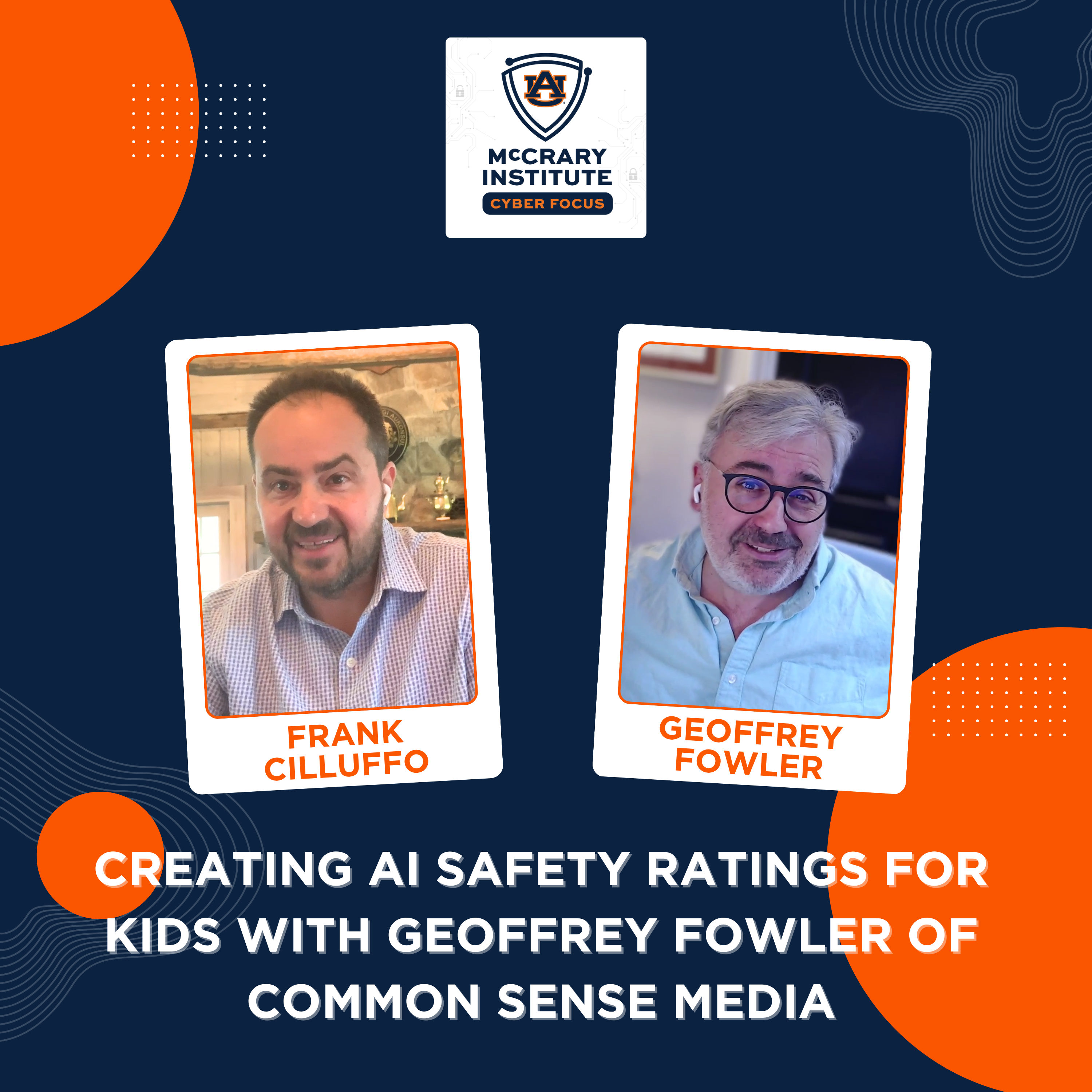
    AI Is Not Your Friend: Geoffrey Fowler on Rating AI for Kids

    In this episode of Cyber Focus, Frank Cilluffo speaks with Geoffrey Fowler, head of public engagement for the Youth AI Safety Institute at Common Sense Media, about why AI requires a different kind of safety framework than movies, apps, games, or social media. Fowler argues that generative AI is not static content; it is dynamic, conversational, multipurpose, and capable of changing from one interaction to the next based on the user, the prompt, the model, and the length of the conversation. The conversation explores how AI products that appear friendly, educational, or therapeutic can create new risks for children, from emotional dependency and privacy concerns to unsafe mental-health guidance and weakening guardrails over extended conversations. Fowler explains how Common Sense Media is working to build independent AI safety ratings for kids, modeled in part on crash testing for cars: transparent evaluations that help parents and schools make better decisions while pushing companies toward safer design. Main Topics Covered Why AI needs a new safety rating Lessons from social media and smartphone adoption AI companions, mental-health claims, and dependency risk AI toys, privacy, and weakening guardrails Independent testing, ratings, and child-development standards Company responsibility, public policy, and trust Key Quotes "AI is not your friend. AI is not human. It does not make the kinds of choices that a human being would make when you're having a bad day or when you're in a crisis or when you need somebody to really trust." — Geoffrey Fowler, Common Sense Media "[AI companies] shouldn't be experimenting on our kids. They should make it safe from the get go." — Geoffrey Fowler, Common Sense Media "These AI toys are little spies that you're putting in kids' rooms. They're recording their voices, they're recording behavioral data." — Geoffrey Fowler, Common Sense Media "The Common Sense Media Youth AI Safety Institute is neither pro AI nor anti AI. It's pro kid." — Geoffrey Fowler, Common Sense Media "We are here to research not just the hype of what companies say about what their technology does, we're here to see what it actually does and tell the truth about it." — Geoffrey Fowler, Common Sense Media Relevant Links and Resources https://www.commonsensemedia.org/ai-ratings/ai-risk-assessments Guest Bio Geoffrey Fowler is head of public engagement for the Youth AI Safety Institute at Common Sense Media. He is a longtime technology journalist whose work has appeared at The Washington Post and The Wall Street Journal. In this role, Fowler helps communicate Common Sense Media's work to evaluate AI products used by children, teens, families, and schools, including the development of independent safety ratings and risk assessments for youth-facing AI tools.

    • Transcript
  • S3 · E22May 26 · 37 min

    Estonia's Lessons for the Cyber Future with Ambassador Kristjan Prikk

    For Estonia, cyber resilience is not an abstract policy goal. It is a national survival issue shaped by history, geography, and the reality of living next to Russia. In this episode, Ambassador Kristjan Prikk explains how Estonia turned a lack of legacy infrastructure into a digital advantage, why the 2007 cyberattacks became a strategic wake-up call for the West, and what Ukraine's defense against Russia reveals about preparation, public-private cooperation, and the future of conflict. The conversation also looks ahead: to AI in government and education, to Estonia's support for Ukraine, and to the cyber lessons NATO must operationalize before the next crisis. At the center is a clear argument from one of the world's most digitally advanced democracies: cyber defense is not just about hardening systems, but building the relationships, institutions, and resilience needed to keep a society functioning under pressure. Main Topics Covered Estonia's digital transformation Life after Soviet occupation The 2007 cyberattacks Resilience over perfect defense Ukraine's cyber defense Private-sector support in wartime AI in government and education Support for Ukraine NATO's cyber priorities Key Quotes "We had a really strong incentive to go ahead and try out something almost crazy, something that no one had ever tried before, and just see what's going to happen." — Ambassador Kristjan Prikk "We believe that our kids will not lose [their] jobs to AI, but rather they may risk losing their jobs to other kids who know how to use AI better than them." — Ambassador Kristjan Prikk "We reduce or limit the risk of particularly high impact threats, risks materializing. But then again, the more important part is the ability to rebound; the ability to use alternatives if plan A is not working." — Ambassador Kristjan Prikk "The way the cyberspace is set up means that we cannot only be confined in our own quarters and expect that if we keep it in order, then nothing happens." — Ambassador Kristjan Prikk "Cybersecurity is a team sport…we have to make sure that when the problem appears, then we don't have to start searching for contacts of other people. The organization has to be there." — Ambassador Kristjan Prikk Relevant Links and Resources Embassy of Estonia in Washington, D.C. Estonia's national cybersecurity strategy or cyber agency resources Tallinn Mechanism information page IT Coalition for Ukraine information page About the Guest: Kristjan Prikk has served as Estonia's Ambassador to the United States since May 2021, and will soon serve as Estonia's Ambassador to NATO. Before assuming his current duties, Prikk served for nearly three years as the Permanent Secretary of the Estonian Ministry of Defense. In this role he was responsible for the management of the Ministry and for the coordination of activities of the agencies under the Ministry, including the Estonian Defense Forces, the Estonian Foreign Intelligence Service, and the Centre for Defense Investments.

    • Transcript
  • S3 · E21May 19 · 31 min

    Who's Accountable When AI Acts? — With Walter Haydock

    In this episode of Cyber Focus, Frank Cilluffo speaks with Walter Haydock, founder of StackAware, about the accountability, governance, and national security challenges emerging as organizations rush to deploy artificial intelligence. Haydock argues that AI does not erase familiar cybersecurity and risk-management problems; it accelerates them. From non-human identities and AI agents to third-party risk, federal regulation, and the environmental demands of AI infrastructure, the conversation centers on a core question: who is accountable when AI systems act, fail, or cause harm? Rather than treating AI governance as a compliance checklist, Haydock makes the case for assigning clear ownership, focusing policy on outcomes, and giving business leaders—not risk advisors alone—responsibility for the risks their organizations accept. Main Topics Covered AI accountability and non-human identities Managing AI agents as unpredictable actors Who should own AI risk inside an organization Third-party risk, supply chains, and contractual accountability Avoiding checkbox compliance in AI governance National AI policy, innovation, and strategic competition Key Quotes: "I see organizations spending a lot of time, money, resources, brain power on low-impact problems, on things that they shouldn't be focused on, and instead they're kind of ignoring the higher-risk issues that have easier mitigations, easier solutions." — Walter Haydock "The question of who is accountable for a given outcome is a critically important one." — Walter Haydock "At the level of an individual business, I think it's important to assign accountability for actions of AI agents to cross-functional business leaders who have the wherewithal, the full understanding of all the issues that are impacting a given company." — Walter Haydock "The framework I use is that business leaders are risk and system owners. They are ultimately accountable. They make the final decisions." — Walter Haydock "When the government hard codes in supposed best practices, they end up creating perverse incentives where companies are focused very closely on checking the box and not necessarily on getting the good outcome." — Walter Haydock Relevant Links and Resources Stack Aware Guest Bio Walter Haydock is the founder of StackAware, an AI security and governance company. Before founding StackAware, he worked in government, national security, and the military, including service on the House Homeland Security Committee, at the National Counterterrorism Center, and in the U.S. Marine Corps in intelligence and reconnaissance roles.

    • Transcript
  • S3 · E20May 12 · 34 min

    The End of Human-Speed Cyber: Mythos, Glasswing & the AI Exploit Race with CrowdStrike's Drew Bagley

    Cyber defense is entering a machine-speed era. With Anthropic's Mythos and Project Glasswing bringing AI-driven vulnerability discovery and exploit development into the center of the cyber conversation, CrowdStrike's Drew Bagley says organizations need to prepare for a world where vulnerabilities can be found, chained, and exploited faster than traditional patching cycles can handle. Bagley joins Frank Cilluffo to explain why this shift is not just about one model, one company, or one headline-grabbing project. It points to a broader change in how attackers and defenders will operate: exploit stacks may make once-latent vulnerabilities newly dangerous, critical infrastructure operators may face risks they cannot patch away, and unmanaged AI agents inside organizations may become another source of exposure. The answer, Bagley argues, is not panic or patching alone, but continuous discovery, continuous remediation, visibility across the kill chain, AI-powered defense, and resilience planning built for a world moving faster than human-speed cyber. Main Topics Covered Mythos, Project Glasswing, and AI-driven vulnerability discovery Why exploit stacks change how organizations should think about risk Continuous patching, prioritization, and machine-speed defense Critical infrastructure, OT systems, and unpatchable legacy technology AI agents, unmanaged access, and the next insider-style risk Key Quotes "We're now in an era in which AI has been proven to be able to find vulnerabilities and write exploits at scale much quicker than humans can." — Drew Bagley "We should think about this as an opportunity to think through this problem set now and assume that this is going to be just a widespread capability pretty soon." — Drew Bagley "Previously latent [OT] vulnerabilities… [relied on] security through obscurity. That's no longer the case. And now those are exploitable." — Drew Bagley "If you don't have visibility and you can't see the risk, then you can't mitigate the risk." — Drew Bagley "It's important to think about the ways in which AI has been incorporated over the past two years, especially in organizations to get work done better, but in ways that have often been unmanaged where AI has access to things you wouldn't give an intern access to." — Drew Bagley Relevant Links and Resources Anthropic's Project Glasswing CrowdStrike's Project Quiltworks Guest Bio: Drew Bagley is CrowdStrike's Chief Privacy Officer, where he leads the company's privacy and public policy work. In his 12 years at CrowdStrike, he has helped shape the company's approach to data protection, cybersecurity policy, and engagement with government leaders as CrowdStrike grew into a global cybersecurity company.

    • Transcript
  • S3 · E19May 5 · 31 min

    What Most People Get Wrong About Secure Messaging with Signal CTO Ehren Kret

    Most people think secure messaging begins and ends with encryption. Signal CTO Ehren Kret says that is only part of the picture. In this episode of Cyber Focus, host Frank Cilluffo sits down with Kret to discuss what private communication really requires, from protecting message content to limiting what platforms can learn from metadata, identity, group membership and social graphs. Kret explains how Signal's nonprofit model shapes its privacy-first design choices, why endpoint security remains a major challenge, and how AI built into operating systems could create new risks for private communication. The conversation also explores post-quantum encryption, lawful access debates, phishing threats against messaging accounts, and why the future of secure communication depends not only on better technology, but on helping users understand what is and is not truly private. Main Topics Secure messaging misconceptions Metadata and social graphs Endpoint security risks AI and platform privacy Post-quantum encryption Signal's nonprofit model Key Quotes "Disappearing messages, and that's one piece of the puzzle... But a lot of people think that's sort of the end." — Ehren Kret "You should also be looking at does your service provider have access to the message content and is it protected from visibility from them?" — Ehren Kret "Being able to build a social graph can reveal information, even though you don't necessarily have the message content, it is highly leaky. You can infer from a social graph, you can see who is talking to who, and a lot of times that reveals information about the content of those communications ." — Ehren Kret "Signal...is an anti mass surveillance tool. It's not necessarily an anti targeted surveillance tool because at the end of the day your phone is still an endpoint that can be targeted." — Ehren Kret "Since it's a nonprofit, the primary goal for Signal is to spread the use of end-to-end encrypted for messaging and for communications in general." — Ehren Kret Relevant Links and Resources Signal Foundation Signal: Sealed Sender Signal: Quantum Resistance and the Signal Protocol Cloudflare Post-Quantum Roadmap Google Research on Quantum Vulnerabilities About Ehren Kret Ehren Kret is the Chief Technology Officer at Signal, where he helps lead the development of privacy-preserving communication technology. He previously served as an engineering director at WhatsApp, where he helped scale end-to-end encryption for more than a billion users.

    • Transcript
  • S3 · E18April 27 · 33 min

    How Idaho National Laboratory Is Building the Future of Infrastructure Security with Zach Tudor

    America is asking more from its critical infrastructure just as adversaries are finding more ways to target it. AI, data centers, electrification, and next-generation energy systems all depend on operational technology—the control systems that keep power, water, transportation, and industry moving. As that backbone grows more connected, the stakes of securing it grow even higher. In this episode of Cyber Focus, Frank Cilluffo speaks with Zach Tudor, Associate Laboratory Director at Idaho National Laboratory, about how INL tests and secures critical infrastructure at scale. Tudor explains why resilience must guide infrastructure defense, what Ukraine and China reveal about the risks facing critical infrastructure, and why cyber-informed engineering is essential as new technologies move into energy, nuclear, wireless, and industrial systems. The conversation also covers AI's role in control environments, the workforce needed to secure future infrastructure, and the challenge of moving faster before a major event forces action. Main Topics Covered INL's critical infrastructure mission Testing infrastructure at scale OT security and resilience AI risks in control systems Cyber-informed engineering Workforce needs for energy security Key Quotes "No infrastructure is impervious to attack." — Zach Tudor "I think we're getting to the point where, if you are delivering power to the nation, then you are a risk professional as well as a power engineer." — Zach Tudor "Resilience for me is not just the preparation for an attack or the response to an attack, but the ability to mitigate the effects of an attack, to respond quickly, and to recover quickly as well." — Zach Tudor "We are a national lab in the public economic and national security interest. And so we'll do what needs to be done. We say that labs do what others can't, won't or shouldn't do." — Zach Tudor "The mindset of an engineer who's thinking about operations is different from the mindset of an IT security person who's protecting databases or privacy or other data." — Zach Tudor Relevant Links and Resources Idaho National Laboratory Department of Energy National Laboratories Cyber-Informed Engineering (CIE) Guest Bio Zach Tudor is Associate Laboratory Director for National and Homeland Security at Idaho National Laboratory, where he leads programs focused on critical infrastructure protection, operational technology security, and national security innovation. He previously served at the Department of Homeland Security's ICS-CERT and is a former U.S. Navy submariner. Tudor has spent decades working at the intersection of cybersecurity, energy systems, and national defense.

    • Transcript
  • S3 · E17April 21 · 24 min

    Hacking Reputation: Disinformation, Trust, and Cyber Crisis Response with Preston Golson

    A cyber incident can damage far more than systems and networks. It can also become a reputational crisis, especially when false or misleading narratives move faster than facts. In this episode of Cyber Focus, Frank Cilluffo speaks with Preston Golson of Brunswick Group about why organizations need to treat reputation as a vulnerability that can be tested, stress-tested, and defended much like any other part of their cyber posture. Drawing on his work in cyber incident response and his earlier career at the CIA, Golson explains how misinformation and disinformation take hold, why many damaging narratives are foreseeable, and how companies can prepare before a crisis hits. The conversation explores red teaming, "prebunking," unified crisis response, and the growing importance of trust, credibility, and AI-generated search results in shaping public perception. For leaders trying to manage cyber risk in a more volatile information environment, this episode offers a practical framework for thinking about reputation, crisis communications, and resilience. Main Topics Covered Reputation as a cyber target Disinformation and viral narratives Red teaming reputational risk Cyber crisis communications Prebunking and digital inoculation Key Quotes "Misinformation is like a forest fire and we live in a forest with combustible conditions … false and misleading narratives can be caught quickly and they can affect a company's license to operate." — Preston Golson "If you have a dedicated team to look for [reputational risks], you can hack your own reputation, understand where your vulnerabilities are and then reverse engineer defenses and proactive communications … to help build resiliency amongst your audiences." — Preston Golson "We don't play whack a mole. Not every narrative deserves a response. As a matter of fact, some narrative, if you give them a response, it'll give it more oxygen." — Preston Golson "What effective [misinformation] narratives are doing are playing on people's insecurities, [and] people's desire to understand a world that is increasingly complex. It doesn't always make sense." — Preston Golson "Ransomware really did democratize cyber. Everyone's a target from the biggest Fortune 10 down to every mom and pop shop..." — Frank Cilluffo Relevant Links and Resources Brunswick Group Preston Golson's article, "Hacking Reputation" Guest Bio Preston Golson is a director at Brunswick Group, where he works on cyber incident response and related communications challenges. Before joining Brunswick, he spent more than 15 years at the Central Intelligence Agency. In this episode, he draws on that experience to discuss cyber crisis response, disinformation, reputational risk, and how organizations can prepare for false or misleading narratives before they take hold.

    • Transcript
  • S3 · E16April 13 · 34 min

    Cult of the Dead Cow and the Roots of Modern Cyber Ethics with Joe Menn

    Cybersecurity's history is often told through breaches, crime, and disruption. Joe Menn argues that the story of early hacker culture also offers something constructive: a model for how technical curiosity, ethical reflection, and independent thinking can shape the public good. Drawing from his work on Cult of the Dead Cow, Menn traces how figures once associated with pranks, underground tools, and legal gray zones helped influence vulnerability disclosure, hacktivism, privacy debates, and even the way government and major companies think about security today. But the episode does not stay in the past. Menn connects those earlier lessons to much more current concerns: digital surveillance, the tightening relationship between big tech and government, and the security risks emerging from the rush into AI. The result is a conversation about far more than hacker lore. It is about who gets to shape technology, what values guide that work, and why critical thinking itself may now be part of the infrastructure worth defending. Main Topics Covered The legacy of Cult of the Dead Cow The evolution of hacktivism Ethics and critical thinking in cyber Surveillance, privacy, and state power AI security and concentrated tech influence Key Quotes "I think it's very interesting to me that... any Fortune 100 CISO who's in his mid-50s or older broke the law as a teenager." — Joe Menn "Hackers are by definition, if they're any good, are critical thinkers, because they're taking stuff and saying, well, okay, this is the intended purpose. What else can it do? What else can I make it do?" ­— Joe Menn "Hackers should be big players in legislation and in protecting critical infrastructure, and all these other things because they are critical thinkers and won't just repeat what the conventional wisdom is. You get value from people who are thinking differently. — Joe Menn "[A]t the most recent inauguration, you had Jeff Bezos and Mark Zuckerberg, and I believe Elon Musk standing closer to Trump than his cabinet members. The allegiance of big tech is actually more important than some of the entire branches of government. And their interests are now, by and large, very closely joined." — Joe Menn "[W]henever there's a new exciting technology; people rush into it and then sometime later they figure out about security ... And right now, there's this land rush where all the vulnerabilities are now visible through the wonder of AI. And so, tech debt that was swept under the rug is now become a forest fire." — Joe Menn Relevant Links and Resources Cult of the Dead Cow Fatal System Error Citizen Lab About the Guest Joe Menn is a longtime technology reporter and author who has covered cybersecurity, privacy, and related policy issues for decades. In the episode, Frank Cilluffo notes that Menn has written for The Washington Post, Financial Times, Reuters, and the Los Angeles Times, and is the author of two bestselling cybersecurity books, including Cult of the Dead Cow.

    • Transcript
  • S3 · E15April 7 · 24 min

    From Fax Machines to Quantum: Canada's Sami Khoury Reflects on Three Decades in Cyber

    Cybersecurity now reaches far beyond government networks and traditional IT systems. In this episode, Sami Khoury explains how the threat environment increasingly touches critical infrastructure, operational technology, undersea cables, and space—and why that shift is pushing governments to work more closely with private industry and trusted international partners. Drawing on more than three decades in Canadian government, Khoury offers a clear view of how Canada has built out its cyber posture, how the Canadian Centre for Cyber Security fits into that mission, and where the threat is evolving fastest. He also reflects on the growing overlap between nation-state activity, cybercrime, and hacktivism; the promise and risk of AI; the long transition toward post-quantum security; and the enduring pull of public service in a field where the stakes keep rising. Main Topics Covered Canada's cyber strategy Critical infrastructure security OT, undersea cables, and space AI and post-quantum risk Public-private and international partnership Key Quotes: "When cyber came about or when we started paying attention to cyber, it was predominantly an IT issue. But unfortunately, these days it's not just an IT issue and we have to pay attention to OT." — Sami Khoury "We know that cyber, and it might be cliche, cyber knows no border." — Sami Khoury "We welcome people from different educational background because it's the analytical thinking capacity that we're looking for, not critical thinking skills. It's not necessarily that you're the best coder or that you are the best hardware architect. We want people with the critical thinking skills." — Sami Khoury "The day there's a cryptographically relevant quantum computer that can break today's encryption will not, I presume, will not come with a press release." — Sami Khoury "It's no longer government on government, it's government on private sector, it's mercenaries on private sector, it's mercenaries on government or hacktivist on government. So it's completely asymmetric and it takes a whole team to basically make a difference." — Sami Khoury Relevant Links and Resources Canadian Centre for Cyber Security Canada's national cyber threat assessment Canada's AI strategy Canada's Post-quantum encryption bulletin Guest Bio: Sami Khoury is the Government of Canada Senior Official for Cyber Security and the former head of the Canadian Centre for Cyber Security. He has spent over 30 years in the Canadian government, primarily within the Communications Security Establishment (CSE), Canada's signals intelligence and cryptologic agency. A veteran of the "Five Eyes" intelligence community, Khoury has been instrumental in shaping Canada's national cyber strategy and fostering deep operational ties with international partners.

    • Transcript
  • S3 · E14March 31 · 33 min

    Ukraine, Private Sector Power, and Cyber Defense with Greg Rattray

    Ukraine's cyber defense has become one of the clearest real-world tests of what resilience actually looks like under sustained attack. In this episode of Cyber Focus, Greg Rattray explains why Ukrainian defenders held up better than many expected, and what their experience reveals about the limits of prevention, the value of shared visibility, and the growing operational role of the private sector. Drawing on his work leading the Cyber Defense Assistance Collaborative, Rattray argues that exposing adversary activity across a more "brightly illuminated cyberspace" helped blunt Russia's offensive advantage. But the larger lesson is not just about threat visibility. It is about recovery, adaptability, and trust: teams under pressure need tools they already know how to use, leaders need to plan for bad days, and governments need to make room for industry to do more than simply wait for direction. Main Topics Covered The "bright room" concept in cyber defense Why resilience matters more than perfect prevention Familiar tools vs. cutting-edge tech in crisis The private sector's front-line role How cyber, EW, and drones are converging Key Quotes: "It's pretty hard to do cyber offense in a bright room, in a dark room, it's a lot easier. But like what we've done here is give the Ukrainians the position that the Russian attacks are trying to occur in a pretty brightly illuminated cyberspace." — Greg Rattray "Kyivstar, [Ukraine's] major telecommunications provider, got leveled in December of 2023. I thought they would be out for weeks. Two days later they were back up and running." — Greg Rattray "The speed at which drones have to change in order to stay survivable and effective; these innovation cycles are weeks, not years." — Greg Rattray "While the NIST cybersecurity framework talks about respond and recover, the amount of energy that goes into resilience is still to my mind, under thought, under exercised, [and] under invested in." — Greg Rattray "The notion that you're going to be targeted has to be part of your risk calculus. And therefore you even with a good team... you cannot guarantee you won't have a bad day." — Greg Rattray Links/Resources Cyber Defense Assistance Collaborative: https://crdfglobal-cdac.org Guest Bio: Dr. Greg Rattray is Chief Strategy and Risk Officer at Andesite and Executive Director of the Cyber Defense Assistance Collaborative (CDAC), which has facilitated more than $30 million in voluntary cyber defense support to Ukraine. He previously served as J.P. Morgan Chase's Global CISO and Head of Global Cyber Partnerships, and spent 23 years in the U.S. Air Force, including as the National Security Council's Director for Cybersecurity.

    • Transcript
  • S3 · E13March 24 · 35 min

    Transatlantic Reset: Private Sector Diplomacy & Digital Trust with Sébastien Garnault

    Overview Transatlantic cyber cooperation is being tested by political strain, regulatory divergence, and competing ideas about sovereignty, trust, and market access. In this episode of Cyber Focus, Sébastien Garnault argues that if the United States and Europe want to keep working together on security, they need to move quickly to make that cooperation practical, especially in critical infrastructure and digital markets. Speaking from a French private-sector perspective, Garnault makes the case that governments alone may not be able to repair or sustain that cooperation at the speed the moment requires. He points instead to private-sector partnerships, shared market incentives, and clearer language around security standards as possible ways to keep the transatlantic relationship workable even when public-sector trust is under pressure. The conversation also explores how Europe and the United States differ on clean versus trusted technology stacks, how threat perceptions shape national requirements, and how privacy, AI, and data localization debates can either strengthen or complicate cooperation. The conversation was recorded on February 11, 2026. Main Topics Covered Private-Sector Cooperation as a Strategic Bridge: Why Garnault believes business-to-business cooperation may move faster than government-to-government diplomacy when trust is strained. Clean Stack vs. Trusted Stack: How U.S. national-security thinking and EU market-standard thinking create different paths for defining who can participate in secure digital markets. Threat Perception and Market Access: How geography, history, and national priorities shape security requirements across Europe and affect access to critical infrastructure markets. Trust, Sovereignty, and the Transatlantic Reset: Why Garnault sees damaged trust as a real obstacle, and why he argues for a reset rather than a rupture in U.S.-European cyber cooperation. Privacy, AI, and Data Localization: How French and European views on privacy, regulation, and AI governance differ from those in the United States, and why those differences matter for security and interoperability. Key Quotes "Maybe what we've done in the last decade and what we will do in the next decade don't belong from government but belongs to us." — Sébastien Garnault "We can do a reset; we cannot afford a reboot." — Sébastien Garnault "The damages that have been done in our trust, mutual trust, are very deep. So we need to fix it quickly." — Sébastien Garnault "The best way for us to cooperate with our allies is to use the market because the market is less political than national security." — Sébastien Garnault "From my standpoint, the glue that binds us together is much greater than anything that can tear us apart." — Frank Cilluffo Links/Resources CyberTaskForce: https://www.cybertaskforce.fr/ Paris Cyber Summit: https://www.paris-cyber-summit.com/ Guest Bio Sébastien Garnault is the founder of the CyberTaskForce and president of the Paris Cyber Summit. He joined Cyber Focus while in Washington leading a French delegation meeting with U.S. policymakers, industry leaders, and other decision-makers, and spoke in a private-sector capacity rather than on behalf of the French government.

    • Transcript
Showing 1–20 of 20 episodes