
Skip to content
Artwork for Crossing the Valley
Crossing the Valley · August 5 · 41 min

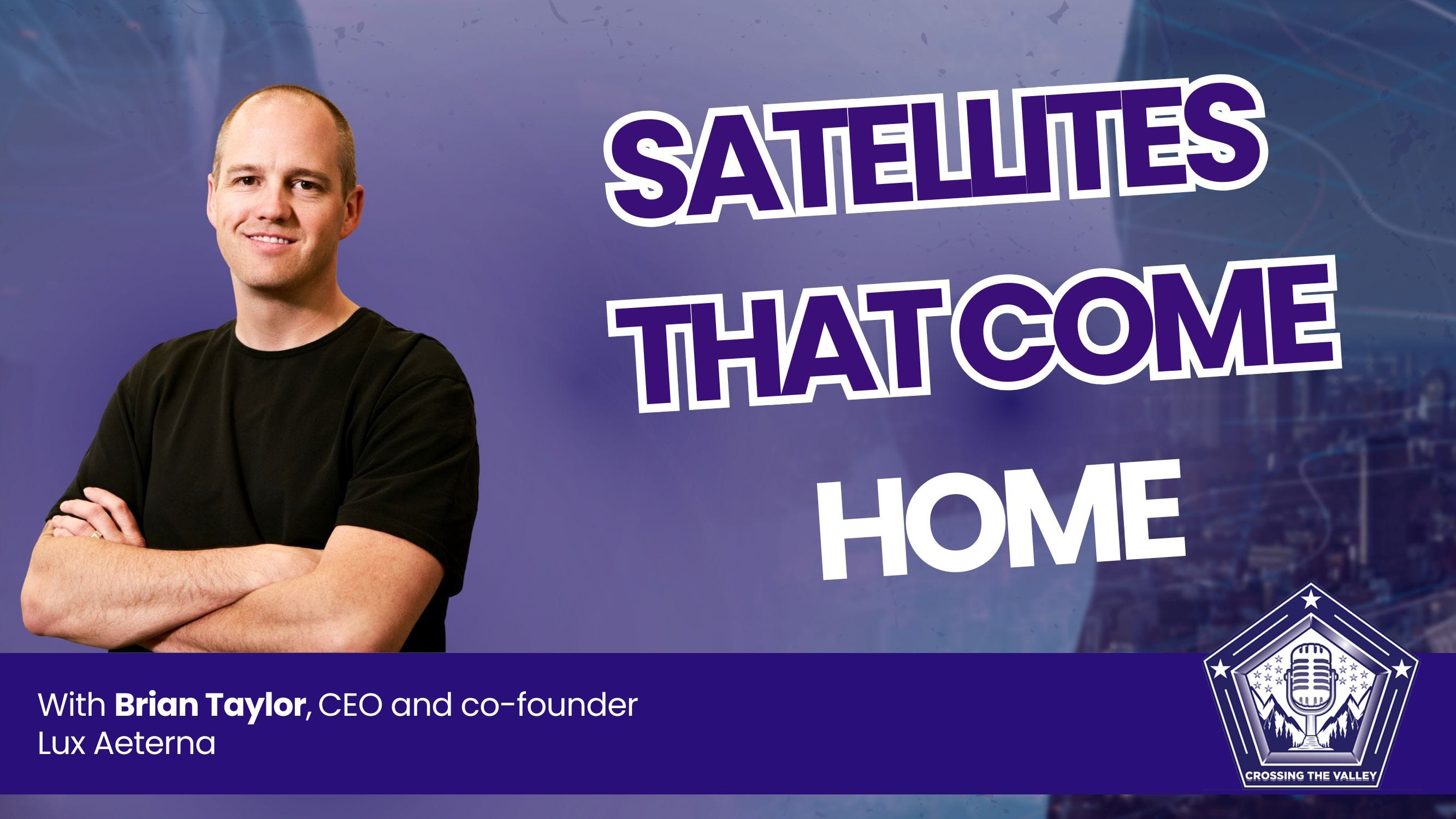
Ep. 89: Lux Aeterna

How Lux Aeterna Is Building a Market the Pentagon Didn’t Ask For About Brian Brian Taylor spent about fifteen years as a mechanical engineer before he ever sat in the founder’s chair. He came up through aviation and aerospace, then landed at SpaceX, where he did development, qualification, and testing on Starlink satellites, including the structural qualification of the first stack of 60. From there it was Amazon’s Project Kuiper for high rate satellite production, then Loft Orbital. But despite this tour d’force through a who’s who of space companies, by his own admission, Brian was never a space nerd. It really bugged him that you would work that hard on something, and unless you happen to be an astronaut, you would never see the hardware again. You do not get to iterate on it. You do not get to enjoy the fruits of your labor. An engineer who wants his hardware back. That frustration became a company. About Lux Aeterna Lux Aeterna builds fully reusable satellites. While there’s been lots of attention heaped on the rockets, Brian and Lux are focused on the satellite itself. The goal is to fly the mission, survive re-entry, land intact, refurbish it, put a new payload on it, and send it back up. Brian founded the company in Denver in August 2024. It came out of stealth in June 2025 with a $4 million pre-seed led by Space Capital, and closed a $10 million oversubscribed seed led by Konvoy in March 2026, bringing the total to $14 million. The company’s first vehicle is called Delphi. It is roughly 200 kilograms, built around a rigid conical heat shield that doubles as the satellite’s primary structure, with a parachute assisted return. It will fly on a SpaceX Transporter rideshare in Q1 2027, with recovery at the Koonibba Test Range in South Australia through a partnership with Southern Launch. The company holds a Space Act Agreement with NASA Ames and two CRADAs supporting the re-entry and thermal protection work, and has stood up a Defense Advisory Board. The entire payload capacity for that first mission is already sold out, across civil, defense, and commercial customers, hardware and software, small companies and large. Also worth noting for the culture watchers: he did this interview from inside a sauna. An actual, off the shelf sauna, sitting on the production floor, because it was cheaper than the fancy sound-proof pods that Google puts all over its offices. The idiot index on that thing has to be excellent. For more on Lux Aeterna: https://www.luxaeterna.com/ Follow Brian: https://www.linkedin.com/in/brianjtaylor/ For more Crossing the Valley: www.valleycrossers.com Follow Noah: https://www.linkedin.com/in/noahsheinbaum/ This is a public episode. If you would like to discuss this with other subscribers or get access to bonus episodes, visit www.valleycrossers.com


0:00-41:51

transcript

No transcript — this publisher did not publish one.

show notes

How Lux Aeterna Is Building a Market the Pentagon Didn’t Ask For

About Brian

Brian Taylor spent about fifteen years as a mechanical engineer before he ever sat in the founder’s chair. He came up through aviation and aerospace, then landed at SpaceX, where he did development, qualification, and testing on Starlink satellites, including the structural qualification of the first stack of 60. From there it was Amazon’s Project Kuiper for high rate satellite production, then Loft Orbital.

But despite this tour d’force through a who’s who of space companies, by his own admission, Brian was never a space nerd. It really bugged him that you would work that hard on something, and unless you happen to be an astronaut, you would never see the hardware again. You do not get to iterate on it. You do not get to enjoy the fruits of your labor.

An engineer who wants his hardware back. That frustration became a company.

About Lux Aeterna

Lux Aeterna builds fully reusable satellites. While there’s been lots of attention heaped on the rockets, Brian and Lux are focused on the satellite itself. The goal is to fly the mission, survive re-entry, land intact, refurbish it, put a new payload on it, and send it back up.

Brian founded the company in Denver in August 2024. It came out of stealth in June 2025 with a $4 million pre-seed led by Space Capital, and closed a $10 million oversubscribed seed led by Konvoy in March 2026, bringing the total to $14 million.

The company’s first vehicle is called Delphi. It is roughly 200 kilograms, built around a rigid conical heat shield that doubles as the satellite’s primary structure, with a parachute assisted return. It will fly on a SpaceX Transporter rideshare in Q1 2027, with recovery at the Koonibba Test Range in South Australia through a partnership with Southern Launch. The company holds a Space Act Agreement with NASA Ames and two CRADAs supporting the re-entry and thermal protection work, and has stood up a Defense Advisory Board.

The entire payload capacity for that first mission is already sold out, across civil, defense, and commercial customers, hardware and software, small companies and large.

Also worth noting for the culture watchers: he did this interview from inside a sauna. An actual, off the shelf sauna, sitting on the production floor, because it was cheaper than the fancy sound-proof pods that Google puts all over its offices. The idiot index on that thing has to be excellent.

For more on Lux Aeterna: https://www.luxaeterna.com/

Follow Brian: https://www.linkedin.com/in/brianjtaylor/

For more Crossing the Valley: www.valleycrossers.com

Follow Noah: https://www.linkedin.com/in/noahsheinbaum/


This is a public episode. If you would like to discuss this with other subscribers or get access to bonus episodes, visit www.valleycrossers.com

links1