Skip to content
Artwork for Construction Disrupted
NewsBusinessNews CommentaryExplicit

Construction Disrupted

Peter Sumpton & Ryan Jones

Construction Disrupted is a podcast for people working in the construction industry who need to stay current without drowning in noise. With a focus on the current, real-world issues across the built environment, the stories behind the headlines, the shifts worth your time, and the ideas to get you thinking.

No froth, all coffee.

Each episode follows a clear 3, 2, 1 structure:

3 headlines.
Covering the most relevant and interesting topics from the world of construction.

2 opinions.
Straight-talking analysis and debrief that digs deep beyond each headline. Why it matters and what it means for the future.

1 takeaway.
Sometimes practical, sometimes actionable, or perhaps something to make you think.

Hosted by Peter Sumpton and Ryan Jones, who bring a combined 40 years in construction and marketing, Construction Disrupted is designed for thought-leaders and decision-makers who prefer podcasts with more substance and less spin.

We know the backdrop, fragmented supply chains, rising costs, skills gaps and sustainability pressures, and we won’t rehash doom for the sake of it. Instead, we move past the headlines and delve into the topics that are shaping the industry today, tomorrow, and probably a couple more days after that.

Subscribe and join us every week – most weeks, anyway.
Expect clear thinking, dry humour and the occasional soapbox moment.

Play
  • 20 episodes
  • weekly
  • Avg 40 min
  • English
  • #138
    Wednesday · 42 min

    Local Plans, For Local People | Episode 138

    Construction Disrupted Episode 138 - Local Plans, For Local People (28.10.26) in partnership with Adobe Acrobat Studio. Check them out and show them some love. In this episode, we're discussing regional leaders seeking control of housing and regeneration, to award-winning council homes that challenge low expectations of public delivery, and Heathrow’s attempt to convert a contested runway into thousands of skilled jobs. These stories expose the same fault line within construction - Big promises are plentiful; durable funding, delivery capacity and political consent are the harder parts. Let's go! What if Britain’s next construction boom is driven from the regions? Devolution could give construction a more dependable route from local ambition to viable projects, shifting influence away from Whitehall and towards regional leaders, councils and place-based partnerships. The opportunity is significant: better alignment of housing, transport, utilities, skills and regeneration could create clearer pipelines and faster delivery. But devolving power alone will not remove barriers. Regional authorities need planning, procurement and development expertise, long-term and flexible funding, and the ability to tailor solutions to local needs. The central test is whether capability and funding move with decision-making. The Accrington regeneration programme illustrates the potential when councils, consultants and communities work around a shared vision rather than institutional boundaries. Lion Green Road’s Stirling Prize victory is a timely political statement about the future of council housing delivery Lion Green Road’s Stirling Prize win puts the quality and ambition of council housing firmly in the spotlight. At a time when local authorities are again being asked to help tackle housing need, the recognition argues that publicly led housing should not be treated as a compromise in design, space or long-term value. The political message is that councils can deliver exemplary homes when they have the confidence, capacity and funding to do so. The challenge is turning an exceptional project into a repeatable model: sustained investment, capable delivery teams and procurement that protects design quality will matter as much as headline targets. Heathrow pitches 17,500 building jobs as runway doubts grow Heathrow is pairing its third-runway case with a major skills offer: at least 17,500 local construction jobs at peak, 33,000 jobs across nine neighbouring boroughs by 2055, and 5,000 youth apprenticeships, traineeships and other entry routes. Its new Infrastructure Skills Council, training-centre role and expanded SME Academy are intended to prepare local people and firms for engineering, logistics and trade opportunities. The economic proposition is substantial, but it remains conditional on political support and a long planning process. While the chancellor backs the growth case, the prime minister has not endorsed expansion, and Heathrow now indicates a possible 2039 opening, four years later than originally targeted. The jobs programme strengthens the project’s local case, but does not resolve the runway’s core political uncertainty. Bios Ryan Jones - SLG Agency For almost 20 years, Ryan’s focus has been on helping brands in the construction and manufacturing sectors tell their story. His career began in PR, working for global businesses across a variety of sectors, before opting to focus on construction and the built environment. In his role as Managing Director, Ryan works to ensure that SLG Agency continues to be one of the construction industry's leading specialist strategic and creative agencies, having seen its work recognised by the likes of Campaign, Marketing Week and The Drum in recent years. Ryan is regularly asked to speak at trade shows and events, and to contribute thought leadership pieces to trade media. He is also a member of several industry advisory boards, including Constructing Excellence and the Greater Manchester Chamber of Commerce. His passion for the construction sector has seen him work with clients on CSR campaigns that tackle the sector’s public perception, culminating in him recently launching a not-for-profit called Deconstruction. Peter Sumpton - buildDifferent Peter is a construction–marketing strategist and co-host of Construction Disrupted. With two decades’ experience spanning manufacturers, contractors and agencies, he helps organisations swap scattergun activity for clear strategy, joined-up planning and measurable outcomes. His approach is practical and plain-spoken: cut the noise, focus on what moves the numbers, and build repeatable systems that teams can actually use. Having seen first-hand how unfocused tactics waste time and budget, Peter works with leaders to align commercial goals, customer insight and content so marketing supports delivery rather than distracting from it. Peter's passion lies in diagnosing organisations' marketing functions' capabilities and existing market, assembling what’s required to create a functional strategy, fit for purpose and scalable. Marketing should create value, not just cost, and Peter’s work is about making that the norm.

  • #137
    October 21 · 42 min

    Radical New Plans | Episode 137

    Construction Disrupted Episode 137 - Radical New Plans (21.10.26) in partnership with Adobe Acrobat Studio. Check them out and show them some love. In this episode, we're discussing what a credible Budget could unlock—from viable homes and long-term retrofit to the apprentices needed to deliver them. With housing consents running at just 58% of the level needed to meet the government’s annual target, ministers must decide how to fund the planning, delivery and skills capacity their promises depend on. Is it possible? The Budget must treat construction as a national priority Construction is presented as the foundation of economic growth, housing delivery and net-zero progress—not a side issue for the Treasury. Planning consents are at a 20-year low: 216,141 homes received permission in the year to Q1 2026, only 58% of the annual level needed to meet the government’s 1.5 million-home target. Meanwhile, contractor failures are damaging supply chains and local projects. The article calls for a serious Budget package: multi-year funding for planning departments, more flexible Section 106 agreements, a construction resilience fund, value-based procurement and a predictable public-work pipeline. It also argues for a decade-long retrofit programme, expanded apprenticeships and FE capacity, plus stronger Building Safety Regulator performance. Think-tank sets out a radical new plan to make housing more affordable in every postcode The Prosper UK Housing Commission argues that the housing crisis cannot be solved with one lever. Weak buyer confidence restricts sales, while rising costs and static prices make consented projects unviable. Since 2020, building a new home has cost £76,000 more, with half of that increase attributed to regulation, policy and tax. Its plan links viability, demand, supply and renting: pause new regulatory burdens for three years; reform developer obligations; offer targeted shared equity for first-time buyers of energy-efficient new homes; create a National Planning Service; review Green Belt boundaries; and make higher-density development standard. For rental housing, it proposes lower stamp duty for Build to Rent, standardised Section 106 terms and a public programme using public land to deliver more social rent homes. CITB’s New Entrant Support Team celebrates milestone of over 13,500 apprenticeship starts CITB’s New Entrant Support Team has helped launch more than 13,500 construction apprenticeships since September 2022, supporting 7,230 employers and 3,925 existing apprentices. In 2024–25 alone, it supported more than 4,100 starts—over 12% of all construction apprenticeship starts in Britain. NEST helps employers recruit, retain and mentor new entrants, while navigating grants and funding. The milestone matters because the sector needs more than 41,000 additional workers each year. The focus is not only on getting people into training, but helping them build lasting construction careers that meet demand for modern building, retrofit and infrastructure skills. Bios Ryan Jones - SLG Agency For almost 20 years, Ryan’s focus has been on helping brands in the construction and manufacturing sectors tell their story. His career began in PR, working for global businesses across a variety of sectors, before opting to focus on construction and the built environment. In his role as Managing Director, Ryan works to ensure that SLG Agency continues to be one of the construction industry's leading specialist strategic and creative agencies, having seen its work recognised by the likes of Campaign, Marketing Week and The Drum in recent years. Ryan is regularly asked to speak at trade shows and events, and to contribute thought leadership pieces to trade media. He is also a member of several industry advisory boards, including Constructing Excellence and the Greater Manchester Chamber of Commerce. His passion for the construction sector has seen him work with clients on CSR campaigns that tackle the sector’s public perception, culminating in him recently launching a not-for-profit called Deconstruction. Peter Sumpton - buildDifferent Peter is a construction–marketing strategist and co-host of Construction Disrupted. With two decades’ experience spanning manufacturers, contractors and agencies, he helps organisations swap scattergun activity for clear strategy, joined-up planning and measurable outcomes. His approach is practical and plain-spoken: cut the noise, focus on what moves the numbers, and build repeatable systems that teams can actually use. Having seen first-hand how unfocused tactics waste time and budget, Peter works with leaders to align commercial goals, customer insight and content so marketing supports delivery rather than distracting from it. Peter's passion lies in diagnosing organisations' marketing functions' capabilities and existing market, assembling what’s required to create a functional strategy, fit for purpose and scalable. Marketing should create value, not just cost, and Peter’s work is about making that the norm.

  • #136
    October 14 · 40 min

    Pre-Budget Conditions in Construction. Pause or Play? | Episode 136

    Construction Disrupted Episode 136 - Pre-Budget Conditions in Construction. Pause or Play? (14.10.26) in partnership with Adobe Acrobat Studio. Check them out and show them some love. In this episode, we're discussing one number, one bottleneck and one new delivery model. An PMI edging upward but still below 50, specialist capacity keeping pressure on project costs, and Liverpool gaining a direct route to turn regeneration plans into homes and sites. Here’s what that means for the projects moving next—and those still waiting for momentum. Let's go! Recovery in commercial work helps see output rise as industry waits on Budget UK construction’s downturn eased in September, with the PMI rising from 44.3 to 46.1, its least severe contraction since January. Commercial activity was the main support, improving to 48.5, while civil engineering and housing also declined more slowly. Housing remained the weakest segment at 40.7 despite an improvement from August. The caveat is clear: output has now been below the no-change mark for 21 months. New work fell at its fastest pace since June as high borrowing costs, geopolitical uncertainty, delayed major-project decisions and rising inputs weighed on demand. Industry confidence has weakened ahead of the Budget, with firms looking for dependable infrastructure commitments and lower uncertainty around the cost of doing business. Tier 1 tender rises cool but specialist trades costs hold firm Tender price inflation is expected to rise by 3.25% in 2026, down from Gardiner + Theobald’s previous 3.5% forecast, as Tier 1 contractors compete more actively for selected work. Well-prepared projects valued at £10m–£30m are attracting the strongest competition. But this is a more selective market, not a cheaper one. Main contractors are sharing a constrained pool of MEP, façade and structural-steel specialists, limiting clients’ ability to benefit from softer headline tender inflation. MEP capacity is the sharpest pinch point, reported by 68% of respondents. Larger or more complex projects, especially above £50m, are finding it harder to secure credible bidder fields. Risk-heavy contract terms, compressed programmes and immature designs are also adding allowances to bids. Liverpool City Region agrees first-of-its-kind regeneration partnership with Homes England Liverpool City Region has become the first English mayoral authority to sign a Place Delivery Agreement with Homes England and the National Housing Bank. The model shifts the relationship from collaboration to co-delivery, using joint delivery units led by representatives from each organisation. The agreement gives Mayor Steve Rotheram greater influence over housing and regeneration investment and targets major schemes including Liverpool North Docks Mayoral Development Corporation and Central Station Gateway, alongside the broader housing pipeline. Its stated ambition is practical: unlock stalled schemes, accelerate council and social housing delivery, and direct investment to where it has the greatest local impact. Homes England intends to pursue similar agreements with other mayoral strategic authorities. Bios Ryan Jones - SLG Agency For almost 20 years, Ryan’s focus has been on helping brands in the construction and manufacturing sectors tell their story. His career began in PR, working for global businesses across a variety of sectors, before opting to focus on construction and the built environment. In his role as Managing Director, Ryan works to ensure that SLG Agency continues to be one of the construction industry's leading specialist strategic and creative agencies, having seen its work recognised by the likes of Campaign, Marketing Week and The Drum in recent years. Ryan is regularly asked to speak at trade shows and events, and to contribute thought leadership pieces to trade media. He is also a member of several industry advisory boards, including Constructing Excellence and the Greater Manchester Chamber of Commerce. His passion for the construction sector has seen him work with clients on CSR campaigns that tackle the sector’s public perception, culminating in him recently launching a not-for-profit called Deconstruction. Peter Sumpton - buildDifferent Peter is a construction–marketing strategist and co-host of Construction Disrupted. With two decades’ experience spanning manufacturers, contractors and agencies, he helps organisations swap scattergun activity for clear strategy, joined-up planning and measurable outcomes. His approach is practical and plain-spoken: cut the noise, focus on what moves the numbers, and build repeatable systems that teams can actually use. Having seen first-hand how unfocused tactics waste time and budget, Peter works with leaders to align commercial goals, customer insight and content so marketing supports delivery rather than distracting from it. Peter's passion lies in diagnosing organisations' marketing functions' capabilities and existing market, assembling what’s required to create a functional strategy, fit for purpose and scalable. Marketing should create value, not just cost, and Peter’s work is about making that the norm.

  • #135
    October 7 · 43 min

    Can UK Construction Really Deliver? | Episode 135

    Construction Disrupted Episode 135 - Can UK Construction Really Deliver? (07.10.26) in partnership with Adobe Acrobat Studio. Check them out and show them some love. In this, our 50th episode, we're discussing how the new government is promising radical reform, but facing entrenched challenges, the brutally fast construction of AI data centers and the generation of young people dangling between ambition and estrangement, these are not polite policy debates. Let's go! Hope again? Five key takeaways from Labour conference 2026 At the 2026 Labour conference, real hope replaced performative slogans, as the built environment sector absorbed the arrival of a new prime minister and a government eager to show tangible progress. Conversations focused less on policy inertia and more on the need for delivery. The introduction of a new National Planning Policy Framework signaled major change, moving planning from the centre of debate to make room for urgent action on leasehold reform and support for first-time buyers. Yet, while the industry welcomed schemes like 'Your First Home,' many questioned whether the benefits would filter down beyond large contractors and bring about enduring improvements for SMEs or local builders. Infrastructure policy, though mentioned with ambitions like public control over utilities, remained in the background, with unresolved questions about devolution and funding casting some uncertainty. For now, the mood across the conference was buoyant, but the difficult work of translating ambition into real-world change remains ahead. If UK construction cannot reach a million willing young people, who can? The claim that the UK has a million young people unwilling to work is largely a myth. Most want meaningful employment, but the pathway from interest to lasting work in construction is fractured and inconsistent. Outreach efforts—school visits, site experiences, work placements—often spark enthusiasm, but they are too fragmented and poorly followed up to convert into careers. The imminent Milburn review on NEETs underscores that the challenge is not reaching young people but nurturing enduring connections; if those first work experiences go awry or support dries up, potential workers are lost. Innovative pilot programmes, such as Morgan Sindall’s Rise and Build, are reimagining this process—offering ongoing mentoring, tracking outcomes for years, and welcoming not just school leavers but returners and career changers alike. The future of the industry depends on persistent, community-based support making opportunity last, ensuring a skilled and motivated workforce is not just a goal, but a reality. AI data centres are going up fast – but can they deliver? The UK is in the midst of a £100bn data centre building boom driven by surging AI demand. However, the rush to deliver new capacity has introduced real risks. Research shows a large majority of operators feel pressured to compromise on critical factors such as cabling just to meet deadlines. Many are making hasty decisions or cutting corners that lead to performance bottlenecks post-launch, undermining both investment and sustainability cases. The challenge is compounded by rapidly evolving hardware needs and a shortage of specialised skills. Instead of simply speeding up builds, industry leaders argue that cabling, compute, power, and cooling should be planned cohesively from the outset to ensure longevity and scalability. In short, the industry must move beyond a mindset focused solely on completion dates to delivering infrastructure that truly meets tomorrow’s needs—and can withstand public scrutiny over resources and performance. Bios Ryan Jones - SLG Agency For almost 20 years, Ryan’s focus has been on helping brands in the construction and manufacturing sectors tell their story. His career began in PR, working for global businesses across a variety of sectors, before opting to focus on construction and the built environment. In his role as Managing Director, Ryan works to ensure that SLG Agency continues to be one of the construction industry's leading specialist strategic and creative agencies, having seen its work recognised by the likes of Campaign, Marketing Week and The Drum in recent years. Ryan is regularly asked to speak at trade shows and events, and to contribute thought leadership pieces to trade media. He is also a member of several industry advisory boards, including Constructing Excellence and the Greater Manchester Chamber of Commerce. His passion for the construction sector has seen him work with clients on CSR campaigns that tackle the sector’s public perception, culminating in him recently launching a not-for-profit called Deconstruction. Peter Sumpton - buildDifferent Peter is a construction–marketing strategist and co-host of Construction Disrupted. With two decades’ experience spanning manufacturers, contractors and agencies, he helps organisations swap scattergun activity for clear strategy, joined-up planning and measurable outcomes. His approach is practical and plain-spoken: cut the noise, focus on what moves the numbers, and build repeatable systems that teams can actually use. Having seen first-hand how unfocused tactics waste time and budget, Peter works with leaders to align commercial goals, customer insight and content so marketing supports delivery rather than distracting from it. Peter's passion lies in diagnosing organisations' marketing functions' capabilities and existing market, assembling what’s required to create a functional strategy, fit for purpose and scalable. Marketing should create value, not just cost, and Peter’s work is about making that the norm.

  • #134
    September 30 · 41 min

    UK Constructions 3% Margin Barrier | Episode 134

    Construction Disrupted Episode 134 - UK Constructions 3% Margin Barrier (30.09.26) in partnership with Adobe Acrobat Studio. Check them out and show them some love. In this episode, as political winds shift and regulatory reforms take hold, the construction and housing sectors are experiencing both renewed optimism and fresh uncertainty. From bold government pivots that could reshape social housing delivery, to a dramatic rebound in housing starts driven by regulatory overhaul, and a historic leap in contractor profitability, these stories reveal the high stakes and rapid changes shaping the industry’s future. Let's go. Burnham’s Pivot to Council Housebuilding Risks an Immediate Drop in Delivery Labour’s recent shift towards council-led social housing, championed by Andy Burnham, aims to address the UK’s deepening housing crisis. However, industry experts warn this pivot could stall thousands of social homes already in the pipeline via housing associations and private developers. With 326,000 people—169,000 of them children—currently in temporary accommodation, the urgency is clear. The new approach risks delays and funding cutbacks for non-council providers, potentially reducing immediate delivery. Experts urge the government to maintain continuity, maximize the capacity of all providers, and treat housing as long-term infrastructure, not just a political quick win. Gateway 2 Push Fuels 20% Jump in Housing Starts The second quarter saw a 20% surge in new-build housing starts in England, reaching 35,910 units. This rebound is largely attributed to reforms at the Building Safety Regulator (BSR), which streamlined approvals and boosted higher-rise project numbers. BSR-reported starts hit 5,758 this quarter—five times their previous peak—making up 16% of all starts. Despite this positive trend, overall activity remains 47% below the 2023 peak, and completions have plateaued. The data suggests the housing pipeline is recovering after a sharp downturn, but the sector is still far from pre-slump levels. CN100 Breaks 3% Margin Barrier For the first time, the UK’s largest contractors have achieved an average pre-tax margin above 3%, according to the 2026 CN100 report. The unweighted average margin rose to 3.4%, up from 2.7% last year and 2.1% the year before. Two-thirds of top firms improved their margins, signaling stronger financial health in the sector. This milestone reflects improved efficiency and resilience among leading contractors, even as the industry navigates ongoing challenges. Bios Ryan Jones - SLG Agency For almost 20 years, Ryan’s focus has been on helping brands in the construction and manufacturing sectors tell their story. His career began in PR, working for global businesses across a variety of sectors, before opting to focus on construction and the built environment. In his role as Managing Director, Ryan works to ensure that SLG Agency continues to be one of the construction industry's leading specialist strategic and creative agencies, having seen its work recognised by the likes of Campaign, Marketing Week and The Drum in recent years. Ryan is regularly asked to speak at trade shows and events, and to contribute thought leadership pieces to trade media. He is also a member of several industry advisory boards, including Constructing Excellence and the Greater Manchester Chamber of Commerce. His passion for the construction sector has seen him work with clients on CSR campaigns that tackle the sector’s public perception, culminating in him recently launching a not-for-profit called Deconstruction. Peter Sumpton - buildDifferent Peter is a construction–marketing strategist and co-host of Construction Disrupted. With two decades’ experience spanning manufacturers, contractors and agencies, he helps organisations swap scattergun activity for clear strategy, joined-up planning and measurable outcomes. His approach is practical and plain-spoken: cut the noise, focus on what moves the numbers, and build repeatable systems that teams can actually use. Having seen first-hand how unfocused tactics waste time and budget, Peter works with leaders to align commercial goals, customer insight and content so marketing supports delivery rather than distracting from it. Peter's passion lies in diagnosing organisations' marketing functions' capabilities and existing market, assembling what’s required to create a functional strategy, fit for purpose and scalable. Marketing should create value, not just cost, and Peter’s work is about making that the norm.

  • #133
    September 16 · 43 min

    UK Construction: A Great Idea, Poorly Executed? | Episode 133

    Construction Disrupted Episode 133 - UK Construction: A Great Idea, Poorly Executed? (16.09.26) in partnership with Adobe Acrobat Studio. Check out Adobe Acrobats NEW Interactive Report feature and turn static documents into insightful, engaging reports. In this episode, we're discussing the quiet end of a government initiative that has some of us fuming, the urgent need for productivity as a core delivery strategy, and why retaining older workers is vital for the industry's future. Let's go! Construction champion role quietly scrapped The UK government's construction champion role, once seen as a promising initiative, has been quietly discontinued. According to former champion Mike Reader, the scheme was "a great idea, poorly executed." Its removal reflects ongoing challenges in government-led industry interventions and raises questions about how the sector will now address leadership and advocacy at a national level. The lack of clear communication around the decision has left many in the industry uncertain about future government engagement and support. Why construction productivity has to become a delivery strategy, not another industry talking point Despite decades of analysis, UK construction productivity remains stagnant—20% lower than in the 1970s, with only a 1% improvement since 1997. The Mace Construct "Build Smart, Build Better" report highlights that productivity gains are driven by early design maturity, stable workforces, supply chain integration, and industrialised methods. Workforce churn alone costs the sector £1.3bn annually. The report urges that productivity must be embedded as a delivery metric, not just discussed. Standardising processes, involving contractors early, and measuring performance can unlock billions in value and help deliver the UK's ambitious infrastructure pipeline with fewer resources. Retention of older workers vital for construction productivity With over 140,000 vacancies and a projected need for 60,000 new workers annually, the construction sector faces a workforce crisis. Older workers (50+) now make up a third of the workforce, but many leave early due to the physical demands and health issues. Retaining these experienced workers is crucial for productivity, quality, and safety. The Centre for Ageing Better advocates for age-friendly employer practices and government action to support longer working lives. Keeping older workers engaged can reduce errors, improve mentoring, and ensure knowledge transfer, all of which are essential for meeting future construction demands. Bios Ryan Jones - SLG Agency For almost 20 years, Ryan’s focus has been on helping brands in the construction and manufacturing sectors tell their story. His career began in PR, working for global businesses across a variety of sectors, before opting to focus on construction and the built environment. In his role as Managing Director, Ryan works to ensure that SLG Agency continues to be one of the construction industry's leading specialist strategic and creative agencies, having seen its work recognised by the likes of Campaign, Marketing Week and The Drum in recent years. Ryan is regularly asked to speak at trade shows and events, and to contribute thought leadership pieces to trade media. He is also a member of several industry advisory boards, including Constructing Excellence and the Greater Manchester Chamber of Commerce. His passion for the construction sector has seen him work with clients on CSR campaigns that tackle the sector’s public perception, culminating in him recently launching a not-for-profit called Deconstruction. Peter Sumpton - buildDifferent Peter is a construction–marketing strategist and co-host of Construction Disrupted. With two decades’ experience spanning manufacturers, contractors and agencies, he helps organisations swap scattergun activity for clear strategy, joined-up planning and measurable outcomes. His approach is practical and plain-spoken: cut the noise, focus on what moves the numbers, and build repeatable systems that teams can actually use. Having seen first-hand how unfocused tactics waste time and budget, Peter works with leaders to align commercial goals, customer insight and content so marketing supports delivery rather than distracting from it. Peter's passion lies in diagnosing organisations' marketing functions' capabilities and existing market, assembling what’s required to create a functional strategy, fit for purpose and scalable. Marketing should create value, not just cost, and Peter’s work is about making that the norm.

  • #132
    September 9 · 44 min

    The Construction Jobs Plan | Episode 132

    Construction Disrupted Episode 132 - The Construction Jobs Plan (09.09.26) in partnership with Adobe Acrobat Studio. Check them out and show them some love. In this episode, we're discussing new insights on salaries and workplace expectations, government plans to address workforce shortages, and bold ideas to accelerate housing delivery around train stations. High salaries but higher expectations: survey takes industry temperature on work trends and salary A recent Construction Management survey reveals that while construction professionals are enjoying higher salaries—average earnings have risen to nearly £78,000, with over 21% earning above £100,000—expectations are also rising. Job stability remains strong, with 76% confident about future opportunities, but satisfaction is increasingly tied to more than just pay. Holiday entitlement and wellbeing benefits are highly valued, while work-life balance and personal development need improvement. The workforce remains predominantly male (87%) and older, raising concerns about succession planning. Professional membership, especially with CIOB, boosts optimism and career prospects. Recruitment experts note that career development and recognition are now as important as salary in retaining talent. Construction Salary and Market Trends Survey 2026 Government to publish construction jobs plan this year The UK government is set to release a comprehensive construction jobs plan aimed at tackling workforce shortages. Housing minister Matthew Pennycook highlighted the sector’s ongoing pressures, particularly the loss of EU labour post-Brexit and high dropout rates from construction courses. The plan, developed with industry input, will include a £625 million skills package for boot camps, placements, and retraining. The government’s new towns programme is expected to provide a long-term pipeline for modern construction methods, helping to attract and upskill workers. Pennycook emphasized the need for certainty and sustained investment to support both traditional and factory-based construction, aiming to make the sector more appealing to young people and those not currently in education or employment. Hand Network Rail land to metro mayors to speed up housing delivery around train stations, think tank tells government The Centre for Cities think tank urges the government to transfer control of Network Rail land around train stations to regional mayors to accelerate housing delivery. Their research shows that matching housing densities seen in France and Japan could reduce the UK’s housing shortage by 25%, adding over a million homes in major cities. The report argues that current low-density development and fragmented land ownership are major barriers. Fast-tracking land transfers and empowering mayoral development corporations could cut planning delays and boost regeneration. While Network Rail’s Platform4 is working to address these issues, the think tank insists that only urgent reform and stronger partnerships will unlock the full potential of these sites for housing and economic growth. Bios Ryan Jones - SLG Agency For almost 20 years, Ryan’s focus has been on helping brands in the construction and manufacturing sectors tell their story. His career began in PR, working for global businesses across a variety of sectors, before opting to focus on construction and the built environment. In his role as Managing Director, Ryan works to ensure that SLG Agency continues to be one of the construction industry's leading specialist strategic and creative agencies, having seen its work recognised by the likes of Campaign, Marketing Week and The Drum in recent years. Ryan is regularly asked to speak at trade shows and events, and to contribute thought leadership pieces to trade media. He is also a member of several industry advisory boards, including Constructing Excellence and the Greater Manchester Chamber of Commerce. His passion for the construction sector has seen him work with clients on CSR campaigns that tackle the sector’s public perception, culminating in him recently launching a not-for-profit called Deconstruction. Peter Sumpton - buildDifferent Peter is a construction–marketing strategist and co-host of Construction Disrupted. With two decades’ experience spanning manufacturers, contractors and agencies, he helps organisations swap scattergun activity for clear strategy, joined-up planning and measurable outcomes. His approach is practical and plain-spoken: cut the noise, focus on what moves the numbers, and build repeatable systems that teams can actually use. Having seen first-hand how unfocused tactics waste time and budget, Peter works with leaders to align commercial goals, customer insight and content so marketing supports delivery rather than distracting from it. Peter's passion lies in diagnosing organisations' marketing functions' capabilities and existing market, assembling what’s required to create a functional strategy, fit for purpose and scalable. Marketing should create value, not just cost, and Peter’s work is about making that the norm.

  • #131
    September 2 · 39 min

    Construction Supply Chain Strength | Episode 131

    Construction Disrupted Episode 131 - Construction Supply Chain Strength (02.09.26) in partnership with Adobe Acrobat Studio. Check them out and show them some love. In this episode, we're discussing the government’s major affordable homes funding announcement, the strengthening industrial construction pipeline, and Foster + Partners’ innovative research into robotic swarm construction systems. Let's go! Government reveals allocations for first £10bn spend from affordable homes programme The UK government has announced the first allocations from its £39bn Social and Affordable Homes Programme (SAHP), with £9.6bn awarded to 33 organisations outside London. This funding aims to deliver over 73,600 homes, 60% of which will be for social rent. Notably, local authorities are named as Homes England strategic partners for the first time, marking a shift in how funding is distributed and empowering councils to build more homes directly. Key recipients include Orbit Group, Together Housing, and Vistry Homes, each receiving around £350m to deliver thousands of affordable homes. Mayoral authorities such as Greater Manchester and West Midlands will also see significant investment, with over £2bn allocated to these regions. The government is further supporting councils by allowing full use of Right to Buy receipts and investing £46m to boost building capacity. Sector leaders have welcomed the funding, highlighting its potential to reduce homelessness and increase the supply of genuinely affordable homes. Industrial construction pipeline strengthens The UK’s industrial construction sector is experiencing robust growth, with planning approvals for industrial projects reaching £2.13bn in the three months to June—a 22% increase year-on-year. Major projects over £100m have tripled in value, particularly in the East Midlands and North East. Manufacturing leads the sector, accounting for two-thirds of new starts, including significant investments by BAE Systems in Kent and Rolls-Royce in Bristol. The food sector is also active, with Apetito UK launching a £73.75m facility in Wiltshire. Logistics and warehousing remain strong, highlighted by a £14.3bn takeover bid for Segro and upcoming projects like the £53.12m Cliffe Hill Farm redevelopment in Leicestershire. The sector is forecast to grow by 16% next year, driven by continued demand in manufacturing and logistics. Foster + Partners secures €4 million to research ‘robotic swarm’ construction system Foster + Partners has been awarded a €4 million grant from the European Innovation Council to lead the SWIFT-BUILD project, an ambitious initiative to revolutionize timber construction using swarms of autonomous robots. Over the next three years, a consortium of leading universities and Foster + Partners will develop a system where ground-based robotic assemblers and lifting units work together to build timber structures from the top down. Drones will monitor progress and provide real-time feedback, enabling the robots to adapt and operate safely with minimal human intervention. The project aims to culminate in a full-scale demonstration of a multi-storey timber pavilion assembled autonomously. SWIFT-BUILD’s focus on modular, reversible construction and integrated AI supports sustainability and circularity, with the potential to transform how buildings are designed, constructed, and deconstructed. Bios Ryan Jones - SLG Agency For almost 20 years, Ryan’s focus has been on helping brands in the construction and manufacturing sectors tell their story. His career began in PR, working for global businesses across a variety of sectors, before opting to focus on construction and the built environment. In his role as Managing Director, Ryan works to ensure that SLG Agency continues to be one of the construction industry's leading specialist strategic and creative agencies, having seen its work recognised by the likes of Campaign, Marketing Week and The Drum in recent years. Ryan is regularly asked to speak at trade shows and events, and to contribute thought leadership pieces to trade media. He is also a member of several industry advisory boards, including Constructing Excellence and the Greater Manchester Chamber of Commerce. His passion for the construction sector has seen him work with clients on CSR campaigns that tackle the sector’s public perception, culminating in him recently launching a not-for-profit called Deconstruction. Peter Sumpton - buildDifferent Peter is a construction–marketing strategist and co-host of Construction Disrupted. With two decades’ experience spanning manufacturers, contractors and agencies, he helps organisations swap scattergun activity for clear strategy, joined-up planning and measurable outcomes. His approach is practical and plain-spoken: cut the noise, focus on what moves the numbers, and build repeatable systems that teams can actually use. Having seen first-hand how unfocused tactics waste time and budget, Peter works with leaders to align commercial goals, customer insight and content so marketing supports delivery rather than distracting from it. Peter's passion lies in diagnosing organisations' marketing functions' capabilities and existing market, assembling what’s required to create a functional strategy, fit for purpose and scalable. Marketing should create value, not just cost, and Peter’s work is about making that the norm.

  • #130
    August 26 · 41 min

    Bold Moves in Construction | Episode 130

    Construction Disrupted Episode 130 - Bold Moves in Construction (26.08.26) in partnership with Adobe Acrobat Studio. Check them out and show them some love. In this episode, we're discussing a surge in government confidence for major infrastructure delivery, a transformative shift in national planning policy, and a bold government commitment to end rough sleeping. Each story carries significant implications for senior leaders and decision makers across the sector. Lets go! ‘Burnham Bounce’ boosts confidence in Government delivery of major infrastructure projects, new research finds New research from the Association for Project Management reveals a marked increase in confidence among project professionals regarding the government’s ability to deliver major infrastructure projects since Andy Burnham became Prime Minister. 64% of respondents report greater confidence, with trust in government delivery rising to 95%. This renewed optimism is underpinned by visible improvements in project leadership and delivery standards, positioning infrastructure as a central driver of economic growth. However, supply chain and procurement management remain areas for further enhancement. Senior leaders should capitalise on this momentum by embedding project-centric thinking and ensuring robust resource allocation to sustain delivery performance. ‘A pretty bold swing’: New NPPF ushers in an era of permissive, nationally-led planning policy but could be scuppered by viability crisis The newly published National Planning Policy Framework (NPPF) marks a decisive shift towards a more permissive, nationally-led planning regime. Key changes include a stronger presumption in favour of development, especially around well-connected transport hubs, and a reduction in the weight of inconsistent local plans. While these reforms are designed to accelerate housing and infrastructure delivery, concerns persist around scheme viability, particularly in the face of rising costs and regulatory burdens. The framework also introduces stricter requirements for accessible homes and community asset protection, but softens some density and environmental standards. The success of the NPPF will hinge on local authority cooperation and the sector’s ability to translate consents into deliverable projects amid ongoing viability challenges. UK National Planning Policy Framework for Sustainable Development PDF Space for you to explore. Govt outlines £422m plans to end rough sleeping by Christmas Prime Minister Andy Burnham has announced a £442 million package to end rough sleeping in England by Christmas, focusing on emergency accommodation, settled homes, and wraparound support. The initiative includes over 1,000 new settled homes and prioritises areas with the greatest need. While the move is widely welcomed, experts highlight the need for integrated support services and caution that housing provision alone will not resolve systemic homelessness. The plan also calls for bringing empty homes back into use and improving design standards for temporary accommodation. For construction leaders, this represents both a social imperative and an opportunity to contribute to housing-led solutions, particularly through retrofitting and mixed-tenure development models. Bios Ryan Jones - SLG Agency For almost 20 years, Ryan’s focus has been on helping brands in the construction and manufacturing sectors tell their story. His career began in PR, working for global businesses across a variety of sectors, before opting to focus on construction and the built environment. In his role as Managing Director, Ryan works to ensure that SLG Agency continues to be one of the construction industry's leading specialist strategic and creative agencies, having seen its work recognised by the likes of Campaign, Marketing Week and The Drum in recent years. Ryan is regularly asked to speak at trade shows and events, and to contribute thought leadership pieces to trade media. He is also a member of several industry advisory boards, including Constructing Excellence and the Greater Manchester Chamber of Commerce. His passion for the construction sector has seen him work with clients on CSR campaigns that tackle the sector’s public perception, culminating in him recently launching a not-for-profit called Deconstruction. Peter Sumpton - buildDifferent Peter is a construction–marketing strategist and co-host of Construction Disrupted. With two decades’ experience spanning manufacturers, contractors and agencies, he helps organisations swap scattergun activity for clear strategy, joined-up planning and measurable outcomes. His approach is practical and plain-spoken: cut the noise, focus on what moves the numbers, and build repeatable systems that teams can actually use. Having seen first-hand how unfocused tactics waste time and budget, Peter works with leaders to align commercial goals, customer insight and content so marketing supports delivery rather than distracting from it. Peter's passion lies in diagnosing organisations' marketing functions' capabilities and existing market, assembling what’s required to create a functional strategy, fit for purpose and scalable. Marketing should create value, not just cost, and Peter’s work is about making that the norm.

  • #129
    August 19 · 42 min

    Does Construction Have A Jesus Complex? | Episode 129

    Construction Disrupted Episode 129 - Does Construction Have A Jesus Complex? (19.08.26) in partnership with Adobe Acrobat Studio. Check them out and show them some love. Here's what we're discussing in this episode - Years of fragmented reforms have left education and training pathways confusing for young people and employers alike, with a persistent divide between academic and technical routes. As the government pushes for devolution and local empowerment, new research shows that construction labour markets are becoming more localised, making regional skills strategies more important than ever. Meanwhile, innovation is accelerating, with technologies like atmospheric water generation offering practical solutions to sustainability and resource challenges on site. Let's go! Why construction must get ahead of Burnham’s skills plan The UK’s construction skills system is widely seen as outdated and confusing, with repeated reforms failing to bridge the gap between academic and technical education. Andy Burnham’s new plan aims to elevate technical subjects in schools from age 14, linking them to local job opportunities and devolving education funding to regional authorities. Early pilots, like the Manchester Baccalaureate, have partnered with hundreds of employers to offer T-level placements in growth sectors such as construction and the green economy. However, the sector must actively engage to ensure reforms deliver real workplace readiness, valuable placements, and sufficient funding—especially for SMEs. Without industry involvement, there’s a risk of perpetuating a broken system and missing out on new talent. New report finds increasingly localised construction labour markets support the Government's agenda Recent research from the Construction Industry Training Board (CITB) highlights a shift: construction workers are less willing to travel long distances for work, with only 28% working more than 50 miles from home (down from 32% in 2022). This trend supports the government’s push for localised skills development and technical education pathways for young people. As workforce mobility declines, employers must invest in local training and recruitment to meet regional labour demands. The report stresses that place-based skills strategies and stronger partnerships between employers, training providers, and local authorities are essential to address emerging skills shortages and deliver on housing and infrastructure goals. Read the report: Workforce Mobility research shows that skills strategies must become more localised Turning air into drinking water: could atmospheric water generation change construction? Atmospheric water generators (AWGs) are emerging as a practical solution for on-site drinking water, extracting moisture from the air and purifying it for consumption. Companies like Altitude Water are promoting AWGs for construction sites, reducing reliance on bottled water and temporary supplies. The technology, already used in disaster relief and remote locations, is gaining traction in the UK due to rising concerns over water security and infrastructure strain. AWGs can be integrated into new developments for direct supply to kitchens and drinking points, while solar-powered mobile units offer off-grid solutions. Although still unfamiliar to many, AWGs could soon become a standard feature on construction projects, supporting sustainability and resilience as water scarcity intensifies. Bios Ryan Jones - SLG Agency For almost 20 years, Ryan’s focus has been on helping brands in the construction and manufacturing sectors tell their story. His career began in PR, working for global businesses across a variety of sectors, before opting to focus on construction and the built environment. In his role as Managing Director, Ryan works to ensure that SLG Agency continues to be one of the construction industry's leading specialist strategic and creative agencies, having seen its work recognised by the likes of Campaign, Marketing Week and The Drum in recent years. Ryan is regularly asked to speak at trade shows and events, and to contribute thought leadership pieces to trade media. He is also a member of several industry advisory boards, including Constructing Excellence and the Greater Manchester Chamber of Commerce. His passion for the construction sector has seen him work with clients on CSR campaigns that tackle the sector’s public perception, culminating in him recently launching a not-for-profit called Deconstruction. Peter Sumpton - buildDifferent Peter is a construction–marketing strategist and co-host of Construction Disrupted. With two decades’ experience spanning manufacturers, contractors and agencies, he helps organisations swap scattergun activity for clear strategy, joined-up planning and measurable outcomes. His approach is practical and plain-spoken: cut the noise, focus on what moves the numbers, and build repeatable systems that teams can actually use. Having seen first-hand how unfocused tactics waste time and budget, Peter works with leaders to align commercial goals, customer insight and content so marketing supports delivery rather than distracting from it. Peter's passion lies in diagnosing organisations' marketing functions' capabilities and existing market, assembling what’s required to create a functional strategy, fit for purpose and scalable. Marketing should create value, not just cost, and Peter’s work is about making that the norm.
  • #128
    August 12 · 39 min

    Stop, Collaborate and Listen | Episode 128

    Construction Disrupted Episode 128 - Stop, Collaborate and Listen (12.08.26) in partnership with Adobe Acrobat Studio. Check them out and show them some love. In this episode, we're discussing record housing starts, the urgent need for supply chain collaboration, and the visionary clients behind the UK’s most celebrated new buildings. Let's go. Housing starts hit the highest level since 2023 The UK recorded 40,770 housing starts in the first quarter of 2026, the highest since the exceptional surge in Q2 2023. This marks a 14% increase over Q1 2025 and a 7.2% rise from the previous quarter, though starts remain below pre-pandemic levels. England led the way, accounting for 84.5% of all UK starts, with private enterprises responsible for most activity. Wales saw the strongest quarterly growth, while Scotland experienced a decline. Completions also rose slightly year-on-year, but remain subdued compared to historic highs. Industry experts highlight the resilience of private developers amid ongoing viability challenges and emphasise the need for balanced regulation and supportive government policy to sustain momentum in housing delivery. From adversarial to aligned - the case for change in supply chain relationships and why collaboration can’t wait Despite decades of effort, adversarial behaviours persist in construction supply chains, undermining project delivery. Only 58% of projects are delivered on time and within budget, with instability driven by poor estimating, uncontrolled scope changes, and late payments. Globally, 61% of professionals view supply chains as inherently adversarial, and UK architects report a high need for formal dispute resolution. However, 83% believe trust is critical, and 81% say collaboration resolves issues faster. Collaborative contracts offer clear benefits—improving delivery, reducing disputes, and boosting profitability—but adoption remains limited, especially in the UK. The report urges clients, particularly in the public sector, to lead the shift toward collaborative frameworks, as better relationships are essential for future project success. Download the report here: https://www.neccontract.com/insights-supply-chain or analyse the report using this PDF Space: https://acrobat.adobe.com/link/spaces/urn:aaid:sc:EU:c9dbb865-d6f8-43d0-b81a-edbb2c5d3b0d The clients commissioning the UK's best new buildings – RIBA Client of the Year 2026 shortlist revealed The RIBA Client of the Year 2026 shortlist honours six clients for their transformative projects: York Minster – Two contemporary buildings forming a public engagement campus at the historic cathedral. British Land for Norton Folgate – Revitalisation of derelict sites into an office-led development in Spitalfields. Sadler's Wells & London Legacy Development Corporation – A new dance theatre and choreography school at Sadler’s Wells East. Redruth Revival CIC for The Buttermarket – Conversion of a historic market into a vibrant, accessible community hub in Cornwall. Brighton College – The Richard Cairns Building, a mixed-use performing arts and teaching facility. Natural History Museum, London – The Urban Nature Project, transforming the museum’s gardens into a living exhibition. These clients exemplify ambition and vision, delivering architecture that benefits users, communities, and visitors. The winner will be announced at the Stirling Prize ceremony on 15 October 2026. Bios Ryan Jones - SLG Agency For almost 20 years, Ryan’s focus has been on helping brands in the construction and manufacturing sectors tell their story. His career began in PR, working for global businesses across a variety of sectors, before opting to focus on construction and the built environment. In his role as Managing Director, Ryan works to ensure that SLG Agency continues to be one of the construction industry's leading specialist strategic and creative agencies, having seen its work recognised by the likes of Campaign, Marketing Week and The Drum in recent years. Ryan is regularly asked to speak at trade shows and events, and to contribute thought leadership pieces to trade media. He is also a member of several industry advisory boards, including Constructing Excellence and the Greater Manchester Chamber of Commerce. His passion for the construction sector has seen him work with clients on CSR campaigns that tackle the sector’s public perception, culminating in him recently launching a not-for-profit called Deconstruction. Peter Sumpton - buildDifferent Peter is a construction–marketing strategist and co-host of Construction Disrupted. With two decades’ experience spanning manufacturers, contractors and agencies, he helps organisations swap scattergun activity for clear strategy, joined-up planning and measurable outcomes. His approach is practical and plain-spoken: cut the noise, focus on what moves the numbers, and build repeatable systems that teams can actually use. Having seen first-hand how unfocused tactics waste time and budget, Peter works with leaders to align commercial goals, customer insight and content so marketing supports delivery rather than distracting from it. Peter's passion lies in diagnosing organisations' marketing functions' capabilities and existing market, assembling what’s required to create a functional strategy, fit for purpose and scalable. Marketing should create value, not just cost, and Peter’s work is about making that the norm.

  • #127
    August 5 · 43 min

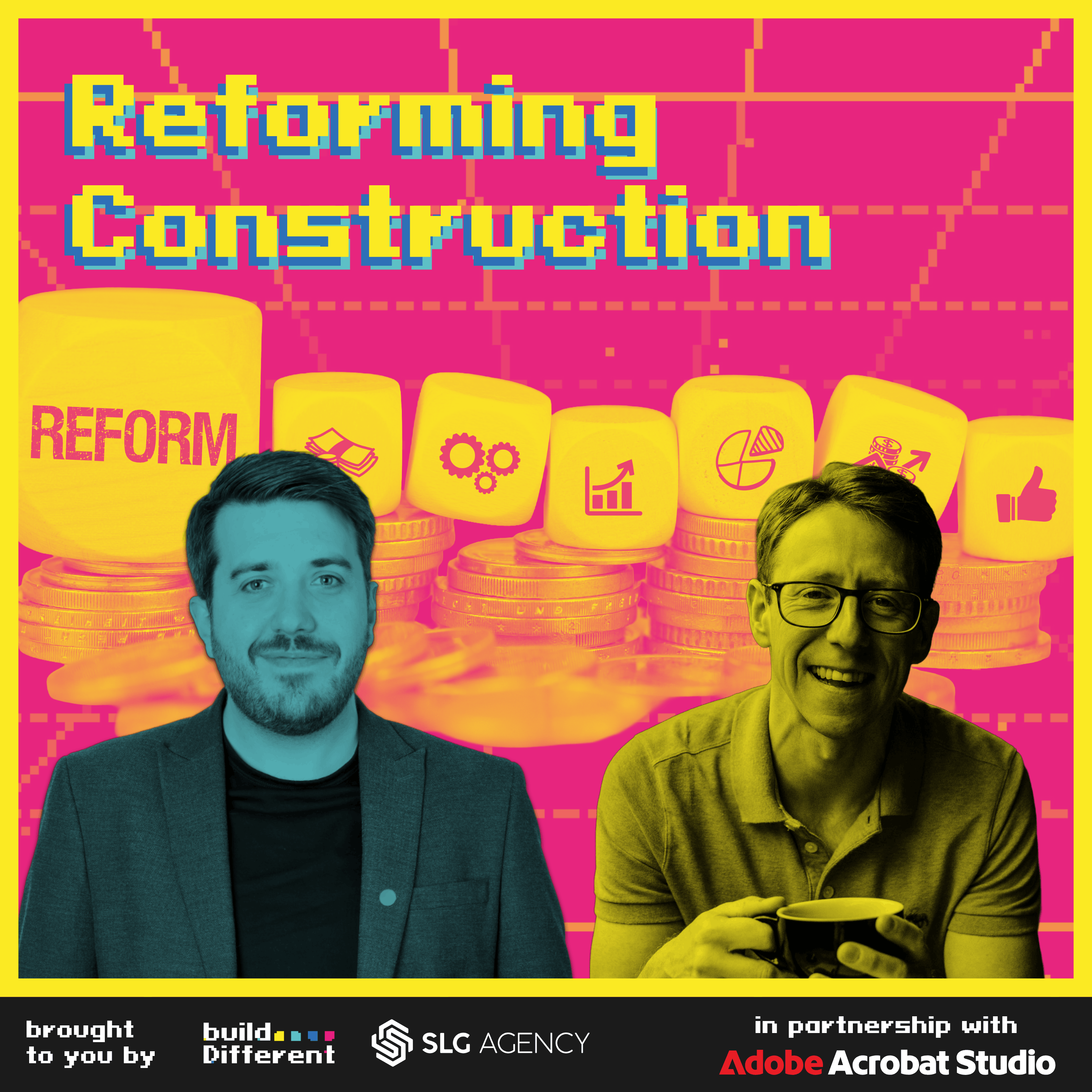
    Reforming Construction | Episode 127

    Construction Disrupted Episode 127 - Reforming Construction (05.08.26) in partnership with Adobe Acrobat Studio. Check them out and show them some love. In this episode, we're discussing industry confidence, the future of technical education, and the complexities of reforming construction professions. Let's go! Construction confidence jumps to highest level this year Construction firms in the UK are experiencing a surge in optimism, with sector confidence reaching its highest point in over a year. According to the latest Lloyds Business Barometer, confidence jumped 10 points to 56%, well above the 12-month average. Key drivers include stronger customer demand and improved financial conditions, with 65% of firms planning to hire more staff. Optimism about the wider economy is also on the rise, supported by steady interest rates and lower global energy prices. This renewed confidence signals a shift from short-term survival to long-term planning and investment in people and capacity. ICE: Why we need to build technical education to last Steve Feeley from the Institution of Civil Engineers highlights the cultural shift needed in technical education. He argues that success should not be measured solely by academic routes but by diverse pathways, including apprenticeships and vocational training. The goal is to create a system where all routes - academic and technical - are valued equally, enabling more young people to see themselves in engineering and infrastructure careers. Feeley calls for policymakers to listen to educators, employers, and students, build cross-party consensus, and ensure reforms are practical for schools. The focus should be on connecting existing pathways and supporting teachers, rather than imposing rapid, unsupported changes. Paul Morrell: The problem with reforming construction professions is knowing where to start Paul Morrell, former chief construction adviser, examines the daunting task of reforming construction professions. He notes the complexity of the sector, with numerous stakeholders and overlapping competencies. Morrell warns against creating a "Christmas tree" of regulations and stresses the need for government clarity on its role, whether as sponsor, client, or regulator. He suggests that reforms must be focused, enforceable, and proportionate, with clear standards of competence and accountability. Morrell also emphasizes that government should lead by example, ensuring its own procurement and regulatory practices reflect the standards it expects from the industry. Call for Evidence: Strategy for the built environment professions, trades and occupations Bios Ryan Jones - SLG Agency For almost 20 years, Ryan’s focus has been on helping brands in the construction and manufacturing sectors tell their story. His career began in PR, working for global businesses across a variety of sectors, before opting to focus on construction and the built environment. In his role as Managing Director, Ryan works to ensure that SLG Agency continues to be one of the construction industry's leading specialist strategic and creative agencies, having seen its work recognised by the likes of Campaign, Marketing Week and The Drum in recent years. Ryan is regularly asked to speak at trade shows and events, and to contribute thought leadership pieces to trade media. He is also a member of several industry advisory boards, including Constructing Excellence and the Greater Manchester Chamber of Commerce. His passion for the construction sector has seen him work with clients on CSR campaigns that tackle the sector’s public perception, culminating in him recently launching a not-for-profit called Deconstruction. Peter Sumpton - buildDifferent Peter is a construction–marketing strategist and co-host of Construction Disrupted. With two decades’ experience spanning manufacturers, contractors and agencies, he helps organisations swap scattergun activity for clear strategy, joined-up planning and measurable outcomes. His approach is practical and plain-spoken: cut the noise, focus on what moves the numbers, and build repeatable systems that teams can actually use. Having seen first-hand how unfocused tactics waste time and budget, Peter works with leaders to align commercial goals, customer insight and content so marketing supports delivery rather than distracting from it. Peter's passion lies in diagnosing organisations' marketing functions' capabilities and existing market, assembling what’s required to create a functional strategy, fit for purpose and scalable. Marketing should create value, not just cost, and Peter’s work is about making that the norm.

  • #126
    July 29 · 36 min

    Shuffling Cabinets | Episode 126

    Construction Disrupted Episode 126 - Shuffling Cabinets (29.07.26) in partnership with Adobe Acrobat Studio. Check them out and show them some love. In this episode, we're discussing key cabinet appointments, regulatory changes in building safety, and the rapid rise of AI in architecture, each with major implications for the UK construction industry. Let's go Andy Burnham’s cabinet: Faces the construction industry should know The new UK cabinet under Prime Minister Andy Burnham introduces several important figures for the construction sector. John Healey, now Chancellor of the Exchequer, is expected to play a major role in funding and investment decisions. Angela Rayner returns as Housing Secretary, bringing experience from her previous tenure, where she led significant housing reforms and prioritised affordable and social housing. Miatta Fahnbulleh, the new Energy Secretary, is known for her expertise in energy efficiency and net zero policy, and her background as an economist and policy developer signals a continued focus on sustainable energy projects. Other notable appointments include Matthew Pennycook as Housing Minister, Wes Streeting as Defence Secretary, and Kanishka Narayan as Minister for AI. Industry leaders have welcomed these appointments, emphasising the importance of strong leadership for housing delivery, planning reform, and energy efficiency. BSR puts main contractors on notice over subcontractor quality The Building Safety Regulator (BSR) is increasing its scrutiny of how main contractors manage subcontractors on high-risk projects. The regulator expects main contractors to have experienced staff who can assess and challenge subcontractor workmanship, ensuring that on-site work matches approved designs. Regular inspections will be conducted to verify compliance from the design approval stage (gateway two) through to project completion (gateway three). This heightened oversight is a response to past failures, such as those seen in the Grenfell Tower tragedy, which highlighted the dangers of poor subcontractor management. Gateway two approval rates have improved significantly, rising to around 85%, and determination times have dropped, but the final success of projects depends on effective quality control throughout the supply chain. AI adoption reaches tipping point across UK architecture – but human judgement remains critical AI is rapidly transforming UK architecture, with 74% of practices now using AI for most projects, up from 59% last year. Many practices report productivity gains and positive returns on investment, but there are concerns about the impact on early-career professionals, as 61% believe AI makes it harder for them to gain essential skills. Despite the widespread adoption, only a minority think AI improves design quality, and the majority believe that human creativity and judgement remain irreplaceable. The Royal Institute of British Architects (RIBA) stresses the need for competence-led regulation and responsible AI use, ensuring that critical decisions remain in the hands of qualified professionals. The profession recognises the benefits of AI but maintains that human oversight is essential for high-quality, safe, and sustainable design. Bios Ryan Jones - SLG Agency For almost 20 years, Ryan’s focus has been on helping brands in the construction and manufacturing sectors tell their story. His career began in PR, working for global businesses across a variety of sectors, before opting to focus on construction and the built environment. In his role as Managing Director, Ryan works to ensure that SLG Agency continues to be one of the construction industry's leading specialist strategic and creative agencies, having seen its work recognised by the likes of Campaign, Marketing Week and The Drum in recent years. Ryan is regularly asked to speak at trade shows and events, and to contribute thought leadership pieces to trade media. He is also a member of several industry advisory boards, including Constructing Excellence and the Greater Manchester Chamber of Commerce. His passion for the construction sector has seen him work with clients on CSR campaigns that tackle the sector’s public perception, culminating in him recently launching a not-for-profit called Deconstruction. Peter Sumpton - buildDifferent Peter is a construction–marketing strategist and co-host of Construction Disrupted. With two decades’ experience spanning manufacturers, contractors and agencies, he helps organisations swap scattergun activity for clear strategy, joined-up planning and measurable outcomes. His approach is practical and plain-spoken: cut the noise, focus on what moves the numbers, and build repeatable systems that teams can actually use. Having seen first-hand how unfocused tactics waste time and budget, Peter works with leaders to align commercial goals, customer insight and content so marketing supports delivery rather than distracting from it. Peter's passion lies in diagnosing organisations' marketing functions' capabilities and existing market, assembling what’s required to create a functional strategy, fit for purpose and scalable. Marketing should create value, not just cost, and Peter’s work is about making that the norm.

  • #125
    July 22 · 40 min

    Build it and they will come, but won't stay | Episode 125

    Construction Disrupted Episode 125 - Build it and they will come, but won't stay (22.07.26) in partnership with Adobe Acrobat Studio. Check them out and show them some love. In this episode, we're discussing government intervention in housebuilding, the real challenge of retaining talent, and how data-driven innovation is transforming development and community trust. Let's go! State housebuilder could support sector through troughs, minister says Housing secretary Steve Reed has revealed that the UK government is considering the creation of a state-owned housebuilder. This initiative aims to support the construction sector during market downturns, maintaining activity and preserving skills, investment, and delivery capacity when private demand weakens. Reed emphasised that while private housebuilders would still deliver most homes, a state-backed developer could help smooth out the effects of deep market troughs, preventing the loss of skilled workers and ensuring a faster recovery. The proposal is in early stages, with officials examining potential models and the broader implications for regional devolution and council housebuilding. Attracting talent isn’t the problem… keeping it is The construction industry has made progress in attracting young talent, but retention remains a significant challenge. Many new entrants leave within their first year, resulting in the loss of future leaders and specialists. The article highlights the importance of structured onboarding, mentorship, and exposure to various roles to help new recruits find their place and purpose. Companies like Legendre UK have seen success with sustained investment in training and rotating young employees through different departments. The sector must also improve its image, showcase its impact, and create inclusive environments to appeal to a diverse workforce. Ultimately, recruitment should be the start of a conversation about long-term career growth and support. Fabian Society - Building Skills Report Data can open doors to new development Real-time data monitoring is revolutionising the built environment by increasing efficiency, enabling proactive decision-making, and building public trust. Technologies like Stantec’s ADAhub platform integrate live data from sensors monitoring noise, air quality, and vibration, helping teams address issues early and comply with regulations. Transparent data sharing can reduce community opposition to new developments by demonstrating efforts to minimise disruption and environmental impact. Case studies in Birmingham, Stockport, and Wrexham show how data-driven approaches have improved air quality and fostered positive relationships with local communities. Embracing smart technology and environmental monitoring is key to creating sustainable, trusted, and community-focused developments. Bios Ryan Jones - SLG Agency For almost 20 years, Ryan’s focus has been on helping brands in the construction and manufacturing sectors tell their story. His career began in PR, working for global businesses across a variety of sectors, before opting to focus on construction and the built environment. In his role as Managing Director, Ryan works to ensure that SLG Agency continues to be one of the construction industry's leading specialist strategic and creative agencies, having seen its work recognised by the likes of Campaign, Marketing Week and The Drum in recent years. Ryan is regularly asked to speak at trade shows and events, and to contribute thought leadership pieces to trade media. He is also a member of several industry advisory boards, including Constructing Excellence and the Greater Manchester Chamber of Commerce. His passion for the construction sector has seen him work with clients on CSR campaigns that tackle the sector’s public perception, culminating in him recently launching a not-for-profit called Deconstruction. Peter Sumpton - buildDifferent Peter is a construction–marketing strategist and co-host of Construction Disrupted. With two decades’ experience spanning manufacturers, contractors and agencies, he helps organisations swap scattergun activity for clear strategy, joined-up planning and measurable outcomes. His approach is practical and plain-spoken: cut the noise, focus on what moves the numbers, and build repeatable systems that teams can actually use. Having seen first-hand how unfocused tactics waste time and budget, Peter works with leaders to align commercial goals, customer insight and content so marketing supports delivery rather than distracting from it. Peter's passion lies in diagnosing organisations' marketing functions' capabilities and existing market, assembling what’s required to create a functional strategy, fit for purpose and scalable. Marketing should create value, not just cost, and Peter’s work is about making that the norm.

  • #124
    July 15 · 37 min

    Constructions Guilty Pleasure | Episode 124

    Construction Disrupted Episode 124 - Constructions Guilty Pleasure (15.07.26) in partnership with Adobe Acrobat Studio. Check them out and show them some love. In this episode, we're discussing calls for stronger safety reforms, the use of robotics on building sites, and what’s really playing in the vans of Britain’s tradespeople. Let's go! Hackitt-led group calls for ‘firmer approach’ to industry A recent report from the Industry Safety Steering Group, chaired by Dame Judith Hackitt, highlights that the construction sector has not changed enough in response to post-Grenfell safety recommendations. While some industry bodies have engaged with government and regulators, the group is concerned that many companies have not acknowledged underlying problems or taken ownership for meaningful change. The report stresses the need for the industry to work together to create a future focused on high building safety standards. It criticises clients for prioritising cost over quality and perpetuating mistrust through practices like retentions, which undermine safety and quality. The group urges the government to lead by example in procurement and contracting, and to accelerate overdue reforms in construction product testing and regulation, emphasising that both incentives and sanctions are needed to drive real progress. Annual Report February 2026: the construction industry. McLaren employs robot army for site quality checks McLaren Construction has partnered with FieldAI to introduce autonomous quadruped robots to its UK sites. These robots are being used to capture 360-degree site imagery and generate data that supports safety compliance and quality assurance. The robots conduct regular automated scans, creating a detailed visual and spatial record of ongoing work. AI-driven analysis compares this data against design models, allowing for quicker identification of quality issues. Unlike previous generations of robots, these machines can navigate complex, changing environments without relying on pre-mapped routes, adapting as the site evolves. This deployment marks a significant step in McLaren’s five-year digital transformation strategy, with plans to expand the robots’ roles from monitoring to logistics and multi-robot coordination, all while working alongside human teams to enhance productivity, safety, and quality. Radio still dominates van listening – and today’s tradies are Swifties According to new research from InstallerSHOW, traditional radio remains the top choice for UK tradespeople while driving or working, with nearly three-quarters preferring it over other audio options. Only a small percentage regularly listen to podcasts, while personal playlists are the second most popular choice. When it comes to music tastes, nostalgic acts like Oasis, Queen, Taylor Swift, and ABBA are the most common “guilty pleasures,” though some newer artists like Sabrina Carpenter and Coldplay also make the list. The findings suggest that, despite the rise of podcasts in the wider market, radio still holds a strong place in the daily routines of tradespeople. The InstallerSHOW 2026 and National Heat Pump Week are also highlighted as key upcoming events for the sector. Bios Ryan Jones - SLG Agency For almost 20 years, Ryan’s focus has been on helping brands in the construction and manufacturing sectors tell their story. His career began in PR, working for global businesses across a variety of sectors, before opting to focus on construction and the built environment. In his role as Managing Director, Ryan works to ensure that SLG Agency continues to be one of the construction industry's leading specialist strategic and creative agencies, having seen its work recognised by the likes of Campaign, Marketing Week and The Drum in recent years. Ryan is regularly asked to speak at trade shows and events, and to contribute thought leadership pieces to trade media. He is also a member of several industry advisory boards, including Constructing Excellence and the Greater Manchester Chamber of Commerce. His passion for the construction sector has seen him work with clients on CSR campaigns that tackle the sector’s public perception, culminating in him recently launching a not-for-profit called Deconstruction. Peter Sumpton - buildDifferent Peter is a construction–marketing strategist and co-host of Construction Disrupted. With two decades’ experience spanning manufacturers, contractors and agencies, he helps organisations swap scattergun activity for clear strategy, joined-up planning and measurable outcomes. His approach is practical and plain-spoken: cut the noise, focus on what moves the numbers, and build repeatable systems that teams can actually use. Having seen first-hand how unfocused tactics waste time and budget, Peter works with leaders to align commercial goals, customer insight and content so marketing supports delivery rather than distracting from it. Peter's passion lies in diagnosing organisations' marketing functions' capabilities and existing market, assembling what’s required to create a functional strategy, fit for purpose and scalable. Marketing should create value, not just cost, and Peter’s work is about making that the norm.

  • #123
    July 8 · 37 min

    UK Government Clearing the Sewage | Episode 123

    Construction Disrupted Episode 123 - UK Government Clearing the Sewage (08.07.26) in partnership with Adobe Acrobat Studio. Check them out and show them some love. In this episode, we're discussing the latest developments shaping the UK construction and housing landscape. We’ll explore political pledges, breakthrough infrastructure deals, and the critical skills gap threatening new-town ambitions. Let's go! Will Andy Burnham’s pledge of growth in every postcode deliver bricks and mortar? Andy Burnham, poised to become the UK’s next prime minister, is recognized for his clear and inspirational communication. His 10-year plan emphasizes investment beyond London, collaboration, and delivering “good growth for all.” However, the real challenge lies in translating this vision into tangible results. Burnham must leverage existing government capacity and capability to create momentum, especially as the nation expects policy promises to materialize by the third year of the parliamentary term. The effectiveness of his leadership will be measured by the ability to deliver actual construction and regeneration across every postcode, not just rhetoric. Ministers clear sewage works deadlock stalling 18,000 homes A major breakthrough has been achieved as the government, through the Water Delivery Taskforce, brokered a deal with Anglian Water to resolve wastewater capacity issues that had stalled nearly 20,000 homes in the East of England. The agreement introduces a phased infrastructure strategy, allowing housing developments and utility upgrades to progress together. Key schemes now moving forward include: 7,750 homes at Tendring Colchester Borders Garden Community 3,700 homes at Dunton Hills, Essex 3,400 homes at Spitalgate Heath, Grantham 3,200 homes at Baldock, Hertfordshire 21 homes at Beccles, Suffolk The deal also initiates plans for a new water recycling centre and a strategic reservoir, marking another success for the government’s efforts to unblock housing delivery by addressing utility constraints. Construction skills shortages threaten new-town delivery, MPs told The government’s ambition to build tens of thousands of homes in seven new towns faces a significant hurdle: construction skills shortages. Jonathan Mitchell of Skills England warned MPs that talent gaps pose a “real risk” to these plans. The success of large-scale housing projects depends on a robust workforce, and current shortages could delay or derail delivery. Addressing this challenge will require coordinated efforts to attract, train, and retain skilled workers across the sector. Bios Ryan Jones - SLG Agency For almost 20 years, Ryan’s focus has been on helping brands in the construction and manufacturing sectors tell their story. His career began in PR, working for global businesses across a variety of sectors, before opting to focus on construction and the built environment. In his role as Managing Director, Ryan works to ensure that SLG Agency continues to be one of the construction industry's leading specialist strategic and creative agencies, having seen its work recognised by the likes of Campaign, Marketing Week and The Drum in recent years. Ryan is regularly asked to speak at trade shows and events, and to contribute thought leadership pieces to trade media. He is also a member of several industry advisory boards, including Constructing Excellence and the Greater Manchester Chamber of Commerce. His passion for the construction sector has seen him work with clients on CSR campaigns that tackle the sector’s public perception, culminating in him recently launching a not-for-profit called Deconstruction. Peter Sumpton - buildDifferent Peter is a construction–marketing strategist and co-host of Construction Disrupted. With two decades’ experience spanning manufacturers, contractors and agencies, he helps organisations swap scattergun activity for clear strategy, joined-up planning and measurable outcomes. His approach is practical and plain-spoken: cut the noise, focus on what moves the numbers, and build repeatable systems that teams can actually use. Having seen first-hand how unfocused tactics waste time and budget, Peter works with leaders to align commercial goals, customer insight and content so marketing supports delivery rather than distracting from it. Peter's passion lies in diagnosing organisations' marketing functions' capabilities and existing market, assembling what’s required to create a functional strategy, fit for purpose and scalable. Marketing should create value, not just cost, and Peter’s work is about making that the norm.

  • #122
    July 1 · 39 min

    Yes, We're Still Talking About Brexit | Episode 122

    Construction Disrupted Episode 122 - Yes, We're Still Talking About Brexit (01.07.26) in partnership with Adobe Acrobat Studio. Check them out and show them some love. In this episode, we're discussing the aftershocks of Brexit, the fierce debate over product safety rules, and a bold new approach to training the next generation of tradespeople. Let's do this! Poll shows construction professionals believe Brexit was wrong A recent YouGov poll of 136 construction professionals reveals that 59% believe leaving the EU was the wrong decision, with only 33% supporting Brexit. If a new referendum were held, 52% would vote to rejoin the EU. The poll highlights ongoing concerns about Brexit's impact on employment and supply chains. While construction employment has declined since 2019, experts note that the primary cause is an aging workforce rather than Brexit alone. However, Brexit continues to disrupt supply chains, with about 10% of UK firms still attributing delays to it. The episode features industry leaders discussing both immediate and lingering effects of Brexit on construction, including labor shortages and increased delivery times. If product safety matters, the rules must apply to everyone Paul Morrell critiques the UK government's construction product safety reforms, arguing that new safety duties should apply to all products, regardless of origin. The current white paper proposes stricter regulations for UK businesses while allowing EU CE-marked products to enter the market without additional requirements. This dual system creates complexity and potential safety risks, as CE marking does not guarantee product safety. Morrell warns that imposing higher standards only on domestic producers is both unfair and counterproductive, potentially driving manufacturing and testing overseas. He calls for a unified approach: if safety measures are necessary, they must be universal to ensure public protection and industry clarity. FMB pilot aims to build pipeline of site-ready tradespeople The Federation of Master Builders (FMB), with support from the Construction Industry Training Board, has launched Build Academy—a pilot program designed to address the construction skills shortage. The academy offers hands-on, multi-trade training in a simulated site environment, preparing students for real-world work. The first cohort of 20 graduates has progressed from no site experience to being job-ready, with many reporting increased confidence and ambition. The FMB hopes to expand the program, emphasizing the importance of employer-led training in building a skilled workforce to meet the UK's housing Bios Ryan Jones - SLG Agency For almost 20 years, Ryan’s focus has been on helping brands in the construction and manufacturing sectors tell their story. His career began in PR, working for global businesses across a variety of sectors, before opting to focus on construction and the built environment. In his role as Managing Director, Ryan works to ensure that SLG Agency continues to be one of the construction industry's leading specialist strategic and creative agencies, having seen its work recognised by the likes of Campaign, Marketing Week and The Drum in recent years. Ryan is regularly asked to speak at trade shows and events, and to contribute thought leadership pieces to trade media. He is also a member of several industry advisory boards, including Constructing Excellence and the Greater Manchester Chamber of Commerce. His passion for the construction sector has seen him work with clients on CSR campaigns that tackle the sector’s public perception, culminating in him recently launching a not-for-profit called Deconstruction. Peter Sumpton - buildDifferent Peter is a construction–marketing strategist and co-host of Construction Disrupted. With two decades’ experience spanning manufacturers, contractors and agencies, he helps organisations swap scattergun activity for clear strategy, joined-up planning and measurable outcomes. His approach is practical and plain-spoken: cut the noise, focus on what moves the numbers, and build repeatable systems that teams can actually use. Having seen first-hand how unfocused tactics waste time and budget, Peter works with leaders to align commercial goals, customer insight and content so marketing supports delivery rather than distracting from it. Peter's passion lies in diagnosing organisations' marketing functions' capabilities and existing market, assembling what’s required to create a functional strategy, fit for purpose and scalable. Marketing should create value, not just cost, and Peter’s work is about making that the norm.

  • #121
    June 24 · 40 min

    Did We Mention 1.5 Million Homes? | Episode 121

    Construction Disrupted Episode 121 - Did We Mention 1.5 Million Homes? (24.06.26) in partnership with Adobe Acrobat Studio. Check them out and show them some love. In this episode, we're discussing the future of the UK's built environment if the King of the North was elected, the impact of AI on planning, and the architectural lowlights of the past two years. Dive into our three featured stories for a comprehensive look at policy, technology, and design in Britain. Let's go! What would prime minister Burnham look like for the built environment? Andy Burnham's potential as UK Prime Minister signals a major shift for housing, infrastructure, and skills. His agenda prioritises: Social Housing: Burnham advocates for a massive increase in council housebuilding, aiming for 500,000 new social rent homes by 2030 and ending Right to Buy. He proposes redirecting existing funding and exploring innovative financing, such as local tax supplements and land value capture. Infrastructure: He supports reviving HS2 between Birmingham and Manchester, but with a slower, cheaper model funded partly by local taxpayers. Burnham also champions the Northern Powerhouse Rail and improved regional transport links. Skills & Education: Burnham’s MBacc program in Greater Manchester offers a technical education pathway, focusing on sectors like construction and the green economy. He envisions nationwide rollout, guaranteeing work placements for 16–18-year-olds. While ambitious, these plans may face fiscal and political constraints, but they mark a clear intent to reshape the built environment. AI tool to slash planning decision times as government accelerates push to build 1.5 million homes The UK government has introduced two AI tools to modernise England’s planning system: AI Prototype for Applications: Currently in early testing, this tool aims to halve the processing time for householder planning applications from 8 to 4 weeks. It triages and summarises applications, supporting planning officers in decision-making. Extract Tool: Now available to all councils, Extract digitises decades-old planning documents, saving an estimated 250,000 hours annually. This streamlines access to planning data and supports faster, more reliable decisions. These innovations are part of a broader push to build 1.5 million homes, reduce administrative burdens, and accelerate housing delivery. Importantly, all AI-assisted decisions are reviewed by qualified officers, ensuring professional oversight. The Carbuncle Cup 2026 The Carbuncle Cup 2026 highlights the worst new buildings in Britain, as judged by a panel of experts and public nominations. This year’s (dis)honours go to: Astley Warehouses: Criticised for its scale, poor design, and as a symbol of bureaucracy and greed over quality of life. Filigree: Noted for technical failures, resident displacement, and failing to deliver on affordable housing promises. Other shortlisted buildings include Robeson House, Belgrove, Aspen Tower, and Art’otel in Hoxton, each exemplifying issues like incoherent design, poor integration, and value engineering gone wrong. The Cup serves as a cautionary tale about the consequences of prioritising scale and cost over community and quality. Bios Ryan Jones - SLG Agency For almost 20 years, Ryan’s focus has been on helping brands in the construction and manufacturing sectors tell their story. His career began in PR, working for global businesses across a variety of sectors, before opting to focus on construction and the built environment. In his role as Managing Director, Ryan works to ensure that SLG Agency continues to be one of the construction industry's leading specialist strategic and creative agencies, having seen its work recognised by the likes of Campaign, Marketing Week and The Drum in recent years. Ryan is regularly asked to speak at trade shows and events, and to contribute thought leadership pieces to trade media. He is also a member of several industry advisory boards, including Constructing Excellence and the Greater Manchester Chamber of Commerce. His passion for the construction sector has seen him work with clients on CSR campaigns that tackle the sector’s public perception, culminating in him recently launching a not-for-profit called Deconstruction. Peter Sumpton - buildDifferent Peter is a construction–marketing strategist and co-host of Construction Disrupted. With two decades’ experience spanning manufacturers, contractors and agencies, he helps organisations swap scattergun activity for clear strategy, joined-up planning and measurable outcomes. His approach is practical and plain-spoken: cut the noise, focus on what moves the numbers, and build repeatable systems that teams can actually use. Having seen first-hand how unfocused tactics waste time and budget, Peter works with leaders to align commercial goals, customer insight and content so marketing supports delivery rather than distracting from it. Peter's passion lies in diagnosing organisations' marketing functions' capabilities and existing market, assembling what’s required to create a functional strategy, fit for purpose and scalable. Marketing should create value, not just cost, and Peter’s work is about making that the norm.

  • #120
    June 17 · 36 min

    Unlocking 500,000 Houses | Episode 120

    Construction Disrupted Episode 120 - Unlocking 500,000 Houses (17.06.26) in partnership with Adobe Acrobat Studio. Check them out and show them some love. In this episode, we're discussing the latest in UK infrastructure, housing regeneration, and construction project delivery. From renewed investor confidence in infrastructure, to ambitious plans for housing-led regeneration in the North, and new evidence on how early contractor involvement can transform project outcomes. Let's go! Investment sentiment in UK infrastructure improving despite geopolitical instability, survey finds Investor confidence in UK infrastructure is at its highest since 2023, even amid global and domestic uncertainty. The UK now outperforms several European peers for infrastructure investment attractiveness. This optimism is driven by government efforts to address regulatory challenges, especially in the water sector, and to improve accountability. However, regulatory complexity and political instability remain significant barriers. Notably, more investors plan to deploy $2–3 billion in UK infrastructure over the next year, with a growing focus on net zero projects. Maintaining a strong project pipeline and a stable regulatory environment is essential to sustain this positive momentum. Housing-led regeneration could unlock 500,000 homes in the North with the right support, report says A Northern Housing Consortium report finds that targeted regeneration could unlock over 500,000 homes in the North of England. Key recommendations include a £500 million annual regeneration fund devolved to mayoral authorities, a dedicated regeneration finance facility via Homes England, and a minister for regeneration. The report suggests these measures could accelerate 100,000 homes through town centre densification, unlock 320,000 homes on brownfield land, and improve 100,000 existing homes. The right framework would enable more social and affordable housing and transform communities in need of investment. Early contractor involvement cuts project cost overruns, study finds A major study by the Centre for Construction Best Practice shows that early contractor involvement (ECI) in public sector projects significantly reduces cost overruns and delays. Projects with contractors engaged at the earliest design stages (RIBA 0–2) delivered on or below budget, while late appointments (RIBA 4) saw average cost overruns of 17.35%. Despite this, most public sector projects still use late-stage procurement, exposing them to avoidable risks. The report recommends mandating ECI by RIBA Stage 2, strengthening public sector capability, and introducing mandatory value checks. Early engagement enables innovation and better project certainty, crucial for future public investments. Bios Ryan Jones - SLG Agency For almost 20 years, Ryan’s focus has been on helping brands in the construction and manufacturing sectors tell their story. His career began in PR, working for global businesses across a variety of sectors, before opting to focus on construction and the built environment. In his role as Managing Director, Ryan works to ensure that SLG Agency continues to be one of the construction industry's leading specialist strategic and creative agencies, having seen its work recognised by the likes of Campaign, Marketing Week and The Drum in recent years. Ryan is regularly asked to speak at trade shows and events, and to contribute thought leadership pieces to trade media. He is also a member of several industry advisory boards, including Constructing Excellence and the Greater Manchester Chamber of Commerce. His passion for the construction sector has seen him work with clients on CSR campaigns that tackle the sector’s public perception, culminating in him recently launching a not-for-profit called Deconstruction. Peter Sumpton - buildDifferent Peter is a construction–marketing strategist and co-host of Construction Disrupted. With two decades’ experience spanning manufacturers, contractors and agencies, he helps organisations swap scattergun activity for clear strategy, joined-up planning and measurable outcomes. His approach is practical and plain-spoken: cut the noise, focus on what moves the numbers, and build repeatable systems that teams can actually use. Having seen first-hand how unfocused tactics waste time and budget, Peter works with leaders to align commercial goals, customer insight and content so marketing supports delivery rather than distracting from it. Peter's passion lies in diagnosing organisations' marketing functions' capabilities and existing market, assembling what’s required to create a functional strategy, fit for purpose and scalable. Marketing should create value, not just cost, and Peter’s work is about making that the norm.

  • #119
    June 10 · 35 min

    A Familia Story For UK Construction | Episode 119

    Construction Disrupted Episode 119 - A Familia Story For UK Construction (10.06.26) in partnership with Adobe Acrobat Studio. Check them out and show them some love. In this episode, we're delving into the evolving landscape of the UK construction industry, examining market trends, workforce initiatives, and efforts to address skills shortages. Each headline provides insight into a major development that is set to shaping the sector’s future. Let's go: Is UK commercial construction experiencing a comeback? The UK construction sector continues to face significant challenges, with Glenigan’s June 2026 Construction Index showing a 7% drop in project starts over the last quarter and a 23% decline year-on-year. The industry is grappling with persistent economic uncertainty, political distractions, and the ongoing Middle East conflict, all of which have contributed to a subdued market. Residential construction remains particularly weak, with private housing starts falling sharply due to affordability issues and reduced investor confidence. Civil engineering and infrastructure projects have also seen notable declines, reflecting a lack of momentum in planned capital works. Despite these headwinds, there are signs of resilience in non-residential construction. Office projects have experienced remarkable growth, buoyed by major developments in London, while retail and leisure sectors have shown modest gains, hinting at a tentative return of consumer confidence. Public sector construction, especially in education and health, has also posted positive results. Regionally, London stands out with strong performance, largely driven by office construction, while other areas show mixed results. Although the overall outlook remains cautious, these pockets of growth suggest that a broader recovery could be on the horizon if economic conditions stabilise. Construction careers campaign could help tackle rising youth unemployment, says CIOB The Chartered Institute of Building (CIOB) emphasises the importance of targeted careers campaigns to address both rising youth unemployment and the construction sector’s skills shortages. With an aging workforce and a growing need for skilled professionals, the CIOB advocates for greater collaboration between industry, government, and educational institutions. By promoting construction as a viable and rewarding career path, and by connecting young people with training and apprenticeship opportunities, such campaigns can help bridge the gap between job seekers and employers. These efforts are seen as essential not only for reducing youth unemployment but also for ensuring the long-term sustainability and growth of the construction industry. CITB launches Accelerated Apprenticeships to boost homebuilding and tackle regional skills shortages The Construction Industry Training Board (CITB) has launched Accelerated Apprenticeships as part of a broader strategy to meet the government’s target of building 1.5 million new homes by 2029 and to address regional skills shortages. This innovative programme allows apprentices to complete their training in as little as 14 to 18 months, compared to the traditional two to three years, by combining intensive early learning with structured block release and on-site experience. The initial rollout targets regions with high housing demand and training gaps, including Greater Manchester, West Yorkshire, the West Midlands, Kent, and Bedfordshire/Hertfordshire. CITB is supporting colleges and training providers with setup funding and ongoing assistance, aiming to increase apprenticeship uptake and completion rates. The programme also places a strong emphasis on long-term employment outcomes, ensuring that trainees are well-prepared for sustained careers in homebuilding. By accelerating the training process and aligning it with local labour market needs, CITB hopes to create a more resilient and responsive construction workforce. Lego gets Familia: https://www.dezeen.com/2026/06/04/lego-sagrada-familia-largest-set-antoni-gaudi/) Bios Ryan Jones - SLG Agency For almost 20 years, Ryan’s focus has been on helping brands in the construction and manufacturing sectors tell their story. His career began in PR, working for global businesses across a variety of sectors, before opting to focus on construction and the built environment. In his role as Managing Director, Ryan works to ensure that SLG Agency continues to be one of the construction industry's leading specialist strategic and creative agencies, having seen its work recognised by the likes of Campaign, Marketing Week and The Drum in recent years. Ryan is regularly asked to speak at trade shows and events, and to contribute thought leadership pieces to trade media. He is also a member of several industry advisory boards, including Constructing Excellence and the Greater Manchester Chamber of Commerce. His passion for the construction sector has seen him work with clients on CSR campaigns that tackle the sector’s public perception, culminating in him recently launching a not-for-profit called Deconstruction. Peter Sumpton - buildDifferent Peter is a construction–marketing strategist and co-host of Construction Disrupted. With two decades’ experience spanning manufacturers, contractors and agencies, he helps organisations swap scattergun activity for clear strategy, joined-up planning and measurable outcomes. His approach is practical and plain-spoken: cut the noise, focus on what moves the numbers, and build repeatable systems that teams can actually use. Having seen first-hand how unfocused tactics waste time and budget, Peter works with leaders to align commercial goals, customer insight and content so marketing supports delivery rather than distracting from it. Peter's passion lies in diagnosing organisations' marketing functions' capabilities and existing market, assembling what’s required to create a functional strategy, fit for purpose and scalable. Marketing should create value, not just cost, and Peter’s work is about making that the norm.

Showing 1–20 of 20 episodes