Cold Logic · April 28 · 45 min
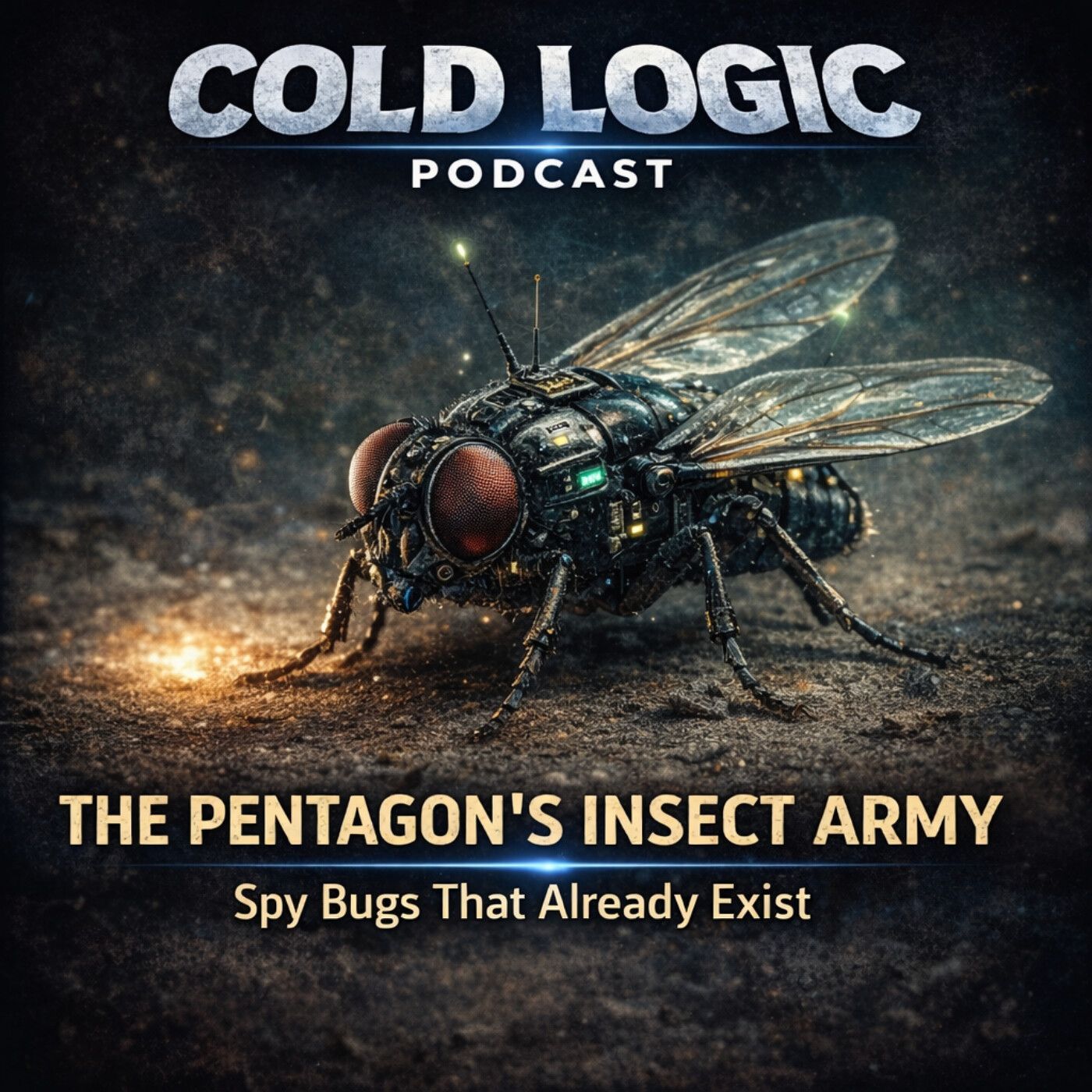
COLD LOGIC "The Pentagon's Insect Army: Spy Bugs That Already Exist"
0:00-45:08
transcript
show notes
COLD LOGIC "The Pentagon's Insect Army: Spy Bugs That Already Exist"
Cold Logic is the investigative podcast that follows the signal — tracking the intersection of suppressed science, frontier research, and the questions that powerful institutions would rather you not ask. Each episode builds a case from documented evidence and follows it wherever it leads.
What if the most dangerous surveillance device in existence weighs twelve milligrams and has already been in your home? In Episode 2 of Cold Logic, we follow the documented evidence of the Pentagon's cyborg insect programs — the federally funded research that was published, demonstrated, and then went quiet in the way that defense technology always goes quiet when it moves from proof of concept to operational capability.We trace the DARPA HI-MEMS program — Hybrid Insect Micro-Electro-Mechanical Systems — and the University of California Berkeley experiments that produced remotely controlled beetles with implanted neural electrodes. We examine the metamorphic integration technique that embeds electronics into an insect before it fully forms, so that by the time it emerges as an adult, the hardware is part of its biology. We cover parallel programs using moths as living chemical sensors, honeybee colonies as trained explosive detectors, and DARPA's DragonflEye project which achieved wireless directional control of a dragonfly using an optical neural interface — all published, all federally funded, all gone dark.Then we ask the question the public record has been constructed to leave unanswered: what does fifteen years of classified refinement produce? And we examine the legal framework — or the absence of one — that governs a surveillance platform that is not a device, not a wiretap, and not a drone, but an organism that was already going to be there.This isn't conspiracy theory. It's Cold Logic.
Did DARPA really create cyborg insects? A: Yes. DARPA funded a program called HI-MEMS — Hybrid Insect Micro-Electro-Mechanical Systems — which produced documented results including remotely controlled beetles with implanted neural electrodes. Researchers at UC Berkeley demonstrated directional flight control of large beetles via wireless radio commands to electronics implanted during the pupal stage of metamorphosis. Results were published in peer-reviewed literature and DARPA's funding was acknowledged.What is the DARPA DragonflEye program? A: DragonflEye was a publicly acknowledged DARPA program developed in partnership with Howard Hughes Medical Institute that achieved directional control of live dragonflies using a miniaturized optical neural interface. Light pulses transmitted through a tiny backpack device activated specific neurons in the dragonfly's ventral nerve cord, producing left, right, up,
Cold Logic is the investigative podcast that follows the signal — tracking the intersection of suppressed science, frontier research, and the questions that powerful institutions would rather you not ask. Each episode builds a case from documented evidence and follows it wherever it leads.
What if the most dangerous surveillance device in existence weighs twelve milligrams and has already been in your home? In Episode 2 of Cold Logic, we follow the documented evidence of the Pentagon's cyborg insect programs — the federally funded research that was published, demonstrated, and then went quiet in the way that defense technology always goes quiet when it moves from proof of concept to operational capability.We trace the DARPA HI-MEMS program — Hybrid Insect Micro-Electro-Mechanical Systems — and the University of California Berkeley experiments that produced remotely controlled beetles with implanted neural electrodes. We examine the metamorphic integration technique that embeds electronics into an insect before it fully forms, so that by the time it emerges as an adult, the hardware is part of its biology. We cover parallel programs using moths as living chemical sensors, honeybee colonies as trained explosive detectors, and DARPA's DragonflEye project which achieved wireless directional control of a dragonfly using an optical neural interface — all published, all federally funded, all gone dark.Then we ask the question the public record has been constructed to leave unanswered: what does fifteen years of classified refinement produce? And we examine the legal framework — or the absence of one — that governs a surveillance platform that is not a device, not a wiretap, and not a drone, but an organism that was already going to be there.This isn't conspiracy theory. It's Cold Logic.
- cyborg insects DARPA
- insect surveillance technology
- spy bug military research
- HI-MEMS program
- DARPA insect drone
- beetle remote control
- dragonfly spy drone
- insect surveillance podcast
- cold logic podcast
- DARPA HI-MEMS hybrid insect micro electro mechanical systems program
- remotely controlled cyborg beetle University of California Berkeley
- how are insects used for military surveillance
- DragonflEye DARPA dragonfly neural interface program
- insects implanted with electronics during metamorphosis
- are governments using insects for spying
- honeybees trained to detect explosives DARPA program
- moth antenna chemical sensor military research
- insect surveillance Fourth Amendment legal framework
- cyborg insect technology classified programs
- piezoelectric energy harvesting insect wing
- optogenetics insect control defense research
- COINTELPRO MK-Ultra surveillance precedent pattern
- what happens when DARPA programs go classified
- insect based surveillance no legal framework
Did DARPA really create cyborg insects? A: Yes. DARPA funded a program called HI-MEMS — Hybrid Insect Micro-Electro-Mechanical Systems — which produced documented results including remotely controlled beetles with implanted neural electrodes. Researchers at UC Berkeley demonstrated directional flight control of large beetles via wireless radio commands to electronics implanted during the pupal stage of metamorphosis. Results were published in peer-reviewed literature and DARPA's funding was acknowledged.What is the DARPA DragonflEye program? A: DragonflEye was a publicly acknowledged DARPA program developed in partnership with Howard Hughes Medical Institute that achieved directional control of live dragonflies using a miniaturized optical neural interface. Light pulses transmitted through a tiny backpack device activated specific neurons in the dragonfly's ventral nerve cord, producing left, right, up,