PSYCH 188: Mentalization-Based Treatment
transcript
show notes
It was a bitterly cold evening in London when Dr Watson received an unusual invitation.
Dear Dr Watson,
You and Mr Holmes are requested at the House of Reflections. Three mirrors have been installed, each revealing a different truth. Unfortunately, those who enter are leaving more distressed than when they arrived.
Yours faithfully,
Professor Elias Merriweather
Holmes studied the letter.
“Three mirrors, Watson. How intriguing. Perhaps we shall discover that they reveal not truth, but three different ways of mistaking appearances for reality.”
The House of Reflections stood at the end of a narrow street in Bloomsbury. Inside, three enormous mirrors occupied a candlelit chamber.
Their guide was a young woman named Clara.
She appeared agitated.
“My fiancé, Edward, was supposed to meet me yesterday. He arrived twenty minutes late. I knew immediately that he no longer loved me.”
“How did you know?” Holmes asked gently.
“Because I could feel it. And when I feel something that strongly, it must be true.”
Holmes gestured towards the first mirror.
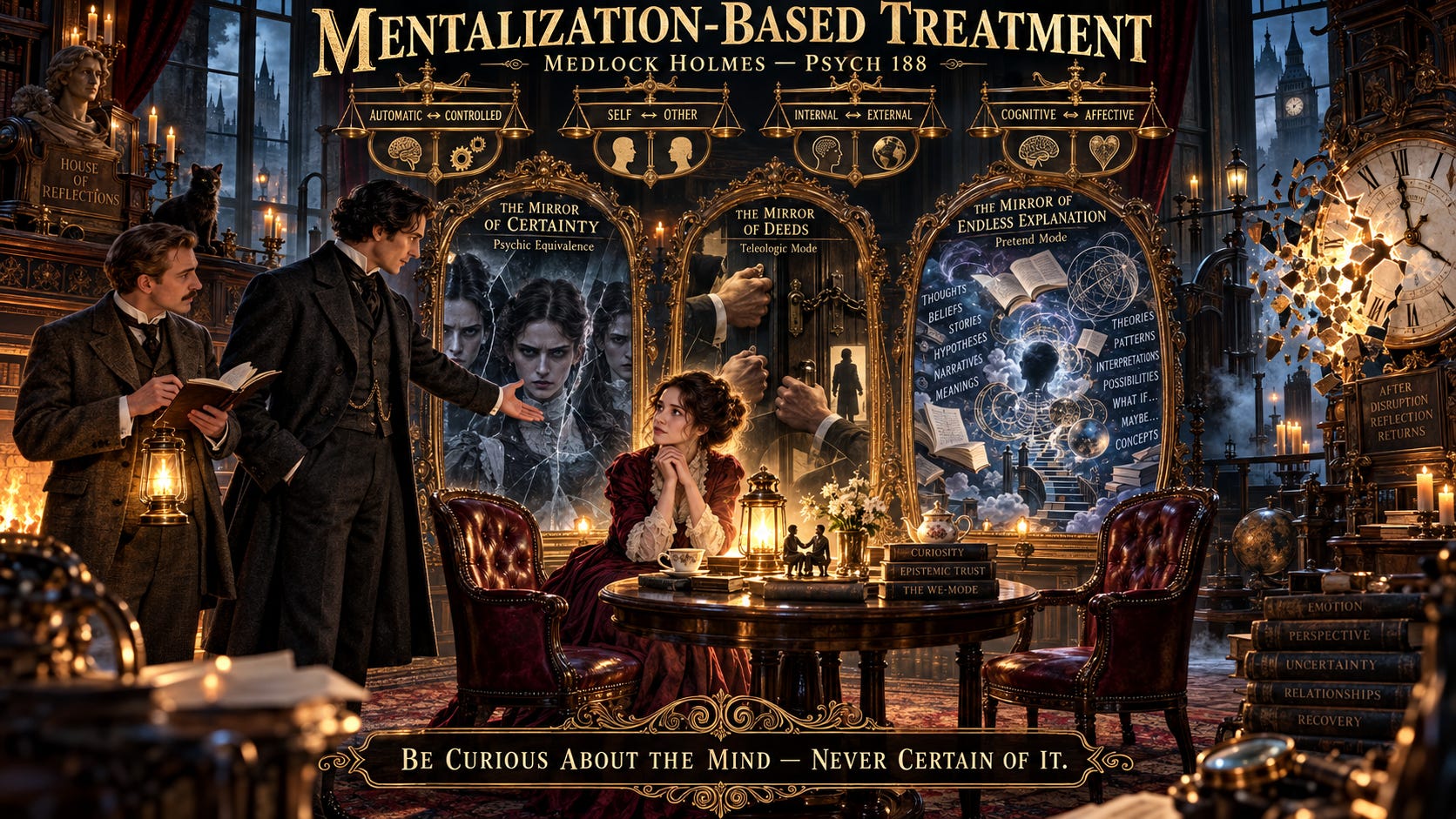
Its surface was perfectly polished, yet everything reflected within it appeared absolute and immovable.
“The Mirror of Certainty,” Holmes murmured.
Watson inspected it.
“She has mistaken a feeling for a fact.”
“Precisely. We call this psychic equivalence. The inner experience becomes indistinguishable from external reality.”
Clara turned sharply.
“Are you saying I imagined it?”
“Not at all,” Holmes replied. “Your hurt is entirely real. But perhaps the explanation for that hurt is not yet established.”
They approached the second mirror.
This one showed no faces, only hands performing actions.
Clara spoke again.
“Edward tells me he loves me, but words mean nothing. If he truly cared, he would cancel his work and stay beside me. Unless he does something, I cannot believe him.”
“The Mirror of Deeds,” said Holmes.
“Teleologic thinking,” Watson observed. “Only physical actions count as proof of an internal state.”
Holmes nodded.
“And when reassurance is sought exclusively through action, the demands may become increasingly difficult for either person to satisfy.”
The third mirror was different.
Its surface shimmered with intricate patterns, endlessly transforming into elaborate shapes.
Clara stared into it.
“I can explain everything about my relationship. His childhood, my attachment patterns, the unconscious meanings of every disagreement. I have thought about it for years.”
“And how do you feel as you tell us this?” Holmes asked.
She paused.
“I don’t know. Nothing, really.”
“The Mirror of Endless Explanation,” Holmes said quietly.
“She can speak about minds without connecting with her own experience,” Watson suggested.
“Yes. The pretend mode. Words and theories multiply, but their connection with felt experience and reality has weakened.”
Suddenly, the candles flickered.
Clara received a message from Edward.
I am sorry I was late. My mother had been taken ill.
She stared at the note.
For a moment, the first mirror darkened.
“I never considered that possibility.”
Holmes pulled two chairs into the centre of the room.
“Tell me, Clara. When he was late, what happened inside you?”
“I felt frightened.”
“Frightened of what?”
“That he would leave me.”
“And when that fear became overwhelming?”
“I became certain he didn’t love me. I sent him terrible messages. Then I demanded he come immediately to prove he cared.”
Watson looked towards the mirrors.
“Fear became certainty. Certainty became action.”
“And action created further difficulties in the relationship,” Holmes added.
Clara lowered her eyes.
“So everything was my fault.”
“That would be another certainty,” Holmes replied. “Let us not replace one absolute conclusion with another.”
He paused.
“What might Edward have been thinking? What else might you have been feeling? And what could you do differently if uncertainty returns?”
For the first time that evening, Clara began considering several possibilities.
“I could ask what happened before deciding what it means.”
Holmes smiled.
“An excellent beginning.”
“But I still feel frightened.”
“Of course. Mentalizing does not require the disappearance of emotion. It means retaining the capacity to reflect while emotion is present.”
As they prepared to leave, Watson noticed that the three mirrors had changed.
They no longer presented a single, compelling interpretation. Instead, each reflected the room from a different angle.
“Remarkable, Holmes. The mirrors have not vanished.”
“Nor should they, Watson. These modes of understanding are part of human experience. Under stress, any of us may become trapped within them.”
“And the treatment?”
“To restore the ability to wonder about minds-our own and those of others-especially when relationships make such wondering most difficult.”
Holmes opened the door to the London night.
“Remember, Watson: the mind is not a fact to be solved, but a mystery to be explored together.”
Key Takeaways
1. Understanding Mentalization-Based Treatment
1. Mentalization-based treatment (MBT) is an evidence-based psychotherapy developed principally by Anthony Bateman and Peter Fonagy, particularly for borderline personality disorder (BPD).
2. Mentalizing is the capacity to understand our own and other people’s behaviour in terms of underlying mental states-thoughts, feelings, wishes, beliefs and intentions.
3. Mentalizing enables us to distinguish between what we feel, what we think and what may actually be happening.
4. Mentalizing is not simply empathy or intellectual insight. It involves understanding minds while recognising that another person’s inner experience can never be known with certainty.
5. The central premise of MBT is that difficulties in BPD are associated with vulnerabilities in mentalizing, especially during interpersonal and attachment-related stress.
6. The aim is to restore mentalizing when it collapses, maintain it when present and strengthen its resilience under emotional pressure.
2. The Four Dimensions of Mentalizing
Effective mentalizing requires flexibility across four dimensions.
Automatic ↔ Controlled
Rapid, intuitive interpretation versus slower, deliberate reflection.
Self ↔ Other
Understanding one’s own mind while also considering another person’s perspective.
Internal ↔ External
Considering inner experience alongside observable expressions and behaviour.
Cognitive ↔ Affective
Reasoning about mental states while remaining connected to emotional experience.
Based on the four dimensions described on pages 4–7 of the chapter.
7. Automatic mentalizing is rapid, implicit and relatively effortless; controlled mentalizing is reflective, deliberate and more demanding.
8. Self–other balance prevents our own emotional experience from completely dominating our understanding of another person.
9. Internal–external balance helps us avoid inferring someone’s entire mental state from facial expressions, tone of voice or observable behaviour alone.
10. Cognitive–affective balance integrates thinking and feeling. Too much cognition may produce emotionally disconnected explanations; overwhelming affect may undermine reflection.
11. In BPD, attachment stress and high arousal can shift mentalizing towards automatic, emotionally driven and inflexible interpretations.
12. The therapist develops an individualised mentalizing profile, identifying which dimensions become unbalanced under stress.
3. The Three Nonmentalizing Modes
Psychic equivalence
“If I feel it, it must be true.”
Internal experience is treated as external reality. Certainty displaces curiosity.
Teleologic mode
“Only actions prove what someone feels.”
Physical acts become the primary evidence of intentions, care or commitment.
Pretend mode
“I can explain everything, but nothing feels real.”
Discussion of mental states becomes disconnected from emotion and lived reality.
Summarised from Tables 32.14–1 to 32.14–3, pages 8–11.
13. Psychic equivalence occurs when a thought or feeling is experienced as an unquestionable fact.
14. In psychic equivalence, the therapist should validate the emotional experience without endorsing an unverified interpretation. Di…
This is a public episode. If you'd like to discuss this with other subscribers or get access to bonus episodes, visit drmanaankarray.substack.com/subscribe