Skip to content
Artwork for Clinical Deep Dives
Clinical Deep Dives · Today · 46 min

PSYCH 187: Single-Session Therapy

At precisely nine o’clock on a fog-laden London morning, a mysterious parcel arrived at 221B Baker Street. Inside was an exquisite Victorian pocket watch. Its face was engraved with a single word: NOW. A note accompanied it. Mr Holmes, I have only one hour in which to resolve a matter that has troubled me for twenty years. If you cannot help me today, I fear I shall never find the courage to ask again. Dr Watson examined the watch. “An hour, Holmes? Surely no meaningful psychological difficulty can be addressed in so little time.” Holmes turned the watch over. “An interesting assumption, Watson. But perhaps we have confused the duration of treatment with the possibility of change.” Their visitor arrived shortly afterwards. Mrs Amelia Harcourt, a woman in her thirties, had travelled from Bath. Her father, from whom she had long been estranged, had recently returned to London. He was demanding access to her home and children. “I have spent years feeling responsible for his happiness,” she explained. “Whenever I refuse him, I feel terribly guilty. I came here because I must decide what to do before I return home tonight.” Watson reached for a thick casebook. “We shall need a complete developmental history, Holmes. Perhaps several consultations to explore the origins of her guilt.” “Those may be useful,” Holmes replied. “But first, let us ask what Mrs Harcourt most needs from this meeting.” He turned towards her. “Suppose this hour proves worthwhile. What would you wish to leave here able to do?” She hesitated. “To tell my father that he cannot visit whenever he pleases. Without feeling that I am a cruel daughter.” Holmes nodded. “Then we have a focus.” Watson glanced at the watch. “But what of the other nineteen years?” “They have shaped the difficulty, Watson. We need not deny them. Yet we must also discover what might help her act differently today.” Holmes drew three intersecting circles upon a sheet of paper. Within them he wrote: ALLIANCE - GOALS - RESOURCES “Therapeutic work becomes possible when we establish a relationship, agree upon a meaningful objective and identify the resources that can help achieve it.” Mrs Harcourt studied the drawing. “My husband has been encouraging me to set boundaries. My sister has already managed to do so.” “Excellent,” Holmes said. “Then you are not without examples or support.” He placed an empty chair opposite her. “Imagine your father is sitting there. What would you like to tell him?” Amelia looked alarmed. “I couldn’t possibly.” “Not yet, perhaps. But we have some time to practise.” After several attempts, she managed to speak. “Father, I care about you. But you cannot arrive at my house without arranging it first.” She stopped. “That sounds so harsh.” Holmes considered her words. “Could you say it in a way that feels both kind and firm?” She tried again. “I want us to have a relationship, but I need you to respect my family’s boundaries. We can arrange visits in advance.” Watson smiled. “That sounded rather different.” “And how did it feel?” Holmes asked. “Uncomfortable. But possible.” Holmes gestured towards the clock. “Notice what has happened. We have not resolved every painful memory. Yet you have begun to practise a response that was previously difficult to imagine.” As the hour drew towards its end, Watson became concerned. “Holmes, surely we should arrange another appointment immediately.” “Perhaps. But the decision should not be ours alone.” He turned to Amelia. “We have ten minutes remaining. Is there anything important we have not yet addressed?” She thought carefully. “What if he becomes angry?” They spent the remaining minutes rehearsing her response, considering support from her husband and sister, and planning what she might do if the conversation became difficult. Finally, Holmes asked: “Would you prefer to arrange another meeting now, or try what we have discussed and decide afterwards whether further help would be useful?” Amelia considered the question. “I would like to try first. Knowing I can return makes that easier.” Holmes smiled. “Then the door remains open.” As she departed, the pocket watch struck once. Watson stared at it. “One hour. One meeting. And yet something meaningful has changed.” “Indeed.” “But surely this cannot work for everyone.” “Of course not, Watson. Some people need sustained treatment, repeated encounters or urgent intervention. The art is not to force every patient into one session. It is to recognise that every session deserves the possibility of being useful in its own right.” Watson closed his notebook. “Then single-session therapy is not merely abbreviated psychotherapy?” “No. It is a different way of approaching the encounter. We treat today as important, without pretending tomorrow will never be needed.” Holmes returned the watch to its velvet case. “Remember, Watson: one session may be enough, but one session need not be the end.” The detective’s mnemonic: MAKE THE MOMENT COUNT - ALLIANCE, GOALS, RESOURCES, ACTION AND AN OPEN DOOR. Key Takeaways 1. What Is Single-Session Therapy? * Single-session therapy (SST) is an intentional therapeutic approach in which each encounter is planned as potentially complete in itself. * SST is also called one-at-a-time therapy (OAAT), reflecting the possibility that patients may return for further sessions when needed. * The defining feature is one session by design, rather than conventional therapy that happens to end after one appointment. * SST does not claim that every psychological problem can be cured or resolved in a single encounter. * A successful session may help someone resolve a difficulty, become unstuck, improve coping, clarify choices or take a meaningful next step. * SST is best understood as a therapeutic format, mindset and delivery approach, rather than one particular school of psychotherapy. * Techniques may be drawn from cognitive-behavioural, psychodynamic, solution-focused, narrative, motivational and family therapies. * Additional sessions do not represent failure: SST deliberately preserves the possibility of further care. 2. The Four Foundations of Single-Session Thinking Attitude Approach the meeting as though it might be the only one. Accessibility Reduce unnecessary barriers to timely help. Acting now Use the opportunity for meaningful change in the present. Alliance Collaborate on what the patient wants to achieve today. * Attitude: Treat every encounter as valuable and potentially sufficient. * Accessibility: Offer help when people are ready, including through walk-in, appointment-based or remote services. * Acting now: Recognise that meaningful change may begin immediately rather than only after prolonged preparation. * Alliance: Establish a collaborative relationship and agree on a clear, patient-led session goal. * SST encourages therapists to be pragmatic, flexible, transparent and active, while remaining sensitive to the patient’s preferences. 3. The Context of Competence Effective therapy occurs where alliance, goals and resources intersect. Adapted conceptually from Figure 32.13–1, page 7 of the chapter. * Alliance provides the collaborative therapeutic relationship. * Goals clarify what the patient wants to achieve during the encounter. * Resources include personal strengths, coping strategies, relationships and available support. * Goals without resources may produce little change; resources without goals lack direction. * The therapist helps patients connect their goals and resources within a productive therapeutic alliance. * The Context of Competence is a central organising principle for both SST and longer-term therapy. 4. History and Development * Sigmund Freud conducted some historically described single-session encounters, including meetings with Katharina and composer Gustav Mahler. * Moshe Talmon observed that many patients attending a Kaiser Permanente outpatient service came only once and nevertheless reported satisfaction. * Talmon collaborated with Robert Rosenbaum and Michael Hoyt to investigate planned SST. * In the Kaiser prospective study, 34 of 58 patients (58.6%) elected to finish after one session despite being offered … This is a public episode. If you'd like to discuss this with other subscribers or get access to bonus episodes, visit drmanaankarray.substack.com/subscribe

0:00-46:56

transcript

No transcript — this publisher did not publish one.

show notes

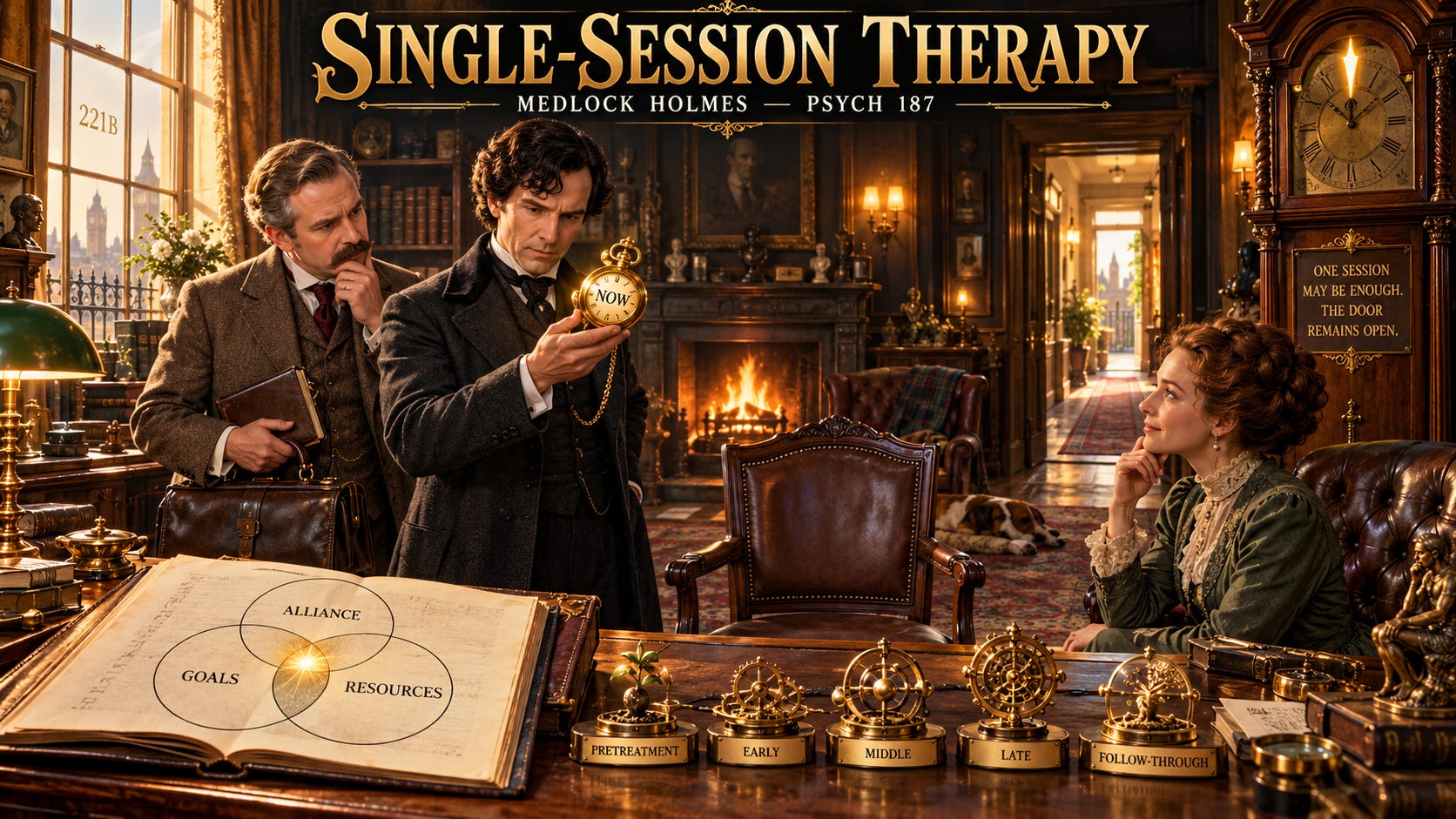
At precisely nine o’clock on a fog-laden London morning, a mysterious parcel arrived at 221B Baker Street.

Inside was an exquisite Victorian pocket watch. Its face was engraved with a single word:

NOW.

A note accompanied it.

Mr Holmes, I have only one hour in which to resolve a matter that has troubled me for twenty years. If you cannot help me today, I fear I shall never find the courage to ask again.

Dr Watson examined the watch.

“An hour, Holmes? Surely no meaningful psychological difficulty can be addressed in so little time.”

Holmes turned the watch over.

“An interesting assumption, Watson. But perhaps we have confused the duration of treatment with the possibility of change.”

Their visitor arrived shortly afterwards.

Mrs Amelia Harcourt, a woman in her thirties, had travelled from Bath. Her father, from whom she had long been estranged, had recently returned to London. He was demanding access to her home and children.

“I have spent years feeling responsible for his happiness,” she explained. “Whenever I refuse him, I feel terribly guilty. I came here because I must decide what to do before I return home tonight.”

Watson reached for a thick casebook.

“We shall need a complete developmental history, Holmes. Perhaps several consultations to explore the origins of her guilt.”

“Those may be useful,” Holmes replied. “But first, let us ask what Mrs Harcourt most needs from this meeting.”

He turned towards her.

“Suppose this hour proves worthwhile. What would you wish to leave here able to do?”

She hesitated.

“To tell my father that he cannot visit whenever he pleases. Without feeling that I am a cruel daughter.”

Holmes nodded.

“Then we have a focus.”

Watson glanced at the watch.

“But what of the other nineteen years?”

“They have shaped the difficulty, Watson. We need not deny them. Yet we must also discover what might help her act differently today.”

Holmes drew three intersecting circles upon a sheet of paper.

Within them he wrote:

ALLIANCE - GOALS - RESOURCES

“Therapeutic work becomes possible when we establish a relationship, agree upon a meaningful objective and identify the resources that can help achieve it.”

Mrs Harcourt studied the drawing.

“My husband has been encouraging me to set boundaries. My sister has already managed to do so.”

“Excellent,” Holmes said. “Then you are not without examples or support.”

He placed an empty chair opposite her.

“Imagine your father is sitting there. What would you like to tell him?”

Amelia looked alarmed.

“I couldn’t possibly.”

“Not yet, perhaps. But we have some time to practise.”

After several attempts, she managed to speak.

“Father, I care about you. But you cannot arrive at my house without arranging it first.”

She stopped.

“That sounds so harsh.”

Holmes considered her words.

“Could you say it in a way that feels both kind and firm?”

She tried again.

“I want us to have a relationship, but I need you to respect my family’s boundaries. We can arrange visits in advance.”

Watson smiled.

“That sounded rather different.”

“And how did it feel?” Holmes asked.

“Uncomfortable. But possible.”

Holmes gestured towards the clock.

“Notice what has happened. We have not resolved every painful memory. Yet you have begun to practise a response that was previously difficult to imagine.”

As the hour drew towards its end, Watson became concerned.

“Holmes, surely we should arrange another appointment immediately.”

“Perhaps. But the decision should not be ours alone.”

He turned to Amelia.

“We have ten minutes remaining. Is there anything important we have not yet addressed?”

She thought carefully.

“What if he becomes angry?”

They spent the remaining minutes rehearsing her response, considering support from her husband and sister, and planning what she might do if the conversation became difficult.

Finally, Holmes asked:

“Would you prefer to arrange another meeting now, or try what we have discussed and decide afterwards whether further help would be useful?”

Amelia considered the question.

“I would like to try first. Knowing I can return makes that easier.”

Holmes smiled.

“Then the door remains open.”

As she departed, the pocket watch struck once.

Watson stared at it.

“One hour. One meeting. And yet something meaningful has changed.”

“Indeed.”

“But surely this cannot work for everyone.”

“Of course not, Watson. Some people need sustained treatment, repeated encounters or urgent intervention. The art is not to force every patient into one session. It is to recognise that every session deserves the possibility of being useful in its own right.”

Watson closed his notebook.

“Then single-session therapy is not merely abbreviated psychotherapy?”

“No. It is a different way of approaching the encounter. We treat today as important, without pretending tomorrow will never be needed.”

Holmes returned the watch to its velvet case.

“Remember, Watson: one session may be enough, but one session need not be the end.”

The detective’s mnemonic: MAKE THE MOMENT COUNT - ALLIANCE, GOALS, RESOURCES, ACTION AND AN OPEN DOOR.

Key Takeaways

1. What Is Single-Session Therapy?

* Single-session therapy (SST) is an intentional therapeutic approach in which each encounter is planned as potentially complete in itself.

* SST is also called one-at-a-time therapy (OAAT), reflecting the possibility that patients may return for further sessions when needed.

* The defining feature is one session by design, rather than conventional therapy that happens to end after one appointment.

* SST does not claim that every psychological problem can be cured or resolved in a single encounter.

* A successful session may help someone resolve a difficulty, become unstuck, improve coping, clarify choices or take a meaningful next step.

* SST is best understood as a therapeutic format, mindset and delivery approach, rather than one particular school of psychotherapy.

* Techniques may be drawn from cognitive-behavioural, psychodynamic, solution-focused, narrative, motivational and family therapies.

* Additional sessions do not represent failure: SST deliberately preserves the possibility of further care.

2. The Four Foundations of Single-Session Thinking

Attitude

Approach the meeting as though it might be the only one.

Accessibility

Reduce unnecessary barriers to timely help.

Acting now

Use the opportunity for meaningful change in the present.

Alliance

Collaborate on what the patient wants to achieve today.

* Attitude: Treat every encounter as valuable and potentially sufficient.

* Accessibility: Offer help when people are ready, including through walk-in, appointment-based or remote services.

* Acting now: Recognise that meaningful change may begin immediately rather than only after prolonged preparation.

* Alliance: Establish a collaborative relationship and agree on a clear, patient-led session goal.

* SST encourages therapists to be pragmatic, flexible, transparent and active, while remaining sensitive to the patient’s preferences.

3. The Context of Competence

Effective therapy occurs where alliance, goals and resources intersect.

Adapted conceptually from Figure 32.13–1, page 7 of the chapter.

* Alliance provides the collaborative therapeutic relationship.

* Goals clarify what the patient wants to achieve during the encounter.

* Resources include personal strengths, coping strategies, relationships and available support.

* Goals without resources may produce little change; resources without goals lack direction.

* The therapist helps patients connect their goals and resources within a productive therapeutic alliance.

* The Context of Competence is a central organising principle for both SST and longer-term therapy.

4. History and Development

* Sigmund Freud conducted some historically described single-session encounters, including meetings with Katharina and composer Gustav Mahler.

* Moshe Talmon observed that many patients attending a Kaiser Permanente outpatient service came only once and nevertheless reported satisfaction.

* Talmon collaborated with Robert Rosenbaum and Michael Hoyt to investigate planned SST.

* In the Kaiser prospective study, 34 of 58 patients (58.6%) elected to finish after one session despite being offered …


This is a public episode. If you'd like to discuss this with other subscribers or get access to bonus episodes, visit drmanaankarray.substack.com/subscribe
links1