Skip to content
Artwork for Clinical Deep Dives
Clinical Deep Dives · October 22 · 51 min

PSYCH 160: Relational Problems

understanding how relationships shape psychological distress, psychiatric illness, recovery and resilience. The House of Invisible Bonds Medlock Holmes arrives at an imposing Neo-Victorian mansion known as The House of Invisible Bonds. Unlike his previous investigations, there is no single patient waiting behind the consulting-room door. Instead, he encounters families, couples, siblings and grieving individuals, each carrying distress that cannot be fully understood in isolation. A child presents with anxiety, but the parents are locked in relentless conflict. A young man experiences repeated psychiatric relapses while living in an atmosphere of criticism and hostility. A couple seeks treatment for depression, yet their relationship has become a cycle of accusation, defensiveness and withdrawal. Holmes notices a remarkable pattern. The symptoms may belong to an individual, but the processes maintaining them may exist between people. The Eight Chambers of Relational Distress Holmes opens eight interconnected chambers, each representing a distinct relational problem. In the first, he encounters a parent and child trapped in escalating arguments. The parent’s attempts at control provoke resistance, and the child’s resistance generates even stricter control. Holmes examines attachment, parenting styles, behavioural difficulties and the influence of parental psychopathology. In the second chamber, siblings compete for affection and recognition. Ordinary rivalry has transformed into persistent hostility, jealousy and, in some cases, violence. The third chamber contains children growing up away from their parents. Some have found stability through foster care or kinship arrangements; others carry the psychological consequences of separation, disrupted attachments and repeated changes of home. In the fourth, a child stands between two arguing parents, desperately attempting to preserve affection for both. Holmes discovers the emotional burden of parental relationship distress, loyalty conflicts and the complexities of parent–child contact refusal. The fifth chamber contains an intimate couple whose communication has deteriorated into criticism, contempt, defensiveness and withdrawal. Holmes traces the vicious cycle through which relationship distress and depression reinforce one another. The sixth chamber reveals the consequences of separation and divorce, including disrupted family routines, changing attachments and the challenge of protecting children from continuing parental conflict. In the seventh, Holmes encounters a family whose conversations are saturated with criticism, hostility and emotional overinvolvement. He recognises the clinical significance of high expressed emotion, particularly in families supporting someone with serious mental illness. The final chamber is quieter. A grieving individual sits beside an empty chair. Holmes distinguishes the natural pain of bereavement from major depression and more persistent, impairing grief. The Relational Detective’s Method Holmes returns to his consulting room and draws a diagram: INDIVIDUAL VULNERABILITY ↔ RELATIONAL PATTERNS ↔ EMOTIONAL RESPONSE ↔ BEHAVIOUR ↔ MENTAL HEALTH He realises that biological and relational explanations are not competitors. They describe interacting dimensions of the same clinical reality. A genetic vulnerability may increase susceptibility to depression. Depression may alter communication and emotional availability. Relationship distress may then intensify depressive symptoms. The cycle can continue until someone intervenes. But Holmes also discovers a critical distinction: relationship distress must never be used to minimise abuse, coercion or violence. Safety and protection take precedence over attempts to restore relational harmony. The investigation ends with a new understanding of psychiatric formulation. “To understand the suffering of one person, we must sometimes examine the relationships in which that suffering is experienced, expressed and sustained.” The central principle of the episode: MENTAL HEALTH = INDIVIDUAL FACTORS + RELATIONAL PROCESSES + SOCIAL CONTEXT Key Takeaways 1. Understanding Relational Problems 1. Human psychological functioning cannot be understood entirely independently of interpersonal relationships. 2. Relationships influence identity, self-esteem, emotional regulation, physical health and psychiatric outcomes. 3. Supportive relationships may protect against psychological distress and improve recovery. 4. Dysfunctional relationships may contribute to the onset, maintenance or worsening of psychiatric symptoms. 5. Relational problems involve maladaptive patterns of feelings, behaviours and perceptions between two or more people. 6. Unlike most psychiatric disorders, which are primarily identified through symptoms in an individual, relational problems concern the interaction between individuals. 7. The chapter identifies four features that distinguish clinically significant relational problems from ordinary interpersonal difficulties. 8. First, there are recognisable, repetitive and relatively fixed patterns of painful or destructive interaction. 9. Second, these patterns are longstanding rather than merely reactions to a recent stressful event. 10. Third, the maladaptive patterns do not readily improve through ordinary supportive influences in the social environment. 11. Fourth, they produce significant psychological, physical, social or occupational consequences for at least one participant. 12. Relational problems may be the primary reason for seeking professional help. 13. They may also influence the course, prognosis or treatment of an existing psychiatric or medical condition. 14. A person may therefore have both a mental disorder and a relational problem. 15. Relational problems are included among conditions that may be a focus of clinical attention in DSM-5-TR. 16. They are not classified as mental disorders in themselves. 17. Nevertheless, they can be documented clinically when relevant to assessment or treatment. 18. The distinction between individual psychopathology and relational dysfunction is conceptual rather than absolute. 19. Biological vulnerabilities can influence relationships, and relationships can influence the expression of biological vulnerabilities. 20. The essential clinical question is not simply “What is wrong with this person?” but also “What is happening between the people involved?” 2. Classification and Diagnostic History 21. Earlier psychiatric classifications gave relatively little attention to relational problems. 22. DSM-II introduced categories recognising significant social or marital maladjustment without necessarily identifying a psychiatric disorder. 23. DSM-III included conditions such as marital problems, parent–child problems and sibling rivalry. 24. DSM-IV introduced a more explicit grouping of relational problems. 25. Earlier diagnostic descriptions were criticised for being insufficiently specific. 26. The Global Assessment of Relational Functioning scale was developed to describe overall relationship functioning. 27. DSM-5 abandoned the traditional multiaxial diagnostic system. 28. Relational problems are now documented alongside other clinically relevant conditions rather than being restricted to a separate psychosocial axis. 29. DSM-5-TR provides more detailed descriptions of relational problems than earlier editions. 30. Nevertheless, precise diagnostic boundaries and operational criteria remain areas requiring further research. 31. ICD-11 also recognises relationship and family circumstances that can influence health. 32. The two classification systems use somewhat different terminology for comparable problems. 33. Relational problems overlap conceptually with the broader social determinants of health. 34. Social determinants include the conditions in which people grow, live, learn, work and participate in society. 35. Relational diagnosis adds clinically relevant information that may be missed by symptom-based psychiatric diagnoses alone. 3. The Eight Re… This is a public episode. If you'd like to discuss this with other subscribers or get access to bonus episodes, visit drmanaankarray.substack.com/subscribe

0:00-51:11

transcript

No transcript — this publisher did not publish one.

show notes

understanding how relationships shape psychological distress, psychiatric illness, recovery and resilience.

The House of Invisible Bonds

Medlock Holmes arrives at an imposing Neo-Victorian mansion known as The House of Invisible Bonds.

Unlike his previous investigations, there is no single patient waiting behind the consulting-room door. Instead, he encounters families, couples, siblings and grieving individuals, each carrying distress that cannot be fully understood in isolation.

A child presents with anxiety, but the parents are locked in relentless conflict. A young man experiences repeated psychiatric relapses while living in an atmosphere of criticism and hostility. A couple seeks treatment for depression, yet their relationship has become a cycle of accusation, defensiveness and withdrawal.

Holmes notices a remarkable pattern.

The symptoms may belong to an individual, but the processes maintaining them may exist between people.

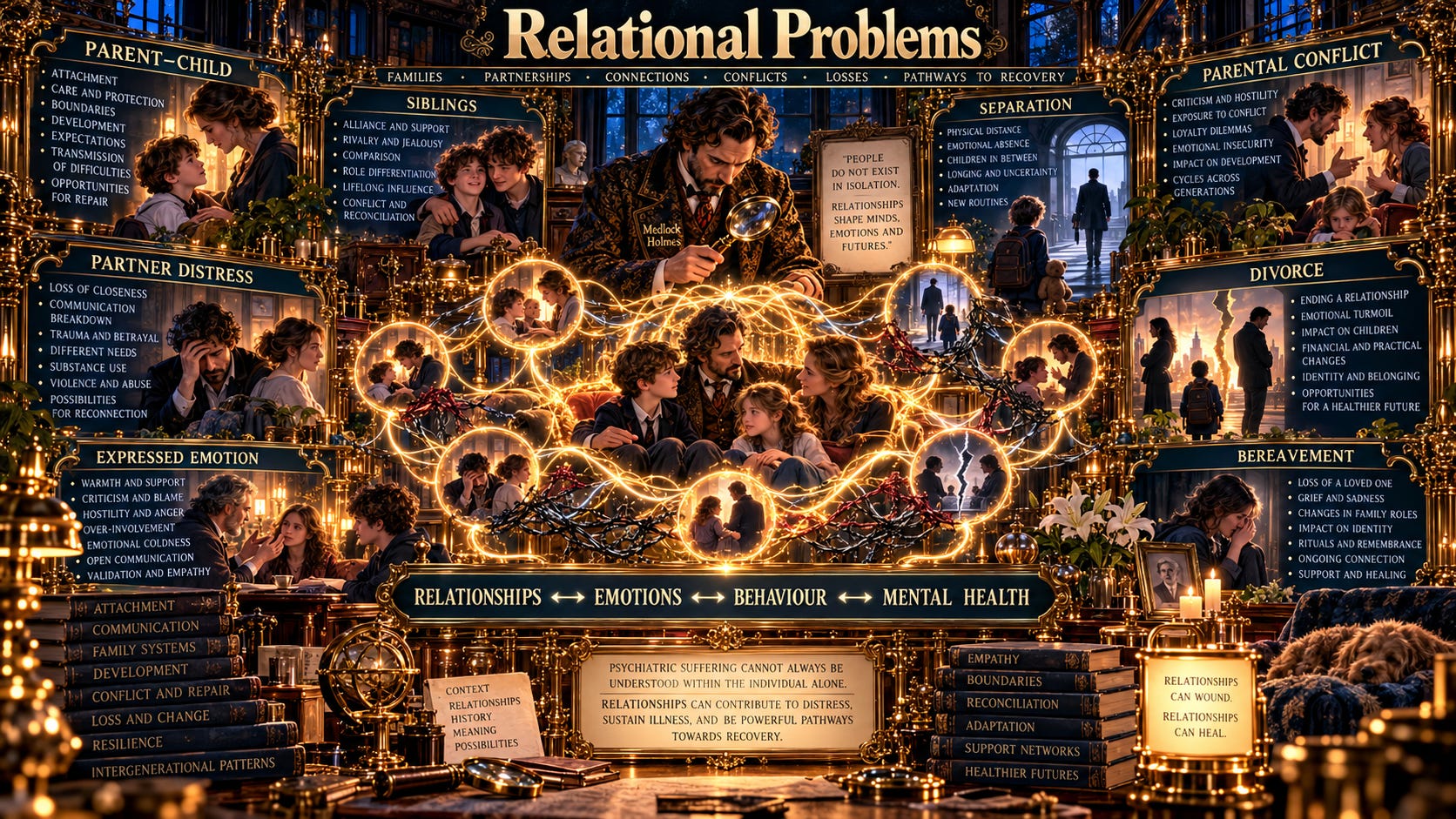
The Eight Chambers of Relational Distress

Holmes opens eight interconnected chambers, each representing a distinct relational problem.

In the first, he encounters a parent and child trapped in escalating arguments. The parent’s attempts at control provoke resistance, and the child’s resistance generates even stricter control. Holmes examines attachment, parenting styles, behavioural difficulties and the influence of parental psychopathology.

In the second chamber, siblings compete for affection and recognition. Ordinary rivalry has transformed into persistent hostility, jealousy and, in some cases, violence.

The third chamber contains children growing up away from their parents. Some have found stability through foster care or kinship arrangements; others carry the psychological consequences of separation, disrupted attachments and repeated changes of home.

In the fourth, a child stands between two arguing parents, desperately attempting to preserve affection for both. Holmes discovers the emotional burden of parental relationship distress, loyalty conflicts and the complexities of parent–child contact refusal.

The fifth chamber contains an intimate couple whose communication has deteriorated into criticism, contempt, defensiveness and withdrawal. Holmes traces the vicious cycle through which relationship distress and depression reinforce one another.

The sixth chamber reveals the consequences of separation and divorce, including disrupted family routines, changing attachments and the challenge of protecting children from continuing parental conflict.

In the seventh, Holmes encounters a family whose conversations are saturated with criticism, hostility and emotional overinvolvement. He recognises the clinical significance of high expressed emotion, particularly in families supporting someone with serious mental illness.

The final chamber is quieter. A grieving individual sits beside an empty chair. Holmes distinguishes the natural pain of bereavement from major depression and more persistent, impairing grief.

The Relational Detective’s Method

Holmes returns to his consulting room and draws a diagram:

INDIVIDUAL VULNERABILITY ↔ RELATIONAL PATTERNS ↔ EMOTIONAL RESPONSE ↔ BEHAVIOUR ↔ MENTAL HEALTH

He realises that biological and relational explanations are not competitors. They describe interacting dimensions of the same clinical reality.

A genetic vulnerability may increase susceptibility to depression. Depression may alter communication and emotional availability. Relationship distress may then intensify depressive symptoms.

The cycle can continue until someone intervenes.

But Holmes also discovers a critical distinction: relationship distress must never be used to minimise abuse, coercion or violence. Safety and protection take precedence over attempts to restore relational harmony.

The investigation ends with a new understanding of psychiatric formulation.

“To understand the suffering of one person, we must sometimes examine the relationships in which that suffering is experienced, expressed and sustained.”

The central principle of the episode:

MENTAL HEALTH = INDIVIDUAL FACTORS + RELATIONAL PROCESSES + SOCIAL CONTEXT

Key Takeaways

1. Understanding Relational Problems

1. Human psychological functioning cannot be understood entirely independently of interpersonal relationships.

2. Relationships influence identity, self-esteem, emotional regulation, physical health and psychiatric outcomes.

3. Supportive relationships may protect against psychological distress and improve recovery.

4. Dysfunctional relationships may contribute to the onset, maintenance or worsening of psychiatric symptoms.

5. Relational problems involve maladaptive patterns of feelings, behaviours and perceptions between two or more people.

6. Unlike most psychiatric disorders, which are primarily identified through symptoms in an individual, relational problems concern the interaction between individuals.

7. The chapter identifies four features that distinguish clinically significant relational problems from ordinary interpersonal difficulties.

8. First, there are recognisable, repetitive and relatively fixed patterns of painful or destructive interaction.

9. Second, these patterns are longstanding rather than merely reactions to a recent stressful event.

10. Third, the maladaptive patterns do not readily improve through ordinary supportive influences in the social environment.

11. Fourth, they produce significant psychological, physical, social or occupational consequences for at least one participant.

12. Relational problems may be the primary reason for seeking professional help.

13. They may also influence the course, prognosis or treatment of an existing psychiatric or medical condition.

14. A person may therefore have both a mental disorder and a relational problem.

15. Relational problems are included among conditions that may be a focus of clinical attention in DSM-5-TR.

16. They are not classified as mental disorders in themselves.

17. Nevertheless, they can be documented clinically when relevant to assessment or treatment.

18. The distinction between individual psychopathology and relational dysfunction is conceptual rather than absolute.

19. Biological vulnerabilities can influence relationships, and relationships can influence the expression of biological vulnerabilities.

20. The essential clinical question is not simply “What is wrong with this person?” but also “What is happening between the people involved?”

2. Classification and Diagnostic History

21. Earlier psychiatric classifications gave relatively little attention to relational problems.

22. DSM-II introduced categories recognising significant social or marital maladjustment without necessarily identifying a psychiatric disorder.

23. DSM-III included conditions such as marital problems, parent–child problems and sibling rivalry.

24. DSM-IV introduced a more explicit grouping of relational problems.

25. Earlier diagnostic descriptions were criticised for being insufficiently specific.

26. The Global Assessment of Relational Functioning scale was developed to describe overall relationship functioning.

27. DSM-5 abandoned the traditional multiaxial diagnostic system.

28. Relational problems are now documented alongside other clinically relevant conditions rather than being restricted to a separate psychosocial axis.

29. DSM-5-TR provides more detailed descriptions of relational problems than earlier editions.

30. Nevertheless, precise diagnostic boundaries and operational criteria remain areas requiring further research.

31. ICD-11 also recognises relationship and family circumstances that can influence health.

32. The two classification systems use somewhat different terminology for comparable problems.

33. Relational problems overlap conceptually with the broader social determinants of health.

34. Social determinants include the conditions in which people grow, live, learn, work and participate in society.

35. Relational diagnosis adds clinically relevant information that may be missed by symptom-based psychiatric diagnoses alone.

3. The Eight Re…


This is a public episode. If you'd like to discuss this with other subscribers or get access to bonus episodes, visit drmanaankarray.substack.com/subscribe
links1