Skip to content
Artwork for Clinical Deep Dives
Clinical Deep Dives · October 21 · 50 min

PSYCH 159: Borderline Intellectual Functioning and Academic or Educational Problems

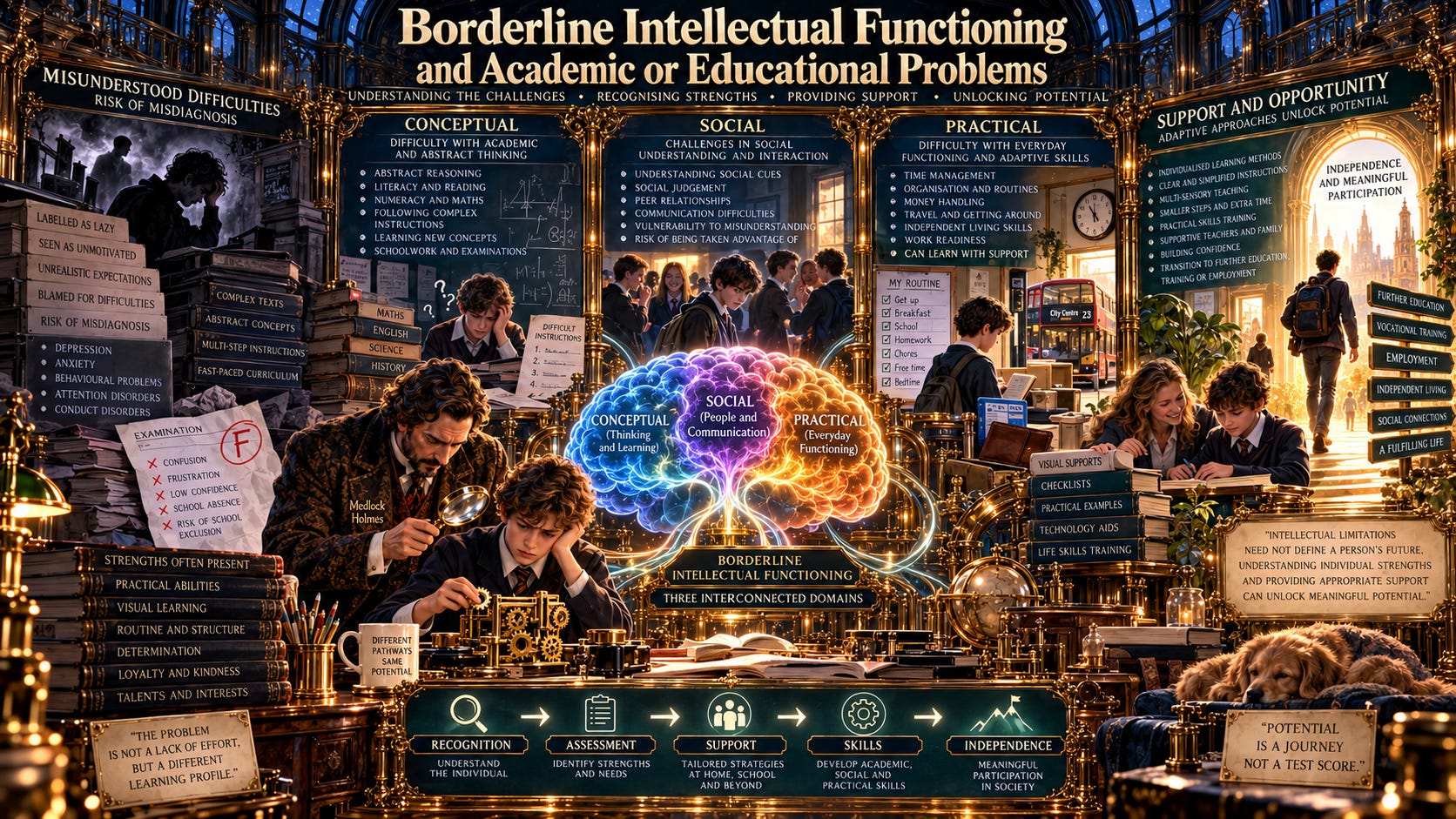
The Mystery of the Invisible Barrier Medlock Holmes enters The Academy of Hidden Potential, where a puzzling pattern has emerged. Some students struggle despite enormous effort. Others appear articulate yet cannot manage everyday responsibilities. A few have been labelled inattentive, oppositional or unmotivated, although repeated treatments have failed. Holmes discovers that the difficulty may lie not in willingness, but in the interaction between intellectual capacity, adaptive functioning and environmental expectations. His investigation reveals borderline intellectual functioning: a frequently overlooked condition associated with below-average cognitive abilities and, in some individuals, significant difficulties with practical and social adaptation. Yet an intelligence quotient tells only part of the story. Holmes examines three interconnected domains: CONCEPTUAL SKILLS ↔ SOCIAL SKILLS ↔ PRACTICAL SKILLS A student may struggle with abstract reasoning yet excel at practical tasks. Another may communicate fluently while finding planning, problem-solving and independent living unexpectedly difficult. The Diagnostic Labyrinth Holmes follows the clues through ADHD, specific learning disorders, autism, intellectual developmental disorder, trauma and emotional difficulties. He discovers that similar outward behaviours can arise from very different underlying problems. Poor performance is not necessarily poor motivation. The investigation then moves beyond the individual to the classroom and home. Bullying, family adversity, educational disadvantage, inaccessible teaching, substance use and psychiatric illness can all interfere with academic achievement. The Pathway to Potential In the final chamber, Holmes finds no miraculous treatment that transforms intellectual capacity overnight. Instead, he discovers something more useful: carefully matched educational support, adapted communication, practical skills training, family involvement, emotional support and vocational preparation. The goal is not to make everyone learn identically. It is to help each person develop their abilities and participate meaningfully in life. Holmes closes his notebook: “The measure of intelligence is not merely what a person knows, but what they can accomplish when the world provides the right opportunities and support.” Key Takeaways 1. Understanding Borderline Intellectual Functioning 1. Borderline intellectual functioning (BIF) describes intellectual abilities substantially below the population average but generally above the range associated with intellectual developmental disorder. 2. Traditionally, BIF has been associated with IQ scores of approximately 70–85, although this range should not be treated as a rigid diagnostic boundary. 3. The chapter argues that the broader concept of borderline intellectual and adaptive functioning (BIAF) better captures the clinical difficulties experienced by affected individuals. 4. Intellectual ability and adaptive functioning are related but distinct. 5. Intellectual ability concerns reasoning, learning, problem-solving and understanding information. 6. Adaptive functioning concerns how effectively an individual manages the demands of everyday life. 7. Some people with borderline-range IQ scores function well independently, whereas others require substantial support. 8. Therefore, a borderline IQ score alone does not establish clinically significant impairment. 9. BIF is not classified as a formal mental disorder in DSM-5-TR; it is a condition that may warrant clinical attention. 10. Nevertheless, it can have substantial implications for mental health, education, employment and independent living. 11. BIF is frequently underrecognised because difficulties may be subtle or attributed to other diagnoses. 12. Its identification is particularly important when repeated educational or psychiatric interventions have been unsuccessful. 13. A major challenge is that people with BIF may experience significant difficulties without meeting eligibility criteria for disability services. 14. The chapter advocates earlier identification and more flexible approaches to support. 15. The fundamental principle is that clinical need should not be determined by an IQ threshold alone. 2. Intelligence Is More Than IQ 16. Intelligence is a multidimensional capacity rather than a single, uniformly expressed ability. 17. Traditional theories emphasised general intelligence, often represented by the factor g. 18. Contemporary models recognise multiple cognitive abilities, including verbal comprehension, fluid reasoning, working memory and processing speed. 19. The Cattell–Horn–Carroll model provides an influential framework for understanding these different abilities. 20. IQ tests estimate aspects of intellectual functioning but do not capture every dimension of real-world competence. 21. A full-scale IQ score summarises performance across several cognitive domains. 22. Important strengths and weaknesses can be obscured by relying exclusively on this composite score. 23. A person may have relatively strong verbal skills but marked difficulties with non-verbal reasoning. 24. Working memory limitations may interfere with following instructions and retaining information. 25. Reduced processing speed may cause difficulty completing tasks within expected timeframes. 26. Fluid reasoning difficulties may impair problem-solving in unfamiliar situations. 27. Executive functioning contributes to planning, organisation, inhibition and flexible adaptation. 28. Language facilitates conceptual understanding and the development of abstract thinking. 29. Emotional regulation and motivation influence how cognitive abilities are expressed. 30. Cognitive performance is affected by fatigue, anxiety, medication, educational opportunity and environmental demands. 31. Intelligence is therefore best understood as the interaction between underlying abilities and the circumstances in which they are used. 32. A useful distinction is COGNITIVE CAPACITY ≠ EVERYDAY PERFORMANCE. 3. Adaptive Functioning: The Three Domains 33. Adaptive functioning describes the practical application of abilities in everyday environments. 34. Assessment generally considers three domains: conceptual, social and practical. 35. The conceptual domain includes language, literacy, numeracy, memory, reasoning and understanding time and money. 36. Conceptual difficulties may manifest as problems reading instructions, calculating change or managing appointments. 37. The social domain includes interpersonal communication, social judgement, understanding relationships and recognising risk. 38. Social difficulties may include naivety, vulnerability to manipulation or difficulty interpreting complex social situations. 39. The practical domain includes personal care, household activities, transport, shopping, employment and money management. 40. Practical functioning may be relatively preserved for familiar tasks but impaired when situations become unfamiliar. 41. Adaptive functioning must be interpreted in relation to age and cultural expectations. 42. A child requiring help with money management is different from an adult who cannot independently manage essential financial responsibilities. 43. Some individuals compensate for weaknesses through repetition, routines and learned procedures. 44. Procedural learning may be a relative strength even when abstract reasoning is limited. 45. Adaptive abilities can improve through education, experience and appropriate support. 46. The degree of assistance required is often more clinically meaningful than a single IQ score. 47. Assessment should examine what the individual can do independently, what they can do with support and what remains difficult. 48. The clinical model is ABILITY + ENVIRONMENT + SUPPORT → FUNCTIONAL OUTCOME. 4. Diagnostic Boundaries and Intellectual Developmental Disorder 49. BIF and intellectual developmental disorder exist along overlapping dimensions of cognitive and adaptive functioning. 50. Intellectual developmental disorder in… This is a public episode. If you'd like to discuss this with other subscribers or get access to bonus episodes, visit drmanaankarray.substack.com/subscribe


0:00-50:37

transcript

No transcript — this publisher did not publish one.

show notes

The Mystery of the Invisible Barrier

Medlock Holmes enters The Academy of Hidden Potential, where a puzzling pattern has emerged.

Some students struggle despite enormous effort. Others appear articulate yet cannot manage everyday responsibilities. A few have been labelled inattentive, oppositional or unmotivated, although repeated treatments have failed.

Holmes discovers that the difficulty may lie not in willingness, but in the interaction between intellectual capacity, adaptive functioning and environmental expectations.

His investigation reveals borderline intellectual functioning: a frequently overlooked condition associated with below-average cognitive abilities and, in some individuals, significant difficulties with practical and social adaptation.

Yet an intelligence quotient tells only part of the story.

Holmes examines three interconnected domains:

CONCEPTUAL SKILLS ↔ SOCIAL SKILLS ↔ PRACTICAL SKILLS

A student may struggle with abstract reasoning yet excel at practical tasks. Another may communicate fluently while finding planning, problem-solving and independent living unexpectedly difficult.

The Diagnostic Labyrinth

Holmes follows the clues through ADHD, specific learning disorders, autism, intellectual developmental disorder, trauma and emotional difficulties.

He discovers that similar outward behaviours can arise from very different underlying problems.

Poor performance is not necessarily poor motivation.

The investigation then moves beyond the individual to the classroom and home.

Bullying, family adversity, educational disadvantage, inaccessible teaching, substance use and psychiatric illness can all interfere with academic achievement.

The Pathway to Potential

In the final chamber, Holmes finds no miraculous treatment that transforms intellectual capacity overnight.

Instead, he discovers something more useful: carefully matched educational support, adapted communication, practical skills training, family involvement, emotional support and vocational preparation.

The goal is not to make everyone learn identically. It is to help each person develop their abilities and participate meaningfully in life.

Holmes closes his notebook:

“The measure of intelligence is not merely what a person knows, but what they can accomplish when the world provides the right opportunities and support.”

Key Takeaways

1. Understanding Borderline Intellectual Functioning

1. Borderline intellectual functioning (BIF) describes intellectual abilities substantially below the population average but generally above the range associated with intellectual developmental disorder.

2. Traditionally, BIF has been associated with IQ scores of approximately 70–85, although this range should not be treated as a rigid diagnostic boundary.

3. The chapter argues that the broader concept of borderline intellectual and adaptive functioning (BIAF) better captures the clinical difficulties experienced by affected individuals.

4. Intellectual ability and adaptive functioning are related but distinct.

5. Intellectual ability concerns reasoning, learning, problem-solving and understanding information.

6. Adaptive functioning concerns how effectively an individual manages the demands of everyday life.

7. Some people with borderline-range IQ scores function well independently, whereas others require substantial support.

8. Therefore, a borderline IQ score alone does not establish clinically significant impairment.

9. BIF is not classified as a formal mental disorder in DSM-5-TR; it is a condition that may warrant clinical attention.

10. Nevertheless, it can have substantial implications for mental health, education, employment and independent living.

11. BIF is frequently underrecognised because difficulties may be subtle or attributed to other diagnoses.

12. Its identification is particularly important when repeated educational or psychiatric interventions have been unsuccessful.

13. A major challenge is that people with BIF may experience significant difficulties without meeting eligibility criteria for disability services.

14. The chapter advocates earlier identification and more flexible approaches to support.

15. The fundamental principle is that clinical need should not be determined by an IQ threshold alone.

2. Intelligence Is More Than IQ

16. Intelligence is a multidimensional capacity rather than a single, uniformly expressed ability.

17. Traditional theories emphasised general intelligence, often represented by the factor g.

18. Contemporary models recognise multiple cognitive abilities, including verbal comprehension, fluid reasoning, working memory and processing speed.

19. The Cattell–Horn–Carroll model provides an influential framework for understanding these different abilities.

20. IQ tests estimate aspects of intellectual functioning but do not capture every dimension of real-world competence.

21. A full-scale IQ score summarises performance across several cognitive domains.

22. Important strengths and weaknesses can be obscured by relying exclusively on this composite score.

23. A person may have relatively strong verbal skills but marked difficulties with non-verbal reasoning.

24. Working memory limitations may interfere with following instructions and retaining information.

25. Reduced processing speed may cause difficulty completing tasks within expected timeframes.

26. Fluid reasoning difficulties may impair problem-solving in unfamiliar situations.

27. Executive functioning contributes to planning, organisation, inhibition and flexible adaptation.

28. Language facilitates conceptual understanding and the development of abstract thinking.

29. Emotional regulation and motivation influence how cognitive abilities are expressed.

30. Cognitive performance is affected by fatigue, anxiety, medication, educational opportunity and environmental demands.

31. Intelligence is therefore best understood as the interaction between underlying abilities and the circumstances in which they are used.

32. A useful distinction is COGNITIVE CAPACITY ≠ EVERYDAY PERFORMANCE.

3. Adaptive Functioning: The Three Domains

33. Adaptive functioning describes the practical application of abilities in everyday environments.

34. Assessment generally considers three domains: conceptual, social and practical.

35. The conceptual domain includes language, literacy, numeracy, memory, reasoning and understanding time and money.

36. Conceptual difficulties may manifest as problems reading instructions, calculating change or managing appointments.

37. The social domain includes interpersonal communication, social judgement, understanding relationships and recognising risk.

38. Social difficulties may include naivety, vulnerability to manipulation or difficulty interpreting complex social situations.

39. The practical domain includes personal care, household activities, transport, shopping, employment and money management.

40. Practical functioning may be relatively preserved for familiar tasks but impaired when situations become unfamiliar.

41. Adaptive functioning must be interpreted in relation to age and cultural expectations.

42. A child requiring help with money management is different from an adult who cannot independently manage essential financial responsibilities.

43. Some individuals compensate for weaknesses through repetition, routines and learned procedures.

44. Procedural learning may be a relative strength even when abstract reasoning is limited.

45. Adaptive abilities can improve through education, experience and appropriate support.

46. The degree of assistance required is often more clinically meaningful than a single IQ score.

47. Assessment should examine what the individual can do independently, what they can do with support and what remains difficult.

48. The clinical model is ABILITY + ENVIRONMENT + SUPPORT → FUNCTIONAL OUTCOME.

4. Diagnostic Boundaries and Intellectual Developmental Disorder

49. BIF and intellectual developmental disorder exist along overlapping dimensions of cognitive and adaptive functioning.

50. Intellectual developmental disorder in…


This is a public episode. If you'd like to discuss this with other subscribers or get access to bonus episodes, visit drmanaankarray.substack.com/subscribe

links1