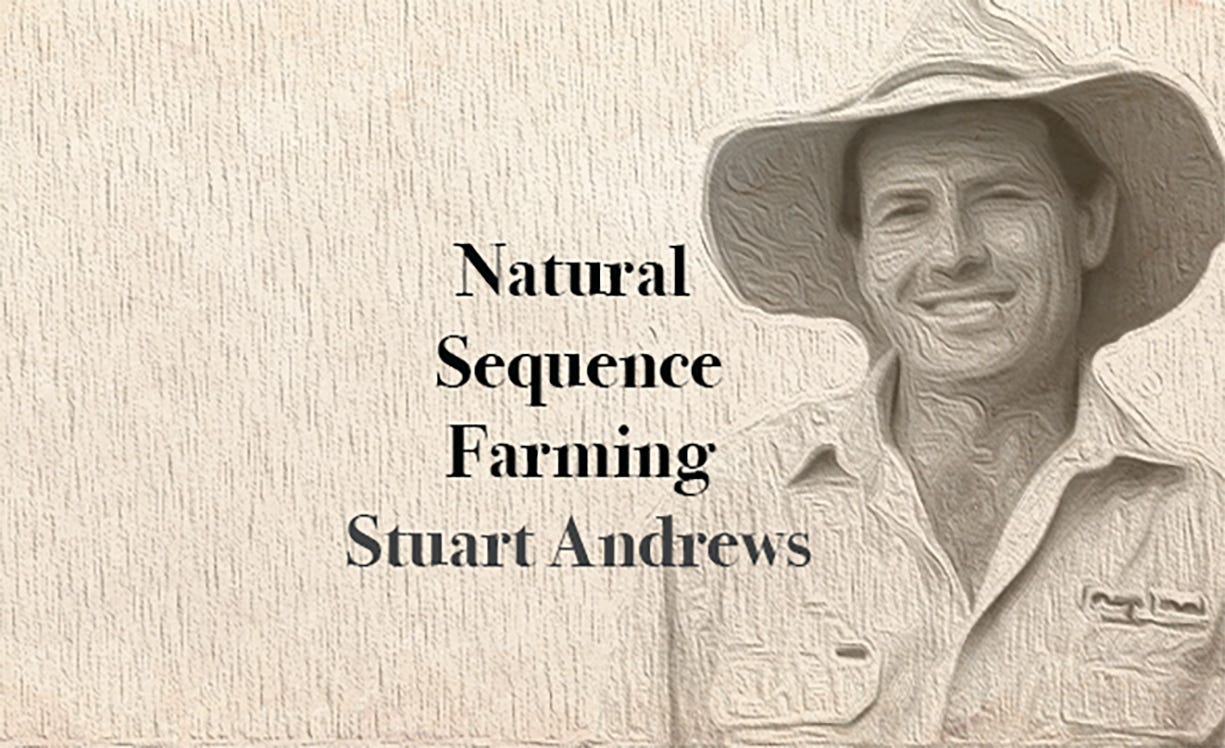
Natural Sequence Farming : Stuart Andrews
transcript
show notes
Peter Andrews, also known as PA, was an Australian racehorse breeder who in the 1970s bought a piece of property, in the state of New South Wales, to raise racehorses. However the land he bought, the Tarwyn Park property, was degraded and the water on it was salinated. After a lot of thought and experimentation he developed his own set of restoration techniques.
He looked at the dried up patterns in the floodplains to figure what used to happen on the land. He saw there used to chains of ponds. So he started to work to rehydrate the floodplains. He repaired the degraded flow lines. He used willows and reeds to restore the river banks.
But the neighbors keep bringing the authorities to try and stop what he was he was doing. Stubborn, brash, and confident, and because he knew he was onto something important, he continued to work anyways.
The plants started bringing back the wet paddocks, and refilling the aquifers. The land turned into a flourishing, vibrant landscape.
The work became known as Natural Sequence Farming. Peter Andrews went around around proselytizing the work - badgering governments, media and land owners, to get them interested. This was a process, he said, which could save Australian farming, help them stay hydrated even with the droughts. His work got on the Australian news, and word spread.
The focus on getting the message out though meant Peter lost sight of running the farm as well, and the bank foreclosed on his property. But then Stuart Andrews, his son, was able to buy back the Tarwyn Park property back from the bank. Stuart had to teach himself the ways of Natural Sequence Farming to run the farm. He then worked with Duane Norris to build a training program there to teach others the same techniques. ( I had became friends with Duane a little while back, and he was very encouraging of my work during the early stages of writing this newsletter. I recruited Duane in my project three years to develop a set of principles that succinctly encapsulated the important aspects of the hydrological cycle.)
Tony Coote, a successful jeweler, who had bought a property on 3 kilometers of Mulloon Creek in the 1960s. He approached Peter Andrews about restoring it. Early on the brought 6 truckloads of blackberries trees and canes to plant, which then started a feedback loop that slowed the water down, which then brought in more vegetation. Fish started coming back. And now there is a Mulloon Institute that teaches and consults on the Natural Sequence Farming work also.
……………………………..
Here is info about Natural Sequence Farming from the Tarwyn Park Training site :
Natural Sequence Farming (NSF) is
“a regenerative practice that restores landscape function, soil health, water retention, and biodiversity by working with natural processes. It explores the principles, emphasises the role of plants and water, and provides practical insights for implementing these principles in your own landscapes.
The key to NSF is that plants manage water; that's what built all the environments we see. Plants are the engineers that build everything, and water is the carrier of the nutrients that feed them. Our landscapes operate in a continuous feedback loop connecting three main areas: Accumulation - The highest area where fertility is built. Production - The area where production takes place. Filtration - The lowest area where fertility is recycled.
Our landscape no longer operates like this; it has become disconnected due to the way humans have managed their land. Natural Sequence Farming is the solution to that. It is about understanding how this system works and implementing works to reconnect the pieces like a puzzle. We need to understand the landscape first. And once we recognise the landscape and how it functions, it is about setting it up to work correctly once again.”
[aerial view of Tarwyn park, photo from Tarwyn Park Training]
The five principles of Natural Sequence Farming (NSF) are:
1) Slow the Flow: Emphasizing the importance of slowing down water flow to allow infiltration into the soil.
2) Let All Plants Grow: Promoting plant diversity and allowing natural regeneration of the landscape.
3) Careful Where the Animals Go: Integrating livestock management with the natural sequence of the landscape.
4) Filtration is a Must Know: Understanding the role of natural filtration systems in purifying water.
5) Return to the Top to Recycle the Lot: Recycling nutrients and resources by returning waste products to the top of the soil.
…..
I was really honored to get a chance to interview Stuart Andrews, the son of Peter Andrews. Below is part of our interview (slightly edited):
Stuart: PA [Peter Andrews] was running a horse stud farm at the time. He wanted to expand. He wanted to be able to produce the best racehorses. So he was looking for an area where he could potentially produce the best racehorse. So he looked around and he realized that the horse market was better in New South Wales.
So he then looked for a property over there. The horse salespeople told him about this property that had come up that was in the 1940s-1950s, one of the leading stud farms in New South Wales, producing some of the best horses. But it had deteriorated. It had salinity come in, so now it wasn't performing the same. Animals generally had ill health.
So he was able to get it at a fair price. So he purchased that, and that's where his real experimentation started off, because he had a place now that was full of what would be determined as weeds, and that had this high water table—but saline water. So it was restricting the growth.
So he had a fairly degraded landscape to work from. So he thought how do I get that functioning again? He started reading these patterns in the landscape. And once you've been out there, and you spend enough time looking at the landscape, you can realize that the patterns are the same everywhere you go. They just vary in size.
You're looking for the patterns that water has created over the landscape. And in conjunction with plants, what role did the plants play to enable that transition to happen?
So Tarwyn Park was predominantly, mostly what we would call floodplains. So it was probably more than half—maybe 60 or 70%—of the property was floodplain. So therefore, it had the potential to have an aquifer of fresh water underneath it. And that's how it evolved. It evolved to be like that.
But since white man had come in, the landscape had deteriorated. They cut a channel right through the floodplain. So instead of the floodplain filling with fresh water, it was recharging from the side elevation with saline water out of the ridges, out of the slopes. And the fresh water all ran away out through the eroded channel.
And I see the same thing in the States. It's no different. You’ve got all of these now-eroded channels which drain the landscape. Our whole landscapes around the world are set up as drainage mechanisms. So Australia, because it's such an arid environment, generally—when white man came here—they set about draining the only areas that were quite wet. And the drainage ended up being uncontrollable because the vast amount of water moving down these systems created bigger eroded channels.
So he said, well, this landscape can’t function as a drainage landscape. What do we need to do to turn it around from a drainage landscape into a landscape that recharges, recharges the aquifer.
He started playing around in the creeks—what we would refer to as a creek, which really is just a drainage line. It’s an eroded channel. But what our government determined this eroded channel to be—they just called it a creek, rather than recognizing that it never actually existed prior to agriculture taking place. Those creeks were never there. It was generally what was referred to as a chain of ponds—so water was ponding, slowing, then moving on and repeating this pattern as it went down the line.
Alpha: The chain of ponds that disappeared by the time he got there?
Stuart: Yes. Yeah. It was alrea…
This is a public episode. If you'd like to discuss this with other subscribers or get access to bonus episodes, visit climatewaterproject.substack.com/subscribe