transcript
show notes
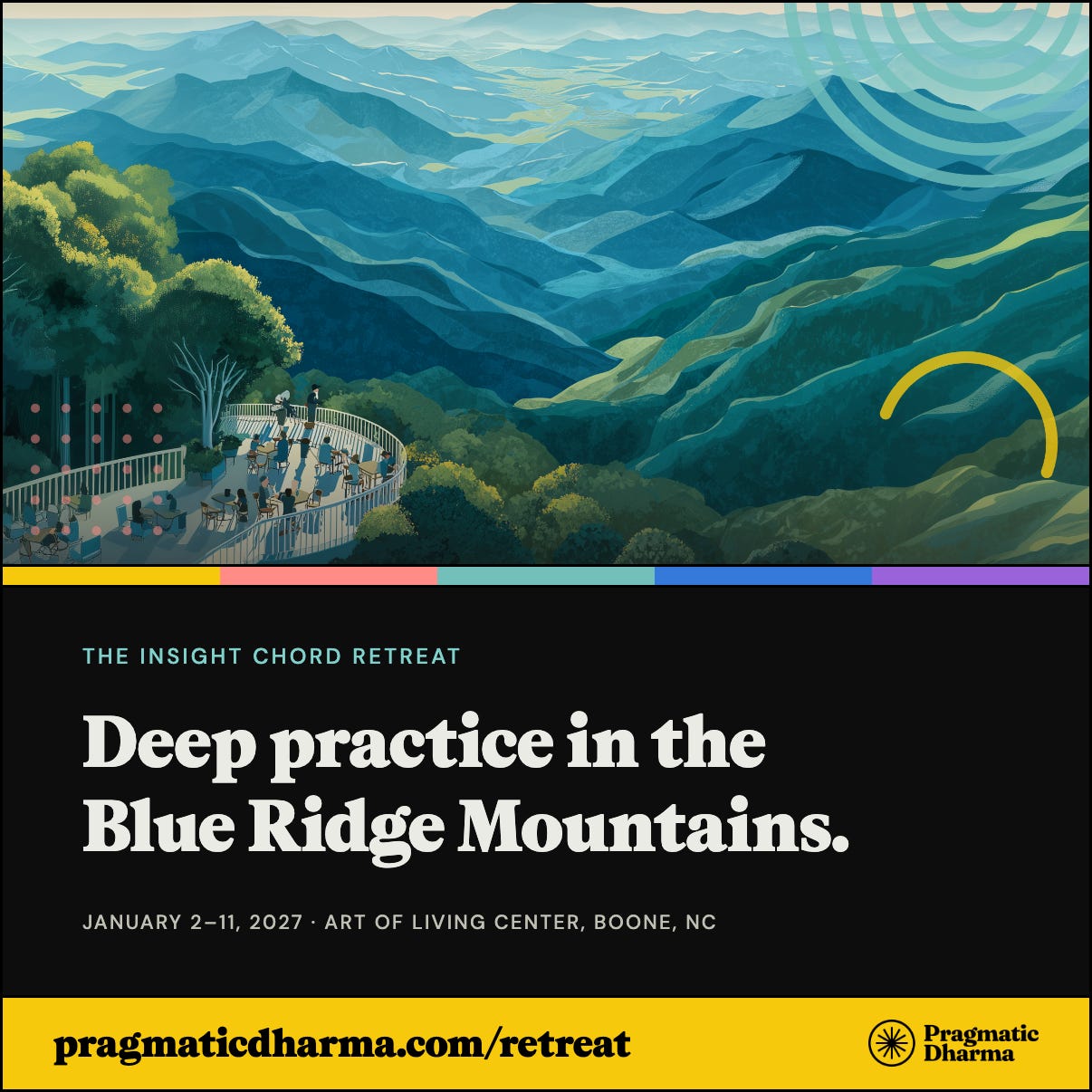
Vince Horn, Emily Horn, and Brian Newman talk through the design of their Insight Chord Retreat in Western North Carolina—why everyone will start with a single “go-to move” (of their choosing) for the first 3 days, what Brian learned about reintegration after doing daily multiplayer meditation on retreat, and how to maximize individual choicemaking on the retreat while having a solid community of practice to fall back on, including qualified teachers & dedicated peers.
💬 Transcript
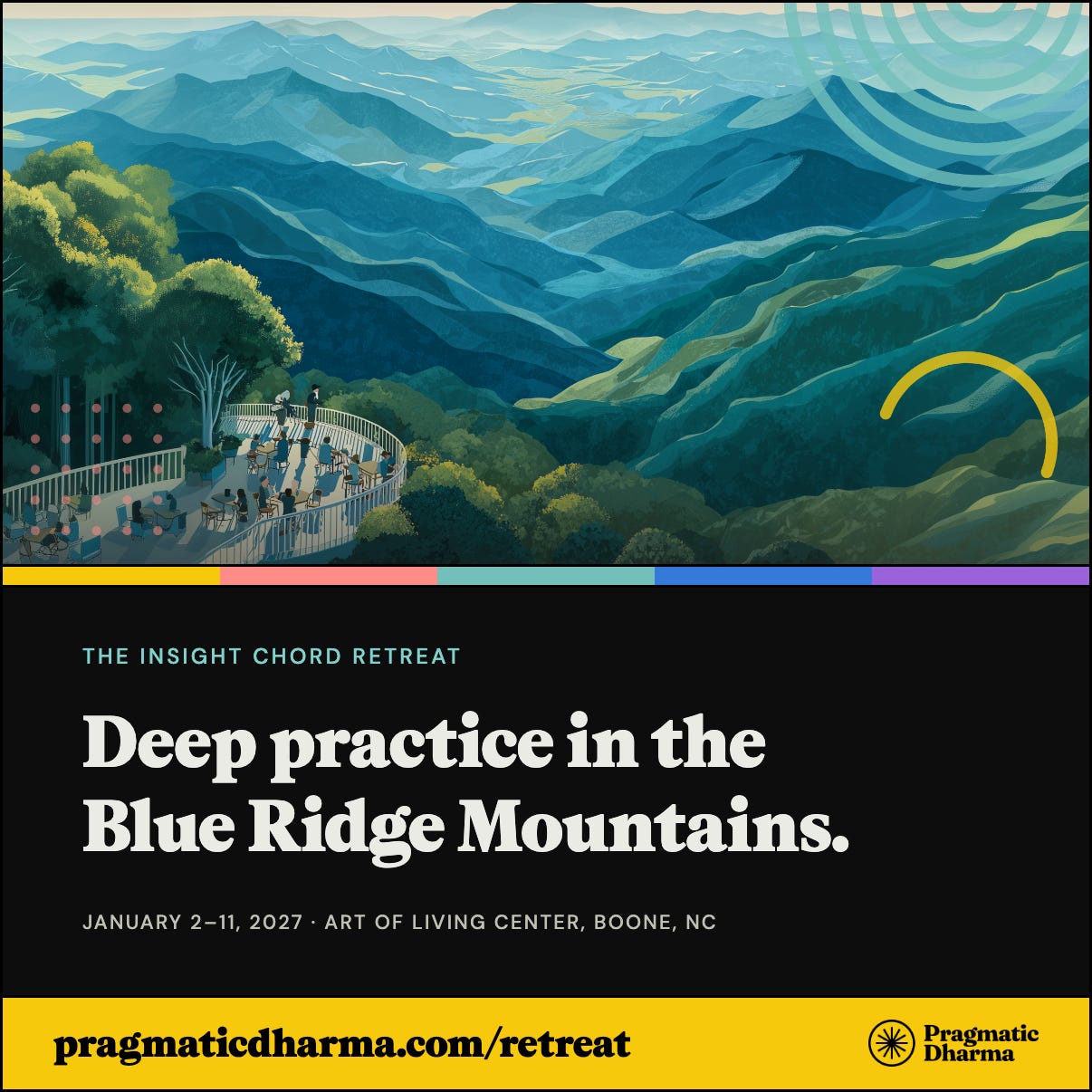
Vince Horn: So in the service of using the time we have wisely here, our plan today—Brian, Emily, and I wanted to have a conversation about this retreat that we’re planning in January 2027 here in Western North Carolina, on the Insight Chord. We wanted to talk a bit about some of, like, the design thinking that’s going into this retreat and how we’re planning on holding it together.
And we’re happy to be tested, and we realize it’s a lot of trust that people put in teachers and communities when they go on retreat. It’s a very intimate and very suggestive space of practice, so we want to make sure we honor people’s choice-making there.
Yeah, thank you, Brian and Emily, for joining me today in this. It’s great to be here with y’all.
So there really are three things that we wanted to talk about. This is going to be more of, like, a free-flowing conversation, but I’ll set up the frame a little bit here for us first. If you got an email from me last week talking about this retreat, you’ll have seen that there were three points I wanted to highlight that I think make this retreat kind of unique and different from the kinds of meditation retreats you might have been on or heard about, in some ways.
I’m not saying that it’s completely different and everything we’re doing is completely novel. Of course, that’s not true. The first thing that we’re doing is not novel at all. In a way, it’s just the way that we’re framing it that I think is novel, and that’s the focus on this retreat on what we’re calling the Insight Chord.
This is, in a way, super traditional in the early Buddhist tradition. You’d see these three practices or these three ways of practicing: Concentration, Mindfulness, and Heartfulness, or shamatha, samādhi, vipassanā, and mettā, brahmavihāra practice. All of these things you’re going to see in early Buddhist retreats.
You’re going to see them at the insight tradition. You’re going to see them on Goenka retreats. You’re going to see them anywhere you go and do an intensive retreat. These practices will show up. What I think is unique is that we see that. We see that as the unique chord or unique combination of practices that makes this early Buddhist tradition sort of distinctive.
It gives it a particular sound or flavor, and we really value that flavor, the three of us, because we’ve trained deeply in that tradition. And so we wanted to kind of build this retreat around these three practices or these three ways of practicing. I’d like to open it up here in a moment just to talk about that, but I’ll just quickly name the other two points of the retreat that are distinctive.
One is that we’re going to be holding a kind of tension that’s hopefully generative. Brian and I certainly found it quite generative on our last retreat, The Flavors of Jhāna, where we’re going to hold this tension between the exclusive focus in meditation—like focusing exclusively on one thing to the exclusion of everything else, narrowing your attention so that you’re just, say, with the breath or just with your mettā phrases or whatever it might be—and then on the other hand, we’ve got an inclusive focus that is broad and open.
It’s like the kind of practice where you’re opening to include everything in your field of awareness. This is very similar to, like, the Zen style of shikantaza, or our social, multiplayer meditation forms, you know, where we’re meditating out loud with other people. And we’re going to hold this tension between exclusive and inclusive on the retreat, giving space for both types of practice.
And then finally, we’re going to hold another tension that’s generative between what I would call here agency-maxing and community-maxing, or between agency and communion. And that is, we’re going to honor and acknowledge that each one of us are adults on this retreat who are going to be practicing our own practice, choosing how to practice.
At the same time, we’re doing that together in an explicitly communal container that’s been designed over thousands of years to help make that process more efficient and more powerful. So how do we hold both agency and communion together in a way that they really serve and support each other?
That’s the third thing that we’re going to be holding together as we do this retreat. So yeah, let me just open it up here to my colleagues and friends. Talk a bit about each of these three points. We can of course go one by one, or we can kind of move around as your minds do.
Emily Horn: Yeah, I just want to say I’m really excited about this particular weaving together of practices. And in some ways you could really go deep on one of the three, or you can really follow, like, a traditional kind of arc. Meaning you can start with concentration, and once concentration gets really steady you can start to incline, if you choose to, to really deepen into the vipassanā or insight.
In particular, you know, we’ll definitely include teachings around three characteristics like impermanence, no self, and, ugh, suffering. And then there’s going to be opportunities to really deepen with the heart. And I’ve been teaching heart jhāna practice for the last, I don’t know, couple years now, and particularly focused on how do you build concentration within the heart states.
And so I’m really excited to have that a part of this retreat, and also have it as part of it in a way where you can emphasize it a lot, or you can just know that it’s happening in the background, and know that you’re held with it. So to me that feels like a really interesting way to be able to participate in a retreat, is to be able to kind of increase that sense of discernment that we all really need to increase with our practice.
Like, really we’re deepening in concentration, insight, and heartfulness, and at the same time we’re also learning how to discern what’s needed in our own practice. And a lot of times I feel like the discernment part is lacking on retreats. Like, how do you really start to learn, like, what’s needed and what’s going to be beneficial to your practice?
And so I’m really hoping that, being held with a teaching team with Brian and Vince and myself, that we’ll be able to support you, and really, in a sense, driving your own car. And then we’re there to really support you in not going off the sides of the cliffs or anything.
We’ll have you. I feel confident in that. So yeah, that’s what comes up for me right now.
Vince Horn: Kenneth, when we were leading retreats together—and Brian, you were on one of those retreats, so you know this well—we came up with this idea of the go-to move, and it was an attempt to sort of help preserve people’s agency on retreat, explicitly to say, “Hey, like, it’s up to you what you choose to do.”
But if you just leave yourself in the sort of paralysis of choice where you could do anything at any time, it’s really problematic, because then you spend a lot of time worrying about what to do and if you’re doing it right, rather than actually doing something useful. So the go-to move was meant to kind of undercut that tendency to get lost in choice while still having choice preserved.
And here the choice is, if on this retreat there’s any point at which I don’t know what to do, this is what I’m going to do. I’m going to do this go-to move. It’s like the thing I know I can trust that I’m good at. For me, it was Noting, and for Kenneth, I think Noting as well. But for other people, it could be focus here on the breath, or it could be back to love, or to May Love Arise.
One thing I th…
Get full access to Buddhist Geeks at www.buddhistgeeks.org/subscribe