Skip to content
Artwork for Buddhist Geeks
Buddhist Geeks · September 9 · 11 min

Social Metta Works!

In “Social Metta Works!”, Vince Fakhoury Horn traces the origin story and practical mechanics of practicing loving-kindness out loud and together, making the case that metta—a fundamentally pro-social practice—works better when it stops being something we do silently, alone in our own heads. If you’d like to learn more about Social Metta, and how to share these pro-social practices with others, I’m beginning a Social Metta Faciltiation training for all hardcore members of the new Pragmatic Dharma App. (cost: $20/month, or try the free version and still get unlimited access to live multiplayer meditations.) 💬 Transcript Vince: Social Metta Works! And I wanted today to kind of talk about and explore, in practical terms, this practice of social metta, or this orientation to metta practice in which we’re doing it out loud, with other people. And so I guess I want to start with just the origin story of that. Every good superhero story starts with the origin story, and to me, good practices are similar — there’s always a good story behind a good practice. And this practice really originates out of the work that I was doing, both as a practitioner and also as a teacher and facilitator, with Kenneth’s Social Noting practices. I had been working with them actively for several years and finding them really helpful — again, both on a personal level, and also as a teaching tool. And so, at a certain point, as I watched Kenneth go through his creative process with coming up with Social Noting and start to generate new practices, new ways of doing the Noting technique, it occurred to me, one, that I could do that too. And Kenneth would’ve actively encouraged me to do that, and other people. So I was like, oh, I can take what I’m learning from how this person’s innovating and make similar kinds of innovations. So I started to kind of play with the noting technique and come up with other alternative formulas for doing the noting practice. And it seemed like a very natural next step from there to say, well, if this works for noting — if you can take the noting practice and do it out loud and make it this intersubjective process, with all these interesting second-order effects — maybe you could do the same with other techniques that are not noting based. And so, some easy ones we started off with — and when I say we, I’m thinking here of my partner Emily and I. We were doing a lot of experimentation together, because we were teaching a lot together at this time. So we did social breath counting. That was our first attempt at socializing another kind of practice. Which is, you’re just taking turns counting out loud, syncing the count with the end of your out-breath, the dissolution of that out-breath — 1, 2, 3, all the way up to 10. But doing it in a group, where there’s a group count. You’re collectively counting instead of just you counting by yourself. And that worked pretty well. It’s, again, taking the sort of peer pressure of social meditation — it works for us. And I found it worked well for helping people stay on point. And then the question arose: well, could we do the same for metta practice? And that’s where Emily and I hit a roadblock with that practice. It took us quite a while to start to get a sense for how we would introduce that to people, because I think the way that traditionally metta, or loving kindness, practices are taught in the contemporary Buddhist scene is they’re taught as a very complex practice, actually. You’re given — or invited. You’re either given a number of phrases, usually four traditionally, or you come up with your own, and then you’re rotating through these phrases. And they’re not just rotating through them, but you’re also then changing who you’re directing these well-wishes to, these phrases of well-wishing — starting with sometimes yourself or a benefactor, and then moving through this traditional sequence of several categories of beings, which is all very cool. And it has a really smart rationale. And it’s a good way to train. But it turns out it’s very hard to take that and just do it out loud. Noting is very simple, right? It’s like we’re using just one or two words often to describe what we’re noticing, and doing that out loud doesn’t — it does change the practice, but not in some fundamental way. But here it’s like, how do you introduce all these moving pieces, these elements of social metta? You have the phrase, or phrases, and then you have the subject or subjects to whom you’re wishing well. And then you’re often rotating through those in some complex order, and then you’re doing it with other people. So I started to try to just do the traditional metta out loud, and it was a train wreck. It was like, oh no, I have four phrases, but it’s an odd number of people, or an even number of people, and so we’re going to end up everyone repeating the same phrase — things like that. And I was like, wait, we’ve got to simplify this. How do we make it like noting, where it’s just a very simple mechanism? And what we got to, Emily and I, was that we started to question: what is the elemental thing that makes up metta? With noting, it’s the note or the label. With metta, what is it? It’s a phrase, fundamentally. It’s a phrase that we’re using to wish ourselves and/or others well. And you can actually frame this phrase in a way that doesn’t include any reference to a particular person or people — in a generalized way. You could say something like this, and this is the first practice that we found that felt like — Emily and I felt like it really made metta accessible as a social practice — which is, you could just say: may it arise. It being whatever it is that you’re wishing well for yourself and all beings. In this practice — and this is something we call May Heartfulness Arise, the name of the technique — so if I were doing that by myself, it would look something like this: May Ease Arise. May Peace Arise. May Self-acceptance Arise. And here you might notice it’s freestyle, in the same way that freestyle noting is, in that you can pick whatever words you want to use to express that positive wish. In this practice, it is freestyle in that sense. And so what we discovered here, I think, is a way to simplify the practice — to make it easy to just start to play with the basic mechanism of wishing well. And here, inviting whatever it is that we’re wishing for to arise, to become manifest, to be actualized — that’s the basic idea. And here I want to say something about the difference between metta practice, or heartfulness practice, and vipassana, or mindfulness practices. To me, there’s a very core difference in the intention behind the words as well. In that, with the noting practice, our intention is to notice what’s happening in our experience — we’re noticing what’s actually there right now — whereas with metta practice we’re aspiring, or we’re wishing, for something to be that may or may not be the case right now. And in that wishing, and that aspiring, we are inclining the mind toward opening the heart. That’s the basic movement in heartfulness practices, I would describe it — we’re inclining in that direction. Or, to use a mettaphor, we’re setting the GPS coordinates of our heart, the direction we want to incline our hearts. And then we’re moving in that direction through setting an intention, through actually just repeating this wish, and connecting with the sincerity behind it, actually. Sometimes it’s just hollow words — we’re just saying words. This is why I’m going to make the case that Social Metta works. It’s because just saying the words by yourself, what I’ve found is, that’s not quite as effective as saying them out loud — or even less so than saying them out loud with other people. So I want to make the case that, for many people, doing this kind of very pro-social practice... The goals and aims of metta are very pro-social. They’re about increased connection, pro-sociability, ease. They’re about a lot of qualities that make sense, an… Get full access to Buddhist Geeks at www.buddhistgeeks.org/subscribe

0:00-11:28

transcript

No transcript — this publisher did not publish one.

show notes

In “Social Metta Works!”, Vince Fakhoury Horn traces the origin story and practical mechanics of practicing loving-kindness out loud and together, making the case that metta—a fundamentally pro-social practice—works better when it stops being something we do silently, alone in our own heads.

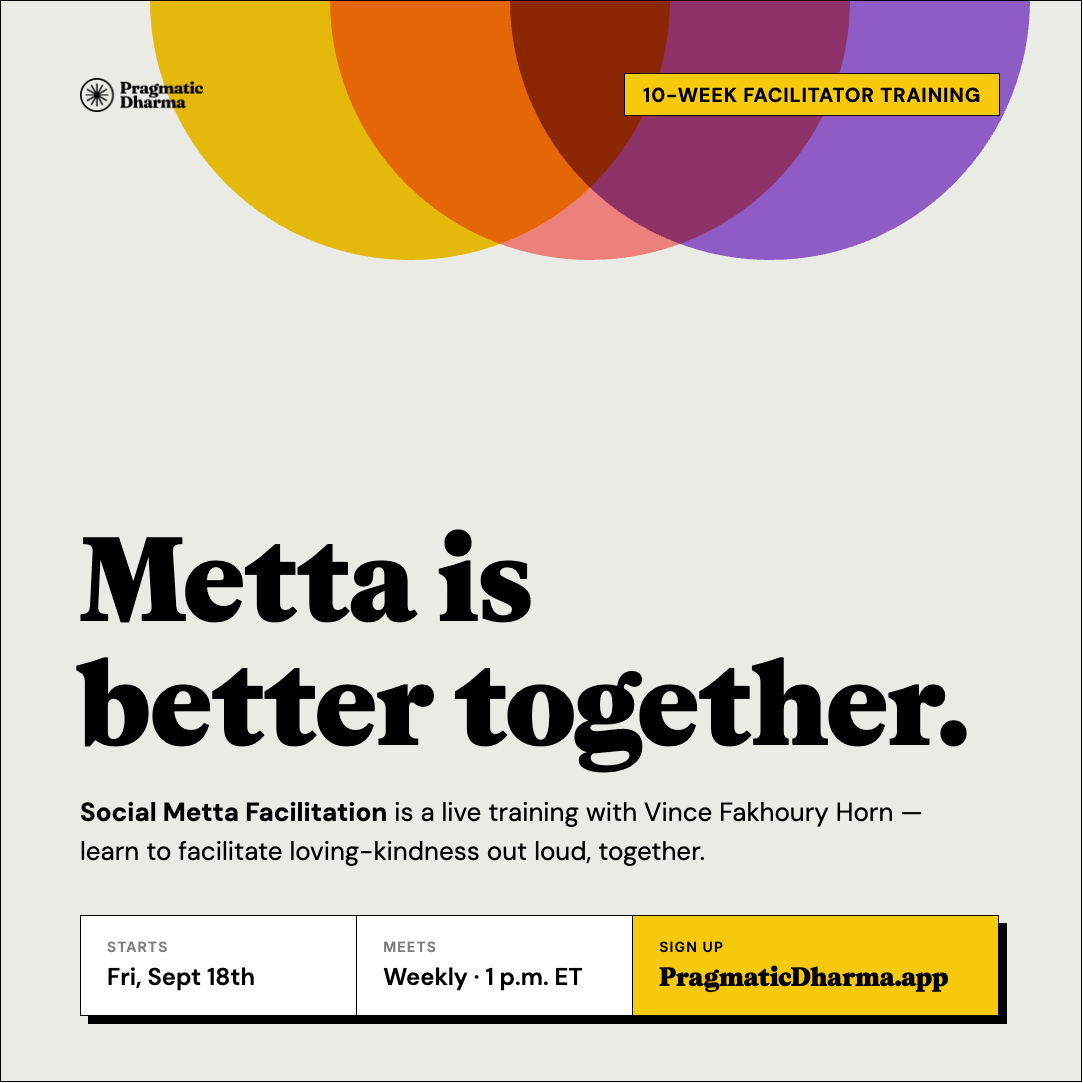
If you’d like to learn more about Social Metta, and how to share these pro-social practices with others, I’m beginning a Social Metta Faciltiation training for all hardcore members of the new Pragmatic Dharma App. (cost: $20/month, or try the free version and still get unlimited access to live multiplayer meditations.)

💬 Transcript

Vince: Social Metta Works! And I wanted today to kind of talk about and explore, in practical terms, this practice of social metta, or this orientation to metta practice in which we’re doing it out loud, with other people.

And so I guess I want to start with just the origin story of that. Every good superhero story starts with the origin story, and to me, good practices are similar — there’s always a good story behind a good practice. And this practice really originates out of the work that I was doing, both as a practitioner and also as a teacher and facilitator, with Kenneth’s Social Noting practices.

I had been working with them actively for several years and finding them really helpful — again, both on a personal level, and also as a teaching tool. And so, at a certain point, as I watched Kenneth go through his creative process with coming up with Social Noting and start to generate new practices, new ways of doing the Noting technique, it occurred to me, one, that I could do that too. And Kenneth would’ve actively encouraged me to do that, and other people. So I was like, oh, I can take what I’m learning from how this person’s innovating and make similar kinds of innovations. So I started to kind of play with the noting technique and come up with other alternative formulas for doing the noting practice.

And it seemed like a very natural next step from there to say, well, if this works for noting — if you can take the noting practice and do it out loud and make it this intersubjective process, with all these interesting second-order effects — maybe you could do the same with other techniques that are not noting based.

And so, some easy ones we started off with — and when I say we, I’m thinking here of my partner Emily and I. We were doing a lot of experimentation together, because we were teaching a lot together at this time. So we did social breath counting. That was our first attempt at socializing another kind of practice.

Which is, you’re just taking turns counting out loud, syncing the count with the end of your out-breath, the dissolution of that out-breath — 1, 2, 3, all the way up to 10. But doing it in a group, where there’s a group count. You’re collectively counting instead of just you counting by yourself.

And that worked pretty well. It’s, again, taking the sort of peer pressure of social meditation — it works for us. And I found it worked well for helping people stay on point. And then the question arose: well, could we do the same for metta practice?

And that’s where Emily and I hit a roadblock with that practice. It took us quite a while to start to get a sense for how we would introduce that to people, because I think the way that traditionally metta, or loving kindness, practices are taught in the contemporary Buddhist scene is they’re taught as a very complex practice, actually.

You’re given — or invited. You’re either given a number of phrases, usually four traditionally, or you come up with your own, and then you’re rotating through these phrases. And they’re not just rotating through them, but you’re also then changing who you’re directing these well-wishes to, these phrases of well-wishing — starting with sometimes yourself or a benefactor, and then moving through this traditional sequence of several categories of beings, which is all very cool.

And it has a really smart rationale. And it’s a good way to train. But it turns out it’s very hard to take that and just do it out loud. Noting is very simple, right? It’s like we’re using just one or two words often to describe what we’re noticing, and doing that out loud doesn’t — it does change the practice, but not in some fundamental way.

But here it’s like, how do you introduce all these moving pieces, these elements of social metta? You have the phrase, or phrases, and then you have the subject or subjects to whom you’re wishing well. And then you’re often rotating through those in some complex order, and then you’re doing it with other people.

So I started to try to just do the traditional metta out loud, and it was a train wreck. It was like, oh no, I have four phrases, but it’s an odd number of people, or an even number of people, and so we’re going to end up everyone repeating the same phrase — things like that. And I was like, wait, we’ve got to simplify this.

How do we make it like noting, where it’s just a very simple mechanism? And what we got to, Emily and I, was that we started to question: what is the elemental thing that makes up metta? With noting, it’s the note or the label. With metta, what is it? It’s a phrase, fundamentally. It’s a phrase that we’re using to wish ourselves and/or others well.

And you can actually frame this phrase in a way that doesn’t include any reference to a particular person or people — in a generalized way. You could say something like this, and this is the first practice that we found that felt like — Emily and I felt like it really made metta accessible as a social practice — which is, you could just say: may it arise. It being whatever it is that you’re wishing well for yourself and all beings. In this practice — and this is something we call May Heartfulness Arise, the name of the technique — so if I were doing that by myself, it would look something like this: May Ease Arise.

May Peace Arise.

May Self-acceptance Arise.

And here you might notice it’s freestyle, in the same way that freestyle noting is, in that you can pick whatever words you want to use to express that positive wish. In this practice, it is freestyle in that sense. And so what we discovered here, I think, is a way to simplify the practice — to make it easy to just start to play with the basic mechanism of wishing well. And here, inviting whatever it is that we’re wishing for to arise, to become manifest, to be actualized — that’s the basic idea. And here I want to say something about the difference between metta practice, or heartfulness practice, and vipassana, or mindfulness practices. To me, there’s a very core difference in the intention behind the words as well.

In that, with the noting practice, our intention is to notice what’s happening in our experience — we’re noticing what’s actually there right now — whereas with metta practice we’re aspiring, or we’re wishing, for something to be that may or may not be the case right now. And in that wishing, and that aspiring, we are inclining the mind toward opening the heart. That’s the basic movement in heartfulness practices, I would describe it — we’re inclining in that direction. Or, to use a mettaphor, we’re setting the GPS coordinates of our heart, the direction we want to incline our hearts. And then we’re moving in that direction through setting an intention, through actually just repeating this wish, and connecting with the sincerity behind it, actually. Sometimes it’s just hollow words — we’re just saying words. This is why I’m going to make the case that Social Metta works. It’s because just saying the words by yourself, what I’ve found is, that’s not quite as effective as saying them out loud — or even less so than saying them out loud with other people.

So I want to make the case that, for many people, doing this kind of very pro-social practice... The goals and aims of metta are very pro-social. They’re about increased connection, pro-sociability, ease. They’re about a lot of qualities that make sense, an…


Get full access to Buddhist Geeks at www.buddhistgeeks.org/subscribe
links2

more episodes

All episodes