transcript
show notes
In “Imaginal Meditation,” Emily West Horn introduces an approach to imaginal practice—drawing on Vajrayana deity yoga, Jack Kornfield, Chögyam Trungpa, and Dzongsar Khyentse Rinpoche—to show how invoking, dissolving, and embodying the image of the Buddha can loosen the boundary between self & world, inclining the mind toward non-duality.
💬 Transcript
Emily Horn: So I want to explore imaginal meditation with you all today. And I want to start just simply with the Buddhist Geeks definition of it, and then I’m going to unpack what imaginal meditation means in the context of the third turning, and in particular Vajrayana practice. I’m not going to unpack what Vajrayana is or some of these terms that we’ve already previously unpacked.
So if you have questions about Vajrayana and Buddhism, things like that, you can watch the other recordings with these sessions. I’m also going to talk about a few of the challenges that I’ve seen and that I’ve experienced with imaginal meditation. And then, of course, we’ll actually practice it after this concludes.
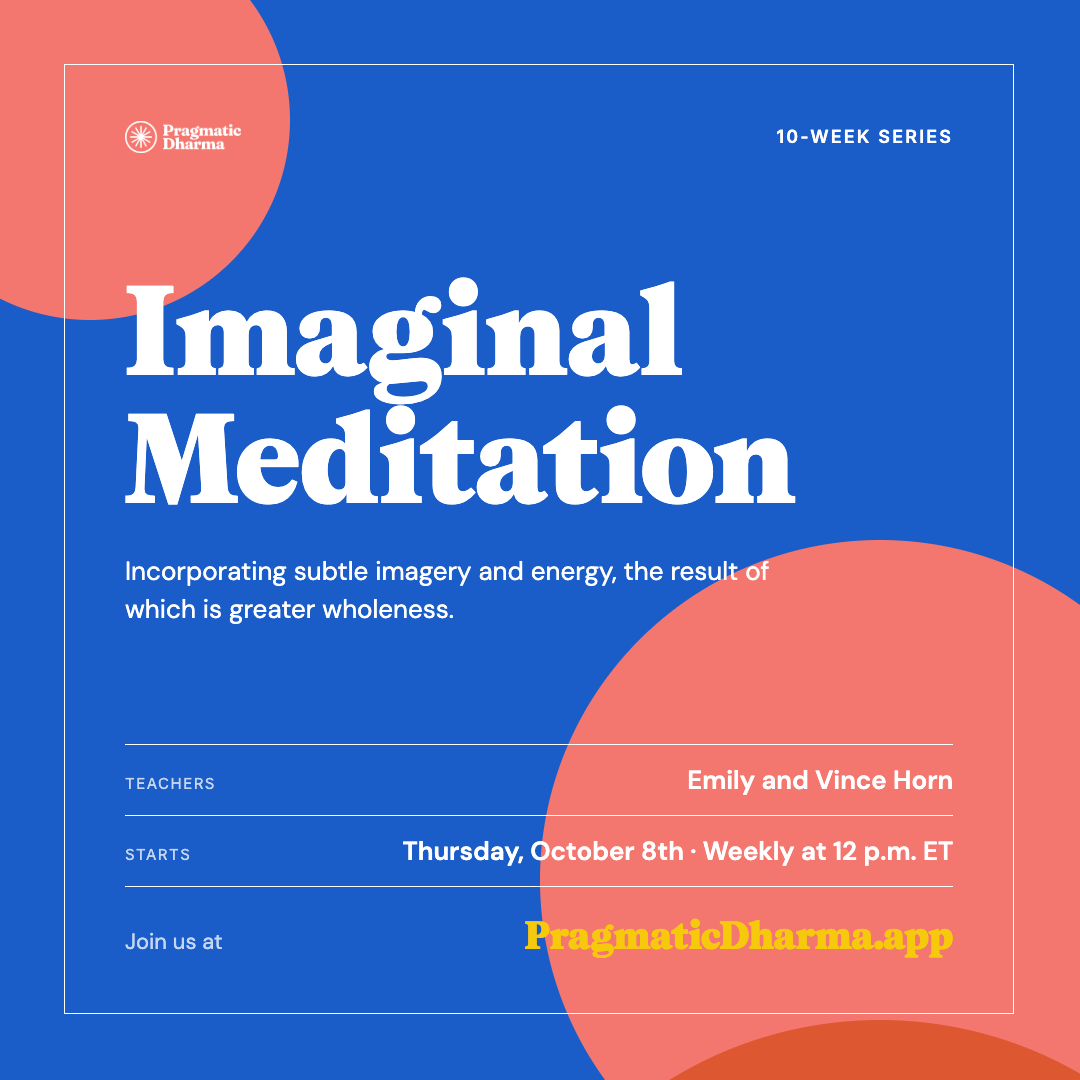
So, the general definition that Buddhist Geeks offers and proposes for you all is: imaginal meditation is the practice of incorporating subtle imagery and energy, the result of which is fullness. So we’re moving into a somewhat — for some people — challenging practice, because it’s really asking us to move beyond our ordinary way of perceiving.
It’s asking us to shift outside of whatever framework you might be entering through. Imaginal meditation asks us to actually sense into the possibilities. It’s a creative practice. And it also challenges the rational mind a little bit, because we’re moving from perceiving to imagining what you might not have even perceived or recognized before.
And it’s also aiming at incorporating subtle vibes. I think “vibe” is the new word, not “energy” necessarily, so we can go with that. If you have these kinds of experiences where it’s like, “Huh, I’m not sure exactly what that is, but I felt it” — I’ve had a lot of those experiences around people. It’s like I can feel this certain kind of energy, vibe, and I’m like, what is that? Well, imaginal meditation is asking us to actually say, okay, there is something beyond our ordinary perception that we can actually get more and more attuned to, and then start to embody.
For example, in the meditation, in the way that I’m going to zoom in today with you all, we’re going to be working with the image of the Buddha. So that image in itself has a certain kind of vibe, and it invokes a certain kind of experience. I’ll give you more information about that in a moment. But I want to also offer you a little bit about what it is from the Vajrayana perspective.
He says, “The technique of visualization” — and I want to highlight and bold “visualization,” and I’m going to honor his way of talking about things, but then I’m also going to tell you all why Buddhist Geeks has changed that to “imaginal.” So “visualization” isn’t the way we’re going to be talking about it. However, I do want to honor where this is coming from and the way that it’s spoken about typically. So: “The technique of visualization is employed throughout the Vajrayana practices of Tibetan Buddhism. Its use of our imagination makes it quite different from other meditations such as shamatha, which is concentration or calm abiding. Imagination also plays a major part in our deluded experience of life. Everything we encounter and perceive in our daily life is a product of our imagination, but because we believe in the illusions we create, they become such deeply rooted mental habits that we completely forget that they’re little more than fantasy. The imagination is therefore one of our most powerful tools, and working with it by changing the ways we look at our world is what we call the practice of visualization.”
So it’s really aimed at starting to sense into: okay, wait, maybe we are creative beings. Maybe there is more here than we actually can recognize. And what’s it like to imagine a different way of living, of being? In some ways, what would it be like to imagine that human beings could all live together and thrive? It can go into that way of looking at it.
Now, I’ve also done a lot of different kinds of visualization or imaginal practices. There are so many different kinds. When I studied with Jack Kornfield, he taught me and others how to guide people. It’s kind of like a mix between a psychological framework and a Buddhist framework. He would offer ways to unlock different ways of knowing through symbols. There were healing journeys. There was a healing temple that we would imagine and venture into. There are time-travel visualizations, imaginal practices where you get on magic carpets and go exploring. And it’s really just a way of getting to know these parts of us that we don’t typically recognize.
There’s also, in psychotherapy, if you’ve done trauma work, which I have — there was a whole thing with my therapist before I could even do EMDR, which is an alleviation-of-trauma technique. And “resourcing”: I had to visualize and imagine a place that brought me some nurturing and comfort. That was my go-to place when things got intense. I would go back to the beach in LA, or wherever. I think that was my safe spot at the time.
So there are all kinds of ways that this has been incorporated into meditation in the West. A lot of the teachers that I’ve studied with, I know, have drawn from Vajrayana and some of the imaginal practices in that tradition. Today, though, we’re going to zoom into a type of deity yoga — or deity imaginal practice. And we’re going to use the Buddha, and I’ll tell you a little bit more about that again in a minute.
So I also want to touch on this: when we sense into imaginal practice, I’m not sure what your relationship to it is. So take a moment and just sense in — have you done this before? Do you feel a little reactive, like, “Oh,” about this? Is it really intriguing, “Ooh, what’s going to happen?” So just sense into what’s going on for you as we explore this, because it does ask us to engage a part of us that, for whatever reasons, is not very well known.
I’m not sure how many people in the United States visualize Buddhas and then start to embody them, let alone Europe, and then as we expand. So I think some of you are there. One of the challenges that comes up with this practice is — again, I highlighted and bolded that word “visualization” — that can be a challenge, with thinking that it’s only visual. So I want to see what we can do in the session to expand and imagine in so many different ways. It can be very unique to you how your imagination actually takes form and shape and senses in this practice.
To think of it as visualization — sometimes visualization gets equated, or there’s this association, with images: like you think in pictures, you see pictures. And I just want to invite us to soften around that, because this practice — some people will see very clearly in images, and that’s not the case for everyone. So just soften around what you might think this needs to look like. It might be kinesthetic. And for me, thought imprints are a way that, a lot of times, I’ve gotten really attuned to sensing the vibes behind thoughts and intuition in these imaginal practices. Sometimes it comes in the form of a thought. So just allow yourself to expand and include more and more and more when we go into the practice. That’s part of where imagination practices take us — to include more and more and more in our experience.
Another challenge — and this is pretty much for all practices, and in particular this one — in a lot of ways it can bring up these thoughts like, “Am I doing this right? Am I doing this right?” The important thing to keep in mind with this practice is that however you invoke the image — we’re going to be working, of course, with imagery and imagining — however that imagining process happens for you, see if you can, if that thought comes in, “Am I do…
Get full access to Buddhist Geeks at www.buddhistgeeks.org/subscribe