transcript
show notes
A new episode – and a new title. Professor Alvin Wang Graylin has just joined the University of Washington as an affiliate professor, teaching AI and technology policy in a joint programme between the engineering and policy schools. Real world projects, real policy makers, real stakes.
In this episode, Jens de Buhr and Prof. Alvin Wang Graylin work through five major developments reshaping the AI landscape.
Anthropic has filed its S-1. The prospectus runs to over 200 pages – of which 90 are risk disclosures. The company has raised over $140 billion, holds cash conservatively, but has committed $400–500 billion in spending over the next decade. Alvin’s read: paying in stock rather than cash signals that Anthropic believes its equity is fairly or over-valued today – and that a market correction is coming. Cash on hand is the hedge.
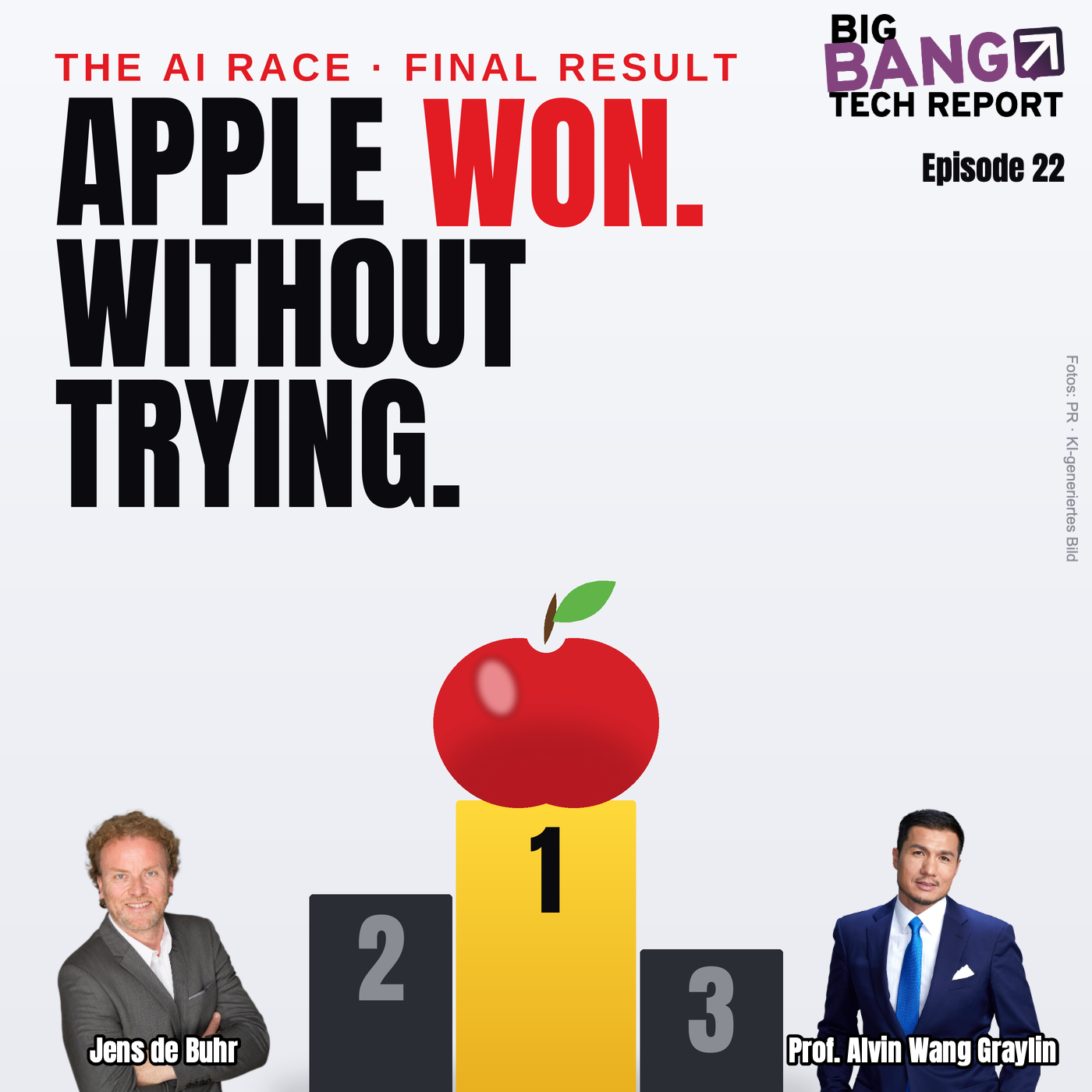
Apple, meanwhile, has spent almost nothing on AI infrastructure. Alvin calls it an “emergent strategy” – not planned, but effective. While competitors burned capital on data centres, Apple kept its customer trust, its edge compute capabilities and its cash flow intact. As models commoditise, the moat shifts to data, trust and proximity to the customer. Apple has all three.
On the infrastructure side: Elon Musk’s observation that debt markets for AI compute have dried up is significant. Over 300 neo-cloud companies built their data centres on cheap loans. Those loans are now distressed. Some facilities will be half-built. And with compute capacity growing 5–10x per year through both new hardware and efficiency gains, GPU utilisation will become the defining economic challenge of the industry – Ken Griffin’s analogy to empty airline seats captures it precisely.
DeepSeek’s latest model and inference stack change the numbers further: $38 of revenue per GPU hour, at token prices 10–20% of frontier model rates. Alvin explains why this squeezes both rental margins and lab economics at the same time – while Accenture’s $28–29 per employee AI budget cap signals that enterprise spending discipline has arrived.
The episode closes with the cybersecurity picture: severe bug disclosures up 300–400%, critical bugs up 1,000% in a year. Alvin’s advice to CEOs is direct – hire experienced security professionals now. And on the broader question of urgency: AI risk is not like climate change, where effects unfold over decades. The timeline here is months and years. And most people in office are not treating it that way.
About the hosts:
Jens de Buhr – Founder & CEO, JDB Holding; publisher of BIG BANG UNTERNEHMER; co-founder BIG BANG AI Festival. He connects business, politics and research to help shape Germany’s digital future. LinkedIn: linkedin.com/in/jens-de-buhr-034b3368 Web: dup-magazin.de
Prof. Alvin Wang Graylin – Affiliate Professor at the University of Washington (AI & Technology Policy); global tech strategist; author of “Our Next Reality”; Chairman of the Virtual World Society. 35+ years across AI, semiconductors, XR, cybersecurity and global technology strategy; former executive at HTC, Intel, IBM and Trend Micro; founder, investor, Stanford HAI Digital Fellow, MIT lecturer and advisor on AI policy and governance. LinkedIn: linkedin.com/in/agraylin Substack: substack.com/@awgraylin X: x.com/AGraylin Web: ournextreality.com
Subscribe to the BIG BANG Tech Report for sharp conversations on AI, chips, cloud, platforms, regulation, capital markets, geopolitics and the business consequences of technological acceleration.