Breaking the Silence, August 9, 2026
transcript
show notes
Breaking The Silence with Dr Gregory Williams
ASL Picture Books and the Power of Accessible Communication
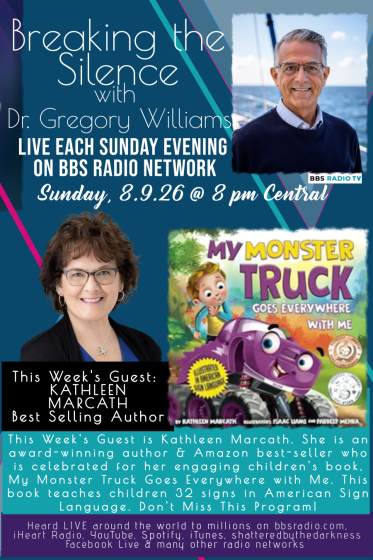
Dr. Gregory Williams hosts Breaking the Silence with guest Kathleen Marcath for a heartfelt conversation about American Sign Language, deaf and hard-of-hearing children, inclusive picture books, My Monster Truck Goes Everywhere With Me, ASL classifiers, deaf representation, brain benefits, classroom learning, family communication, and the hope that sign language can become more visible, normal, and accessible for everyone.
This week's guest is Kathleen Marcath.
She is an award-winning author and Amazon best-seller who is celebrated for her engaging children's book. "My Monster Truck Goes Everywhere with Me" This book teaches children 32 signs in American Sign Language.
Guest Spotlight: Kathleen Marcath
This episode of Breaking the Silence, hosted by Dr. Gregory Williams and dated August 9, 2026, features guest Kathleen Marcath is the author of My Monster Truck Goes Everywhere With Me and related ASL learning resources.
Dr. Gregory Williams Opens With Gratitude, Housekeeping, and Hope
Dr. Gregory Williams opens from Houston, Texas, welcoming listeners, noting the approaching back-to-school season, and sharing updates about his own writing projects. He mentions the upcoming seventh anniversary of Breaking the Silence, gives call-in and text information, praises the BBS Radio team, and introduces the evening’s guest as a subject he has never quite had on the show before. His personal connection is immediate: he recalls having deaf family members, watching relatives communicate through sign language, and wishing he had learned more himself.
Kathleen Marcath’s Path Into American Sign Language
Kathleen explains that her interest in sign language began at a retreat where a group learned to sign the song “Our God Is an Awesome God.” That experience stayed with her, eventually leading her to study sign language at Madonna University. While taking a class that required her to choose and sign a picture book, she looked for children’s books that naturally included signing children but could not find what she wanted. Years later, after working in schools and spending time with her grandson, she entered a writing contest and realized her story could become the kind of ASL picture book she had once searched for.
Why Representation and Natural ASL Learning Matter
The conversation highlights the importance of representing deaf and hard-of-hearing children in books and classrooms. Kathleen says American Sign Language is a full language, even though it is not spoken, and describes how children become excited when they learn it. She shares a classroom story about a child she calls Jonathan, who began to smile and participate more after using sign language activities to tell simple stories. Dr. Williams connects this to his own awe at watching deaf relatives communicate, emphasizing how powerful and overlooked this form of communication can be.
My Monster Truck Goes Everywhere With Me and the 32 Signs
Kathleen describes My Monster Truck Goes Everywhere With Me as a fun, natural way to introduce ASL. Each page includes at least one sign, and the book teaches 32 signs. To support readers, the back of the book includes QR codes linking to videos with deaf storytellers signing the story and teaching the signs with variations. Dr. Williams praises the book’s layout, illustrations, and accessibility, noting that even someone unfamiliar with ASL can begin to understand what is being shown. Kathleen explains that babies can learn sign language from birth and emphasizes that it is not “baby sign language,” but sign language that babies learn.
Deaf Illustration, Purple Monster Trucks, and ASL Classifiers
Kathleen explains that it was important to her to work with a deaf illustrator, and she found Isaac Ling in Singapore, who created the storyboard and drawings, while Perdi Mira handled the coloring. Dr. Williams praises the book’s bright color and asks about the purple monster truck, which Kathleen says emerged after the original red did not feel right. The discussion also explores ASL classifiers, especially the vehicle classifier used for the monster truck. Kathleen explains that after a signer identifies an object, a classifier can represent it throughout the story, making it a powerful storytelling tool.
Activity Books, Schools, Seniors, and Untapped ASL Potential
Kathleen discusses the companion coloring and activity book, which includes 77 pages of coloring, math, writing, clocks, handshapes, and activities meant to work for younger children as well as first-, second-, and third-grade students. Dr. Williams asks why ASL is not taught more widely in schools, and Kathleen points to deaf history, oralism, signing debates, teacher preparation, and the need for even small daily exposure when deaf children are present. She describes ASL as an untapped resource with unlimited potential, useful not only for children but also for seniors, couples, underwater communication, space, baseball signs, and everyday across-the-room communication.
Website Resources, Freebies, and the Call for Broader Awareness
Kathleen directs listeners to ASLPictureBooks.com, where people can find her books, blog, favorite-book resources, free charts, coloring pages, and information about classifiers, signer space, and sign selection. Dr. Williams repeatedly frames the book as a valuable gift for children, grandchildren, families, and anyone who wants a gentle introduction to ASL. Kathleen also mentions other authors and books connected with deaf representation, including stories about deaf and deaf-blind children and families learning to communicate. Together, they present ASL as not only practical, but normal, fun, brain-engaging, and deeply human.
Closing Encouragement: Hope, Resilience, and Never Giving Up
After saying goodbye to Kathleen, Dr. Williams closes with a message for children and families heading into the school year. He reminds listeners that no matter what they are facing, there is always a better day and always hope. Using the image of the sun setting behind him over the Texas Medical Center, he says that no matter how dark things get outside or inside, the sun will rise again tomorrow. He encourages children and adults to hold on, stay resilient, discover the resilience already inside them, and return next week for Chief Matt’s appearance.