9Natree · Today
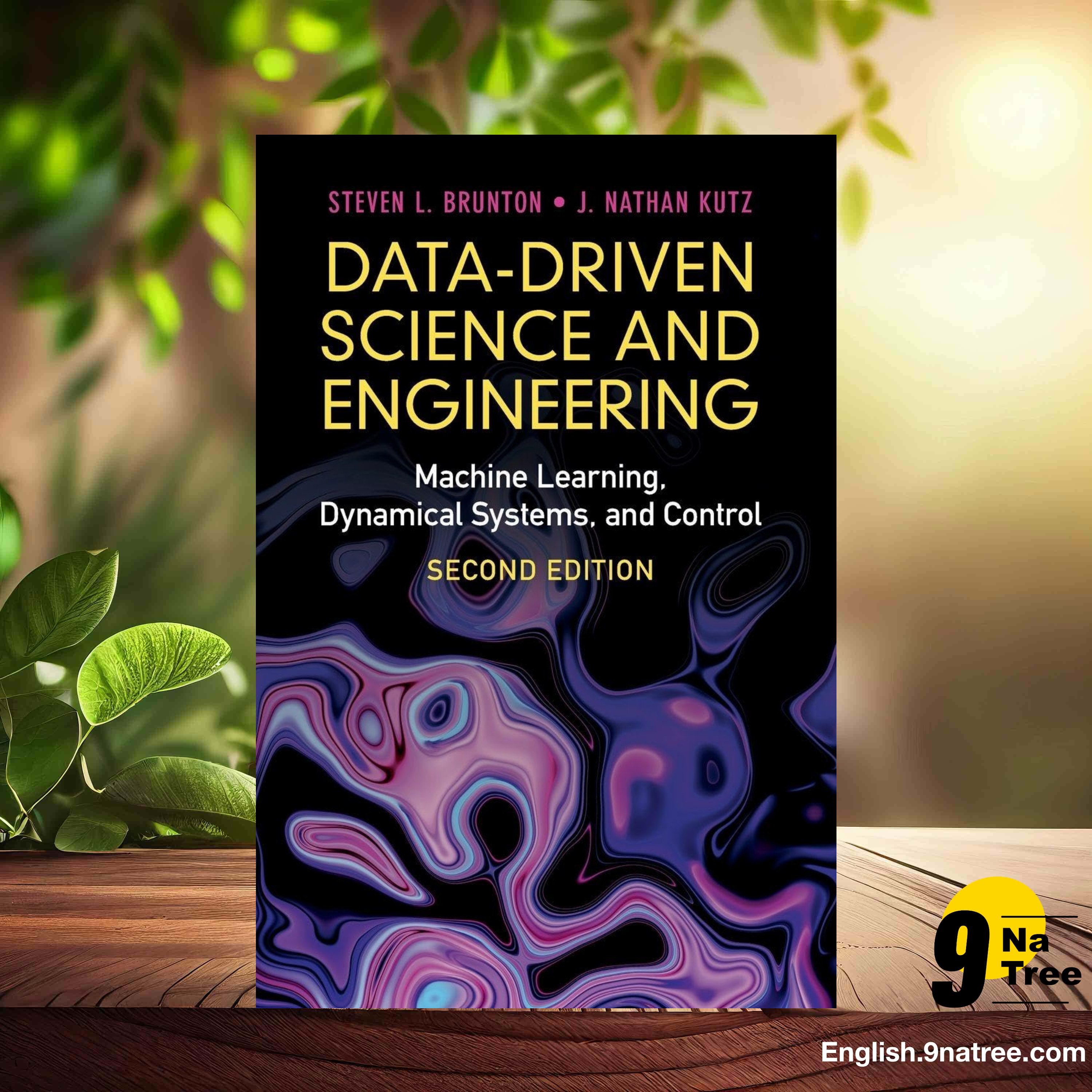
[Review] Data-Driven Science and Engineering (Steven L. Brunton) Summarized.
0:00Duration unknown
transcript
show notes
Data-Driven Science and Engineering (Steven L. Brunton)
- Buy on Amazon Books:
https://www.amazon.com/dp/1009098489?tag=9natree-20
- Buy on Apple Books:
https://books.apple.com/us/audiobook/data-driven-science-and-engineering-mastering-the/id1762587111?itsct=books_box_link&itscg=30200&ls=1&at=1001l3bAw&ct=9natree
- Sponsor and Support us:
https://9natree.com/page/sponsor-and-support.html
- Interesting Topics:
- Scientific machine learning is framed as model discovery rather than black-box prediction
- Sparse Identification of Nonlinear Dynamics favors concise governing equations
- Dynamic Mode Decomposition and reduced-order models extract coherent evolution from high-dimensional data
- Control is treated as the test of whether a learned model is operationally useful
- Physics-informed learning sets boundaries on data-driven flexibility
- Read more: https://english.9natree.com/read/1009098489/
Data-Driven Science and Engineering: Machine Learning, Dynamical Systems, and Control is a technical textbook by Steven L. Brunton and J. Nathan Kutz, presented here in its second-edition ISBN listing. It addresses a central problem in modern scientific computing: how to infer useful models, make predictions, and design control strategies when complex systems are observed through data. Rather than treating machine learning as a separate predictive toolkit, the book connects it to applied mathematics, dynamical systems, optimization, and control theory. Its scope moves from foundational linear-algebraic and regression-based methods toward nonlinear system identification, reduced-order modeling, sparse sensing, reinforcement learning, and physics-informed approaches. The organizing purpose is to develop models that are not merely accurate on recorded examples but also compact, interpretable, and usable for analysis or intervention. Written for advanced undergraduates, beginning graduate students, and technically prepared researchers, it assumes calculus, linear algebra, and basic programming ability. Extensive accompanying code, data, exercises, and lecture resources support its use as both a course text and a practical reference.